Review
. 2022 May 3;7(1):145.
doi: 10.1038/s41392-022-00990-4.

High-throughput single-сell sequencing in cancer research

Affiliations
Review

High-throughput single-сell sequencing in cancer research

Qingzhu Jia et al. Signal Transduct Target Ther. .

Abstract

With advances in sequencing and instrument technology, bioinformatics analysis is being applied to batches of massive cells at single-cell resolution. High-throughput single-cell sequencing can be utilized for multi-omics characterization of tumor cells, stromal cells or infiltrated immune cells to evaluate tumor progression, responses to environmental perturbations, heterogeneous composition of the tumor microenvironment, and complex intercellular interactions between these factors. Particularly, single-cell sequencing of T cell receptors, alone or in combination with single-cell RNA sequencing, is useful in the fields of tumor immunology and immunotherapy. Clinical insights obtained from single-cell analysis are critically important for exploring the biomarkers of disease progression or antitumor treatment, as well as for guiding precise clinical decision-making for patients with malignant tumors. In this review, we summarize the clinical applications of single-cell sequencing in the fields of tumor cell evolution, tumor immunology, and tumor immunotherapy. Additionally, we analyze the tumor cell response to antitumor treatment, heterogeneity of the tumor microenvironment, and response or resistance to immune checkpoint immunotherapy. The limitations of single-cell analysis in cancer research are also discussed.


Conflict of interest statement

The authors declare no competing interests.

Figures
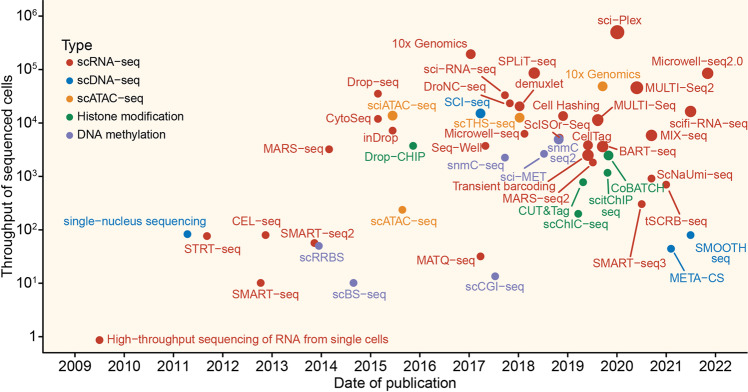
Fig. 1
Fig. 1
Timeline and throughput of single-cell sequencing milestones. Timeline of single-cell sequencing milestones. Scatterplot depicts the published date and throughput of sequencing for each technology. Color indicates different sequencing specifications
Fig. 2
Fig. 2
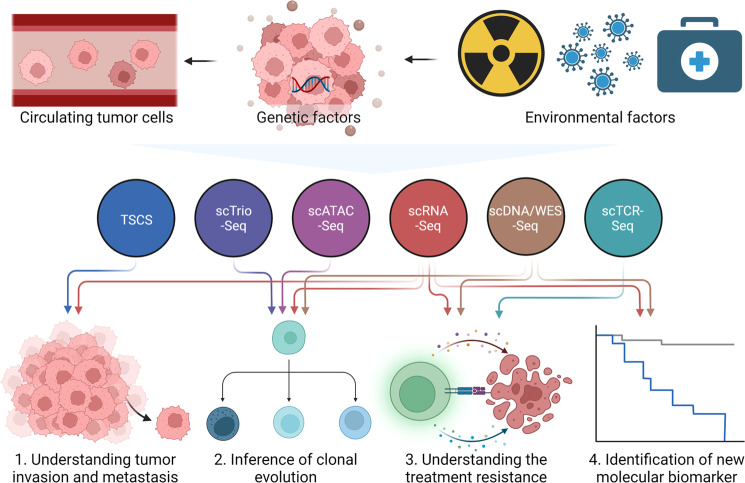
Application of single-cell omics in research of tumor cells. Tumor cells are composed of cells with various genomic alterations that influence disease progression and response to environmental perturbations and drug treatment. The characterization of high-dimensional profiling at a single tumor cell resolution facilitates the understanding of complex tumor cell behavior, clonal evolution during tumor progression, and identification of novel biomarkers for clinical application. Colored circle with arrows represents sing cell sequencing technologies and their applications in research of tumor cells
Fig. 3
Fig. 3
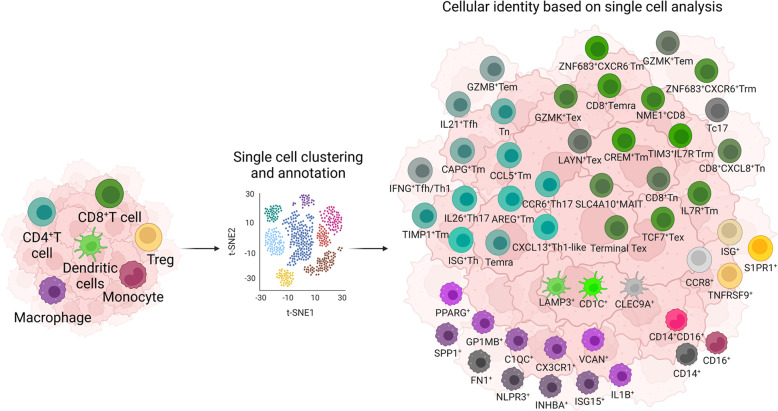
High-resolution characterization of tumor microenvironment (TME) by single-cell sequencing. Cellular architecture of the TME-infiltrated immune cells in the TME is broadly grouped using flow cytometry-based markers. Single-cell sequencing has made it possible to characterize the phenotypic heterogeneity of immune cells at the transcriptomic, proteomic, and epigenetic levels
Fig. 4
Fig. 4
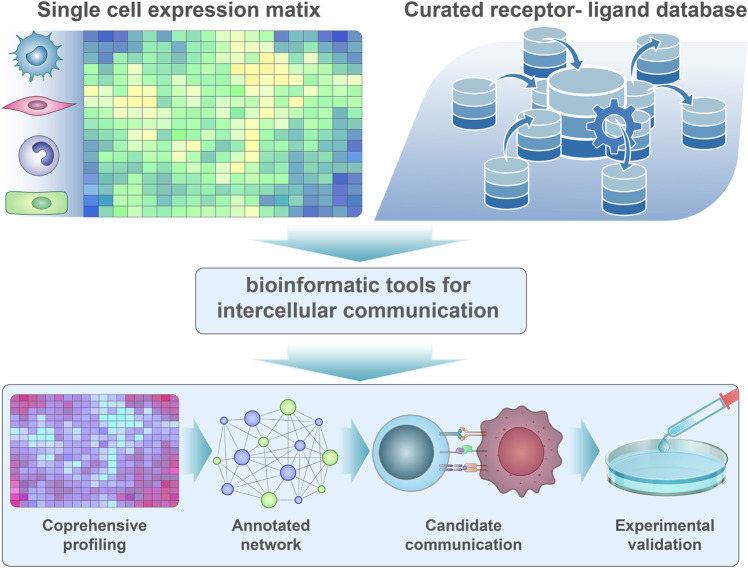
Inferring inter-cellular communication by single-cell sequencing. Inter-cellular contact or transfer of informative material is essential for coordinating the antitumor immune response and the malignant phenotype of tumor cells. Dissecting inter-cellular communication with single-cell sequencing analysis is instructive in understanding active signaling pathways between different cell types, which could eventually be applied to construct a communication network in the tumor immune microenvironment

References

    1. Jia Q, et al. Local mutational diversity drives intratumoral immune heterogeneity in non-small cell lung cancer. Nat. Commun. 2018;9:5361. doi: 10.1038/s41467-018-07767-w. - DOI - PMC - PubMed
    1. Pilkington EH, et al. From influenza to COVID-19: lipid nanoparticle mRNA vaccines at the frontiers of infectious diseases. Acta Biomater. 2021;131:16–40. doi: 10.1016/j.actbio.2021.06.023. - DOI - PMC - PubMed
    1. Gerlinger M, et al. Intratumor heterogeneity and branched evolution revealed by multiregion sequencing. N. Engl. J. Med. 2012;366:883–892. doi: 10.1056/NEJMoa1113205. - DOI - PMC - PubMed
    1. Cavalli FMG, et al. Intertumoral heterogeneity within medulloblastoma subgroups. Cancer Cell. 2017;31:737–754 e736. doi: 10.1016/j.ccell.2017.05.005. - DOI - PMC - PubMed
    1. Jia Q, et al. Tracking neoantigens by personalized circulating tumor dna sequencing during checkpoint blockade immunotherapy in non-small cell lung cancer. Adv. Sci. 2020;7:1903410. doi: 10.1002/advs.201903410. - DOI - PMC - PubMed

Substances