


The first COVID-19 new graduate nurses generation: findings from an Italian cross-sectional study
- PMID: 35505402
- PMCID: PMC9062856
- DOI: 10.1186/s12912-022-00885-3
The first COVID-19 new graduate nurses generation: findings from an Italian cross-sectional study
Abstract
Background: Nursing education has been disrupted by the onset of the COronaVIrus Disease 19 (COVID-19) pandemic, potentially impacting learning experiences and perceived competencies at the time of graduation. However, the learning experiences of students since the onset of COVID-19, their perceived competences achieved and the employment status one month after graduation, have not been traced to date.
Methods: A cross sectional online survey measured the individual profile, the learning experience in the last academic year and the perceived competences of the first COVID-19 new nursing graduates in two Italian universities. Details relating to employment status and place of employment (Covid-19 versus non-COVID-19 units) one month after graduation were also collected and the data compared with those reported by a similar cohort of new graduates pre-pandemic in 2018-2019. All those who graduated in November 2020 and attended their third year after the onset of the COVID-19 pandemic were eligible. The online survey included individual, nursing programme and first working experience variables alongside the Nurse Competence Scale (NCS). Descriptive and inferential statistical analyses were performed.
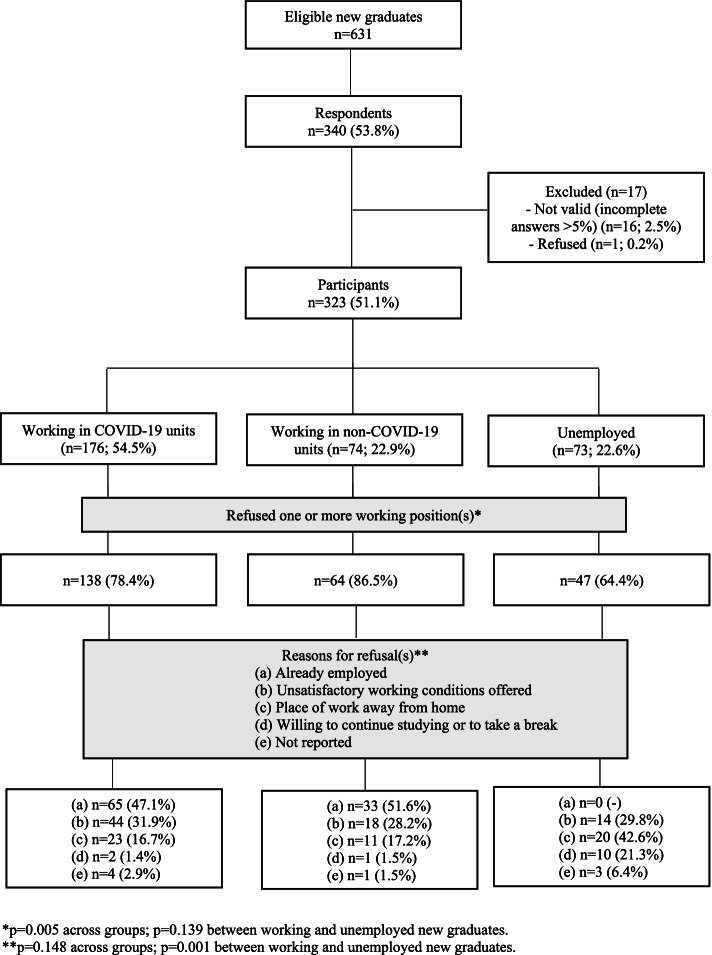
Results: A total of 323 new graduates participated. In their last academic year, they experienced a single, long clinical placement in non-COVID-19 units. One month after graduation, 54.5% (n = 176) were working in COVID-19 units, 22.9% (n = 74) in non-COVID-19 units and 22.6 (n = 73) were unemployed. There was no statistical difference among groups regarding individual variables and the competences perceived. Fewer new graduates working in COVID-19 units experienced a transition programme compared to those working in non-COVID-19 units (p = 0.053). At the NCS, the first COVID-19 new graduate generation perceived significantly lower competences than the pre-COVID-19 generation in the 'Helping role' factor and a significant higher in 'Ensuring quality' and 'Therapeutic interventions' factors.
Conclusions: The majority of the first COVID-19 new graduate generation had been employed in COVID-19 units without clinical experience and transition programmes, imposing an ethical debate regarding (a) the role of education in graduating nurses in challenging times with limited clinical placements; and (b) that of nurse managers and directors in ensuring safe transitions for new graduates. Despite the profound clinical placement revision, the first COVID-19 new graduate generation reported competences similar to those of the pre-COVID-19 generation, suggesting that the pandemic may have helped them to optimise the clinical learning process.
Keywords: COVID-19; Competences; Cross-sectional study; New graduates; Nursing education; Nursing students.
© 2022. The Author(s).
Conflict of interest statement
The authors declare no conflict of interest.
Figures
References
-
- Gonella S, Brugnolli A, Terzoni S, Destrebecq A, Saiani L, Zannini L, Dimonte V, Canzan F, Mansutti I, Palese A. A national study of nursing homes as learning environments according to undergraduate nursing student's perspective. Int J Older People Nurs. 2019,14(3). 10.1111/opn.12245. - PubMed
-
- European Parliament. Directive 2013/55/EU of the European Parliament and of the council of 20 November 2013 amending Directive 2005/36/EC on the recognition of professional qualifications and Regulation (EU) No 1024/2012 on administrative cooperation through the Internal Mark. Off J Eur Union. 2013;132–170.
-
- Italian Prime Minister. Decreto del Presidente del Consiglio dei Ministri 10 aprile 2020. Ulteriori disposizioni attuative del decreto-legge 25 marzo 2020, n. 19, recante misure urgenti per fronteggiare l'emergenza epidemiologica da COVID-19, applicabili sull'intero territorio nazionale. (20A02179) (GU Serie Generale n.97 del 11–04–2020) Art. 1, comma k. https://www.gazzettaufficialeit/eli/id/2020/03/08/20A01522/sg (Accessed 04 Mar 2021).
