


Scared to evolve? Non-consumptive effects drive rapid adaptive evolution in a natural prey population
- PMID: 35506228
- PMCID: PMC9065975
- DOI: 10.1098/rspb.2022.0188
Scared to evolve? Non-consumptive effects drive rapid adaptive evolution in a natural prey population
Abstract
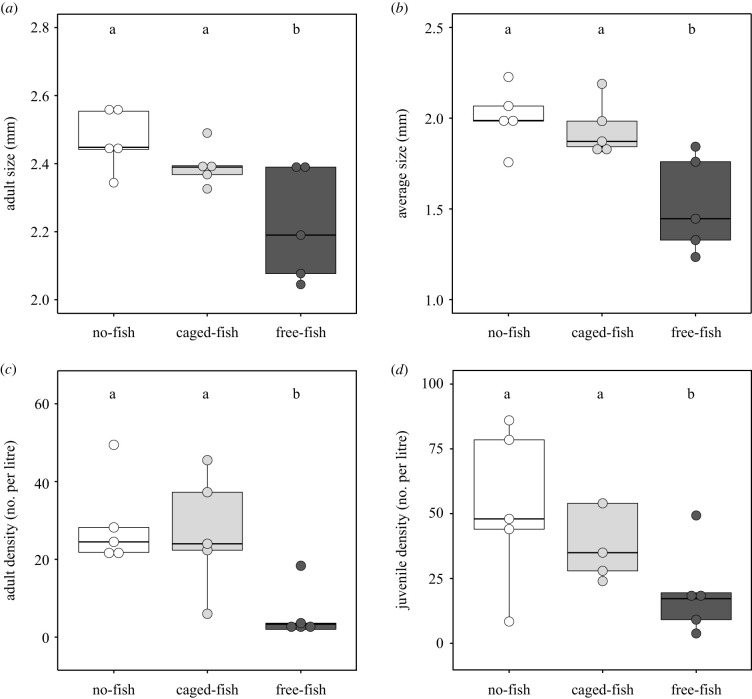
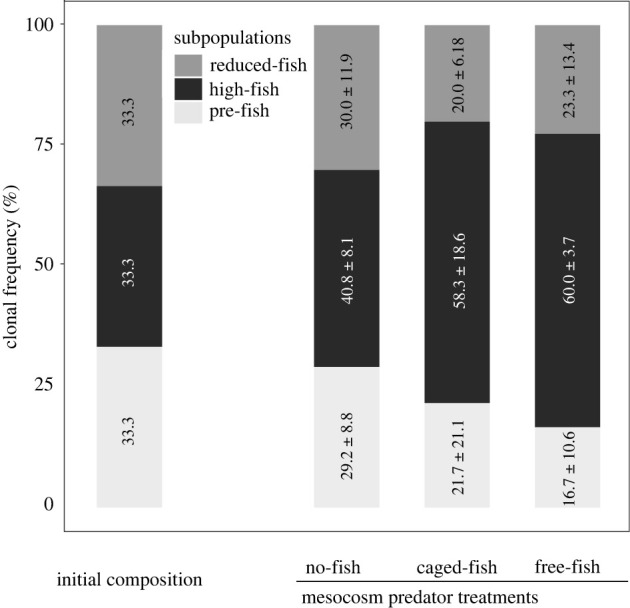
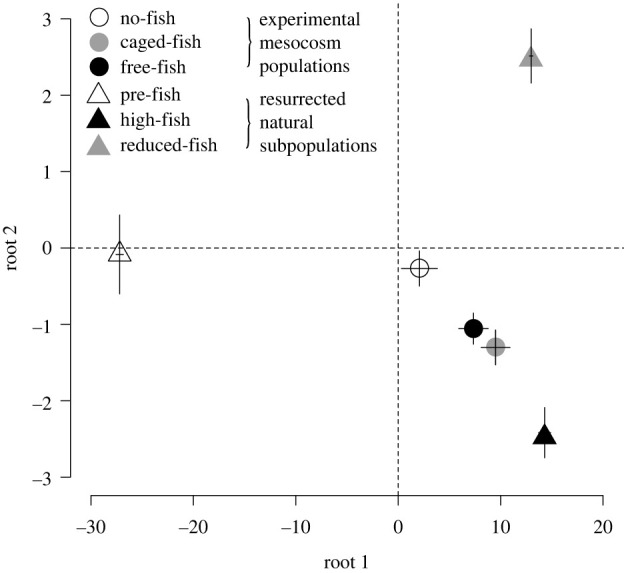
Predators can strongly influence prey populations through both consumptive and non-consumptive effects. Nevertheless, most studies have focused on the consumptive effects in driving evolutionary changes. By integrating experimental evolution and resurrection ecology, we tested the roles of non-consumptive and consumptive effects in driving evolution in a Daphnia magna population that experienced strong changes in fish predation pressure. All resurrected genotypes were pooled, inoculated in outdoor mesocosms, and exposed to free-fish or caged-fish treatments. Non-consumptive effects induced rapid, repeatable changes in the clonal composition and associated genotypic trait changes that were similar in magnitude and direction to those imposed by killing. Both non-consumptive and consumptive effects caused a shift towards a dominance of the high-fish period clones that can perform better under fish predation, and this may be explained by the higher intrinsic growth rate of the high-fish period clones under predation risk. The genotypic trait changes (e.g. reduced body sizes, earlier maturation, more and smaller offspring) of the Daphnia in the mesocosm experiments were in the same direction as the adaptive trait shifts observed in situ through resurrection ecology. Our results demonstrate that non-consumptive effects can induce rapid adaptive evolution and may represent an overlooked driver of eco-evolutionary dynamics.
Keywords: eco-evolutionary dynamics; experimental evolution; micro-evolution; non-consumptive effects; predator–prey interactions; resurrection ecology.
Conflict of interest statement
We declare we have no competing interests.
Figures
References
-
- Preisser EL, Bolnick DI, Benard MF. 2005. Scared to death? The effects of intimidation and consumption in predator–prey interactions. Ecology 86, 501-509. ( 10.1890/04-0719) - DOI
Publication types
MeSH terms
LinkOut - more resources
Full Text Sources
