


Sex and Race Differences in the Evaluation and Treatment of Young Adults Presenting to the Emergency Department With Chest Pain
- PMID: 35506534
- PMCID: PMC9238573
- DOI: 10.1161/JAHA.121.024199
Sex and Race Differences in the Evaluation and Treatment of Young Adults Presenting to the Emergency Department With Chest Pain
Abstract
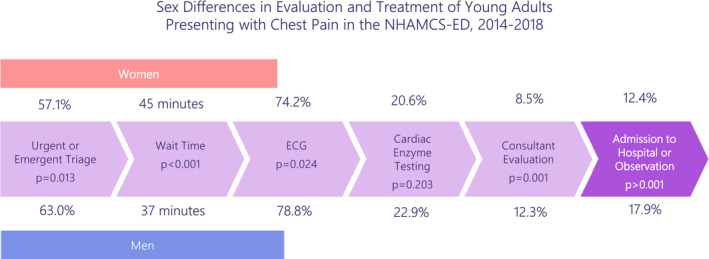
Background Acute myocardial infarctions are increasingly common among young adults. We investigated sex and racial differences in the evaluation of chest pain (CP) among young adults presenting to the emergency department. Methods and Results Emergency department visits for adults aged 18 to 55 years presenting with CP were identified in the National Hospital Ambulatory Medical Care Survey 2014 to 2018, which uses stratified sampling to produce national estimates. We evaluated associations between sex, race, and CP management before and after multivariable adjustment. We identified 4152 records representing 29 730 145 visits for CP among young adults. Women were less likely than men to be triaged as emergent (19.1% versus 23.3%, respectively, P<0.001), to undergo electrocardiography (74.2% versus 78.8%, respectively, P=0.024), or to be admitted to the hospital or observation unit (12.4% versus 17.9%, respectively, P<0.001), but ordering of cardiac biomarkers was similar. After multivariable adjustment, men were seen more quickly (hazard ratio [HR], 1.15 [95% CI, 1.05-1.26]) and were more likely to be admitted (adjusted odds ratio, 1.40 [95% CI, 1.08-1.81]; P=0.011). People of color waited longer for physician evaluation (HR, 0.82 [95% CI, 0.73-0.93]; P<0.001) than White adults after multivariable adjustment, but there were no racial differences in hospital admission, triage level, electrocardiography, or cardiac biomarker testing. Acute myocardial infarction was diagnosed in 1.4% of adults in the emergency department and 6.5% of admitted adults. Conclusions Women and people of color with CP waited longer to be seen by physicians, independent of clinical features. Women were independently less likely to be admitted when presenting with CP. These differences could impact downstream treatment and outcomes.
Keywords: chest pain; emergency department; myocardial infarction; race; sex; triage; young adult.
Figures
References
-
- Arora S, Stouffer GA, Kucharska‐Newton AM, Qamar A, Vaduganathan M, Pandey A, Porterfield D, Blankstein R, Rosamond WD, Bhatt DL, et al. Twenty year trends and sex differences in young adults hospitalized with acute myocardial infarction. Circulation. 2019;139:1047–1056. doi: 10.1161/CIRCULATIONAHA.118.037137 - DOI - PMC - PubMed
-
- Bucholz EM, Strait KM, Dreyer RP, Lindau ST, D’Onofrio G, Geda M, Spatz ES, Beltrame JF, Lichtman JH, Lorenze NP, et al. Editor's choice‐sex differences in young patients with acute myocardial infarction: a VIRGO study analysis. Eur Heart J Acute Cardiovasc Care. 2017;6:610–622. doi: 10.1177/2048872616661847 - DOI - PMC - PubMed
-
- Lichtman JH, Leifheit EC, Safdar B, Bao H, Krumholz HM, Lorenze NP, Daneshvar M, Spertus JA, D'Onofrio G. Sex differences in the presentation and perception of symptoms among young patients with myocardial infarction: evidence from the VIRGO study (variation in recovery: role of gender on outcomes of young AMI patients). Circulation. 2018;137:781–790. doi: 10.1161/CIRCULATIONAHA.117.031650 - DOI - PMC - PubMed
Publication types
MeSH terms
LinkOut - more resources
Full Text Sources
Medical
Miscellaneous
