. 2022 May 4;13(1):2453.
doi: 10.1038/s41467-022-29939-5.

E(3)-equivariant graph neural networks for data-efficient and accurate interatomic potentials

Affiliations

E(3)-equivariant graph neural networks for data-efficient and accurate interatomic potentials

Simon Batzner et al. Nat Commun. .

Abstract

This work presents Neural Equivariant Interatomic Potentials (NequIP), an E(3)-equivariant neural network approach for learning interatomic potentials from ab-initio calculations for molecular dynamics simulations. While most contemporary symmetry-aware models use invariant convolutions and only act on scalars, NequIP employs E(3)-equivariant convolutions for interactions of geometric tensors, resulting in a more information-rich and faithful representation of atomic environments. The method achieves state-of-the-art accuracy on a challenging and diverse set of molecules and materials while exhibiting remarkable data efficiency. NequIP outperforms existing models with up to three orders of magnitude fewer training data, challenging the widely held belief that deep neural networks require massive training sets. The high data efficiency of the method allows for the construction of accurate potentials using high-order quantum chemical level of theory as reference and enables high-fidelity molecular dynamics simulations over long time scales.


Conflict of interest statement

The authors declare no competing interests.

Figures
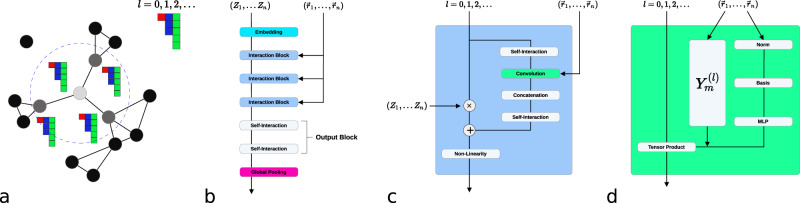
Fig. 1
Fig. 1. The NequIP network architecture.
From left to right: (a) a set of atoms is interpreted as an atomic graph with local neighborhoods (b) atomic numbers are embedded into l = 0 features, which are refined through a series of interaction blocks, creating scalar and higher-order tensor features. An output block then generates atomic energies, which are pooled to give the total predicted energy. c The interaction block, containing the convolution. d The convolution combines the product of the radial function R(r) and the spherical harmonic projection of the unit vector r^ij with neighbouring features via a tensor product.
Fig. 2
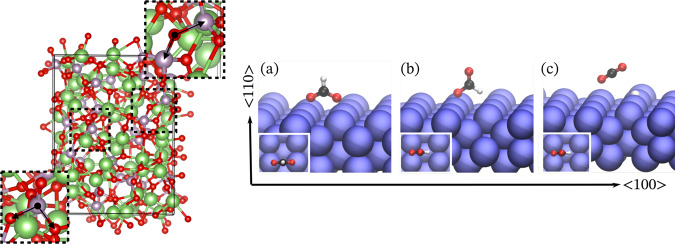
Fig. 2. Benchmark systems.
Left: Quenched glass structure of Li4P2O7, including the tetrahedral bond angle (bottom left) and the bridging angle between corner-sharing phosphate tetrahedra (top right). Right: The formate on Cu system. Perspective view of atomic configurations of (a) bidentate HCOO (b) monodentate HCOO and (c) CO2 and a hydrogen adatom on a Cu(110) surface. The blue, red, black, and white spheres represent Cu, O, C, and H atoms, respectively. The subset shown in each subplot is the corresponding top view along the <110> orientation.
Fig. 3
Fig. 3. Structure of Li4P2O7.
a Radial Distribution Function, (b) Angular Distribution Function, tetrahedral bond angle, (c) Angular Distribution Function, bridging oxygen. All are defined as probability density functions; NequIP results are averaged over 10 runs with different initial velocities.
Fig. 4
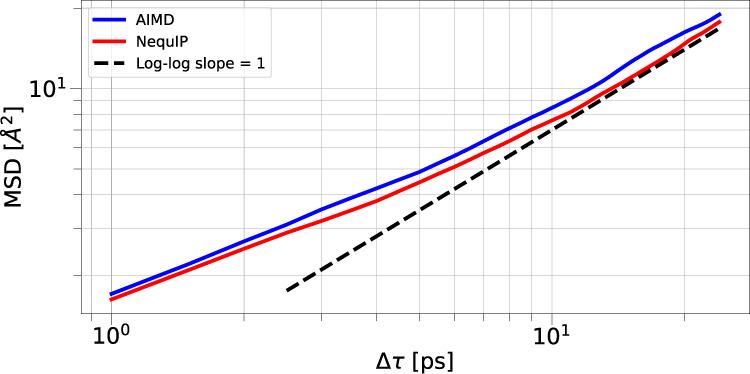
Fig. 4. Lithium Kinetics.
Comparison of the Li MSD of AIMD and an example NequIP trajectory of Li6.75P3S11.
Fig. 5
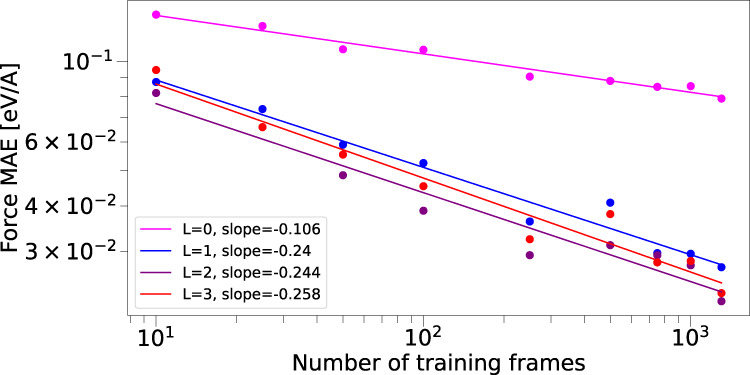
Fig. 5. Learning curves.
Log-log plot of the predictive error on the water data set from using NequIP with l ∈ {0, 1, 2, 3} as a function of training set size, measured via the force MAE.

References

    1. Richards WD, et al. Design and synthesis of the superionic conductor na 10 snp 2 s 12. Nat. Commun. 2016;7:1–8. doi: 10.1038/ncomms11009. - DOI - PMC - PubMed
    1. Boero M, Parrinello M, Terakura K. First principles molecular dynamics study of ziegler- natta heterogeneous catalysis. J. Am. Chem. Soc. 1998;120:2746–2752. doi: 10.1021/ja972367i. - DOI
    1. Lindorff-Larsen K, Piana S, Dror RO, Shaw DE. How fast-folding proteins fold. Science. 2011;334:517–520. doi: 10.1126/science.1208351. - DOI - PubMed
    1. Behler J, Parrinello M. Generalized neural-network representation of high-dimensional potential-energy surfaces. Phys. Rev. Lett. 2007;98:146401. doi: 10.1103/PhysRevLett.98.146401. - DOI - PubMed
    1. Bartók AP, Payne MC, Kondor R, Csányi G. Gaussian approximation potentials: the accuracy of quantum mechanics, without the electrons. Phys. Rev. Lett. 2010;104:136403. doi: 10.1103/PhysRevLett.104.136403. - DOI - PubMed

Publication types

MeSH terms