


Transbronchial lung biopsy versus transbronchial lung cryobiopsy in critically ill patients with undiagnosed acute hypoxemic respiratory failure: a comparative study
- PMID: 35509092
- PMCID: PMC9067550
- DOI: 10.1186/s12890-022-01966-4
Transbronchial lung biopsy versus transbronchial lung cryobiopsy in critically ill patients with undiagnosed acute hypoxemic respiratory failure: a comparative study
Abstract
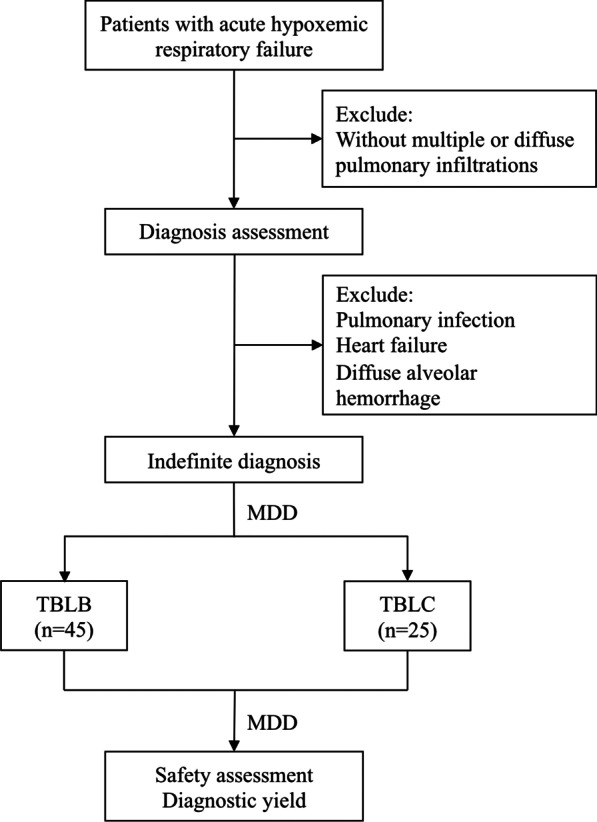
Background: In patients with acute hypoxemic respiratory failure whose diagnosis is not established after initial evaluation, obtaining a histopathological diagnosis may improve the patients' prognosis. This study aims to compare the safety profile and diagnostic yields between transbronchial lung biopsy (TBLB) and transbronchial lung cryobiopsy (TBLC) in these patients.
Methods: A retrospective comparative study was conducted in a 26-bed intensive care unit over a 5-year period. The consecutive patients with acute hypoxemic respiratory failure who underwent TBLB or TBLC were included to determine the potential etiology. Patients characteristics, procedure related complications, pathological and multidisciplinary discussion (MDD) diagnostic yields, treatment modification and 28-day survival were analyzed. Prognostic factors were identified by Cox regression analysis.
Results: Forty-five and 25 consecutive patients underwent TBLB and TBLC, respectively. The patients underwent TBLC were more critical. There was no significant difference in overall procedure related complications of patients underwent TBLB and TBLC [15.6% (7/45) vs 28.0% (7/25), p = 0.212]. The rate of pathological diagnostic yield [72.0% (18/25) vs 37.8% (17/45), p = 0.006], MDD diagnostic yield [84.0% (21/25) vs 55.6% (25/45), p = 0.016] and subsequent treatment modification [84.0% (21/25) vs 57.8% (26/45), p = 0.025] in patients underwent TBLC were significantly higher than those in patients underwent TBLB. Multivariate analysis revealed that MDD diagnosis [HR 0.193 (95% CI 0.047-0.792), p = 0.022] and treatment modification [HR 0.204 (95% CI 0.065-0.638), p = 0.006] may be prognostic protective factors.
Conclusions: TBLC can lead to an increased chance of establishing a diagnosis, which could significantly improve the patients' prognosis, with an acceptable safety profile.
Keywords: Acute respiratory failure; Complications; Cryobiopsy; Diagnostic yields.
© 2022. The Author(s).
Conflict of interest statement
All the authors state that there are no conflicts of interest related to this study.
Figures
References
-
- Gerard L, Bidoul T, Castanares-Zapatero D, Wittebole X, Lacroix V, Froidure A, et al. Open lung biopsy in nonresolving acute respiratory distress syndrome commonly identifies corticosteroid-sensitive pathologies, associated with better outcome. Crit Care Med. 2018;46(6):907–914. doi: 10.1097/CCM.0000000000003081. - DOI - PMC - PubMed
MeSH terms
LinkOut - more resources
Full Text Sources
Medical
