


Effect of short-term artificial light and transvaginal progesterone device on first ovulation in late transitional mares
- PMID: 35510073
- PMCID: PMC9018460
- DOI: 10.1294/jes.33.1
Effect of short-term artificial light and transvaginal progesterone device on first ovulation in late transitional mares
Abstract
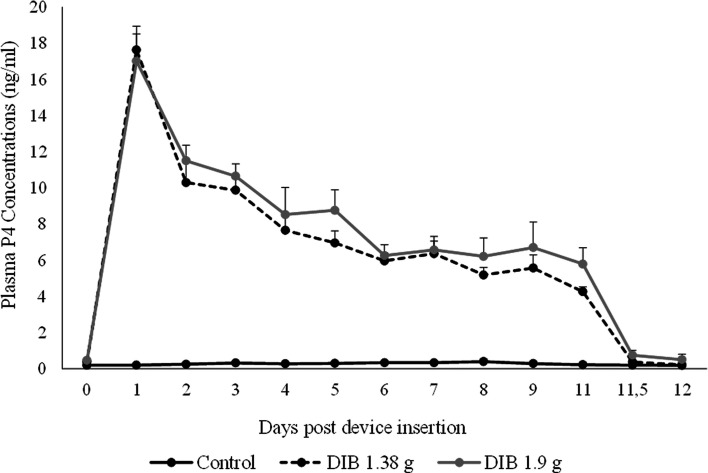
In study I, plasma progesterone concentrations were evaluated in anoestrous mares that received an intravaginal progesterone release device (IPRD) for 10 days. Mares were divided into 3 groups based on the dosage of progesterone (0 g, n=3; 1.38 g, n=5; and 1.9 g, n=5). No statistical differences were found in plasma progesterone concentrations between the two doses tested. In study II, the effects of a protocol based on a short program of artificial light combined with an IPRD containing 1.38 g of progesterone on oestrous behaviour and onset of ovulation were evaluated. IPRDs were inserted into 31 late transitional mares (10 days of treatment). The mares were divided into a control group (n=9, IPRD with 0 g of progesterone) and two treatment groups (T1, n=10, IPRD with 0 g of progesterone and artificial light; T2, n=12, IPRD with 1.38 g of progesterone and artificial light). The percentages of mares in heat within the first 14 days after treatment were 100%, 70%, and 100% in the control, T1, and T2 groups, respectively (P=0.097), and their ovulation rates were 44%, 60%, and 100%, respectively (P≤0.01). In conclusion, a protocol based on artificial light and an IPRD containing 1.38 g of progesterone for 10 days could be considered to advance the first ovulation of the year in late transitional mares, as it ensures a higher rate of ovulation within the first 14 days after treatment.
Keywords: late transitional mares; light; ovulation; progesterone.
©2022 The Japanese Society of Equine Science.
Figures
References
-
- Allen W.R., Urwin V., Simpson D.J., Greenwood R.E.S., Crowhurst R.C., Ellis D.R., Ricketts S.W., Hunt M.D., Digby N.J. 1980. Preliminary studies on the use of an oralprogestogen to induce oestrus and ovulation in seasonally anoestrous Thoroughbredmares. Equine Vet. J. 12: 141–145. - PubMed
-
- Allen W.R., Sanderson M.W., Greenwood R.E.S., Ellis D.R., Crowhurst J.S., Simpson D.J., Rossdale P.D. 1987. Induction of ovulation in anoestrous mares witha slow-release implant of a GnRH analogue (ICI 118 630). J. Reprod. Fertil. Suppl. 35: 469–478. - PubMed
-
- Arbeiter K., Barth U., Jöchle W. 1994. Observations on the use of progesteroneintravaginally and of deslorelin sti in acyclic mares for induction ofovulation. J. Equine Vet. Sci. 14: 21–25.
-
- Baggot J. 1995. Pharmacokinetics: disposition and fate of drugs in the body. pp.18–52. In: Veterinary Pharmacology and Therapeutics (Adames, R. ed.), Iowa State University Press, Ames.
-
- Bianchi C.P., Guerrero R., VidelaDorna I., Cavilla M.V., Aba M.A. 2011. Efecto de un dispositivo intravaginal conprogesterona sobre la actividad ovárica en yeguas cíclicas. InVet (B. Aires) 13: 71–78.
LinkOut - more resources
Full Text Sources