


Quercetin ameliorates Di (2-ethylhexyl) phthalate-induced nephrotoxicity by inhibiting NF-κB signaling pathway
- PMID: 35510228
- PMCID: PMC9052324
- DOI: 10.1093/toxres/tfac006
Quercetin ameliorates Di (2-ethylhexyl) phthalate-induced nephrotoxicity by inhibiting NF-κB signaling pathway
Abstract
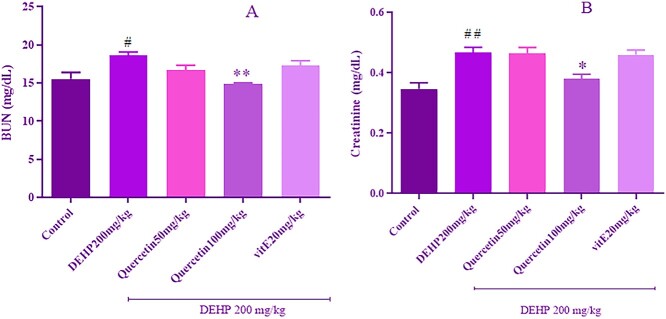
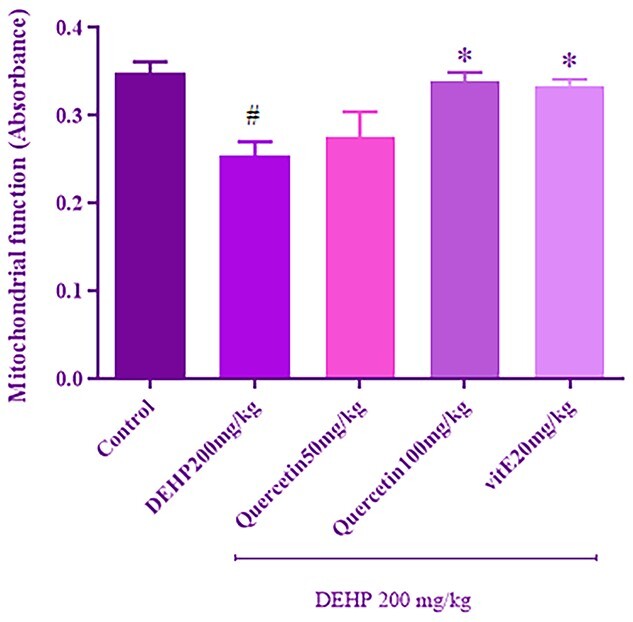
This study aimed to evaluate the possible protective effects of quercetin, a natural flavonoid, against nephrotoxicity induced by Di (2-ethylhexyl) phthalate (DEHP) in kidney tissue of rats and human embryonic kidney (HEK) 293 cell line. The HEK-293 cells were treated with different concentrations of quercetin 24 h before treatment with monoethylhexyl phthalate (MEHP). Male rats were treated with 200-mg/kg DEHP, 200-mg/kg DEHP plus quercetin (50 and 100 mg/kg), and 200-mg/kg DEHP plus vitamin E (20 mg/kg) for 45 days by gavage. Quercetin treatment reduced cytotoxicity and oxidative damage inducing by MEHP in HEK-293 cells. The in vivo findings showed that 100-mg/kg quercetin significantly suppressed DEHP-induced kidney damage. For exploring the involved mechanisms, the expressions of nuclear factor E2-related factor 2 (Nrf2), heme oxygenase-1 (HO-1), nuclear factor kappa B (NFκB), and tumor necrosis factor alpha (TNFα) genes were determined via real-time Polymerase chain reaction (PCR) assay. High dose of quercetin significantly decreased the gene expressions of NF-κB and TNFα, whereas the alternations of Nrf2 and HO-1 gene expressions were not significant in quercetin groups in compared with DEHP group. These findings suggested that the suppression of DEHP-induced nephrotoxicity via quercetin is correlated, at least in part, with its potential to regulate NF-κB signaling pathway.
Keywords: Di (2-ethylhexyl) phthalate; HEK293 cell line; mitochondria; nephrotoxicity; nuclear factor kappa B; quercetin.
© The Author(s) 2022. Published by Oxford University Press. All rights reserved. For Permissions, please email: journals.permissions@oup.com.
Figures




References
-
- Aydemir D, Karabulut G, Şimşek G, Gok M, Barlas N, and Ulusu N. Impact of the Di (2-ethylhexyl) phthalate administration on trace element and mineral levels in relation of kidney and liver damage in rats. Biol Trace Elem Res. 2018:186(2):474–488. - PubMed
-
- Dong J, Ma Y, Leng K, Wei L, Wang Y, Su C, Liu M, Chen J. Associations of urinary di-(2-ethylhexyl) phthalate metabolites with the residential characteristics of pregnant women. Sci Total Environ. 2020:707(10):135671. - PubMed
-
- Chen H, Zhang W, Rui B, Yang S, Xu W, Wei W. Di (2-ethylhexyl) phthalate exacerbates non-alcoholic fatty liver in rats and its potential mechanisms. Environ Toxicol Pharmacol. 2016:42(2):38–44. - PubMed
-
- Kamijo Y, Hora K, Nakajima T, Kono K, Takahashi K, Ito Y, Higuchi M, Kiyosawa K, Shigematsu H, Gonzalez F, Aoyama T. Peroxisome proliferator–activated receptor α protects against glomerulonephritis induced by long-term exposure to the plasticizer Di-(2-Ethylhexyl) phthalate. J Am Soc Nephrol. 2007:18(1):176–188. - PubMed
LinkOut - more resources
Full Text Sources
Miscellaneous
