Association Between Use of a Flying Intervention Team vs Patient Interhospital Transfer and Time to Endovascular Thrombectomy Among Patients With Acute Ischemic Stroke in Nonurban Germany
- PMID: 35510389
- PMCID: PMC9092197
- DOI: 10.1001/jama.2022.5948
Association Between Use of a Flying Intervention Team vs Patient Interhospital Transfer and Time to Endovascular Thrombectomy Among Patients With Acute Ischemic Stroke in Nonurban Germany
Abstract
Importance: The benefit of endovascular thrombectomy (EVT) for acute ischemic stroke is highly time-dependent, and it is challenging to expedite treatment for patients in remote areas.
Objective: To determine whether deployment of a flying intervention team, compared with patient interhospital transfer, is associated with a shorter time to endovascular thrombectomy and improved clinical outcomes for patients with acute ischemic stroke.
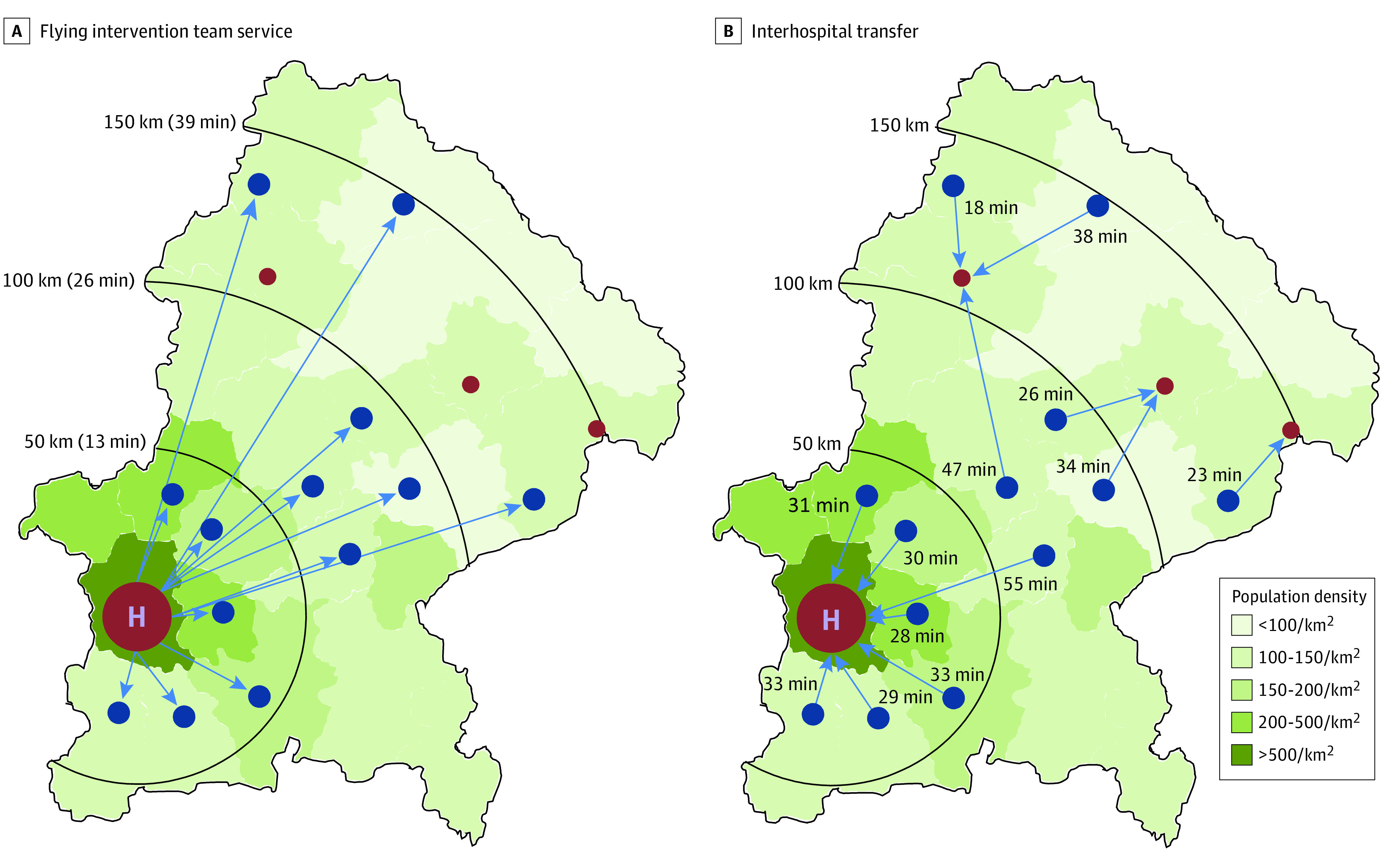
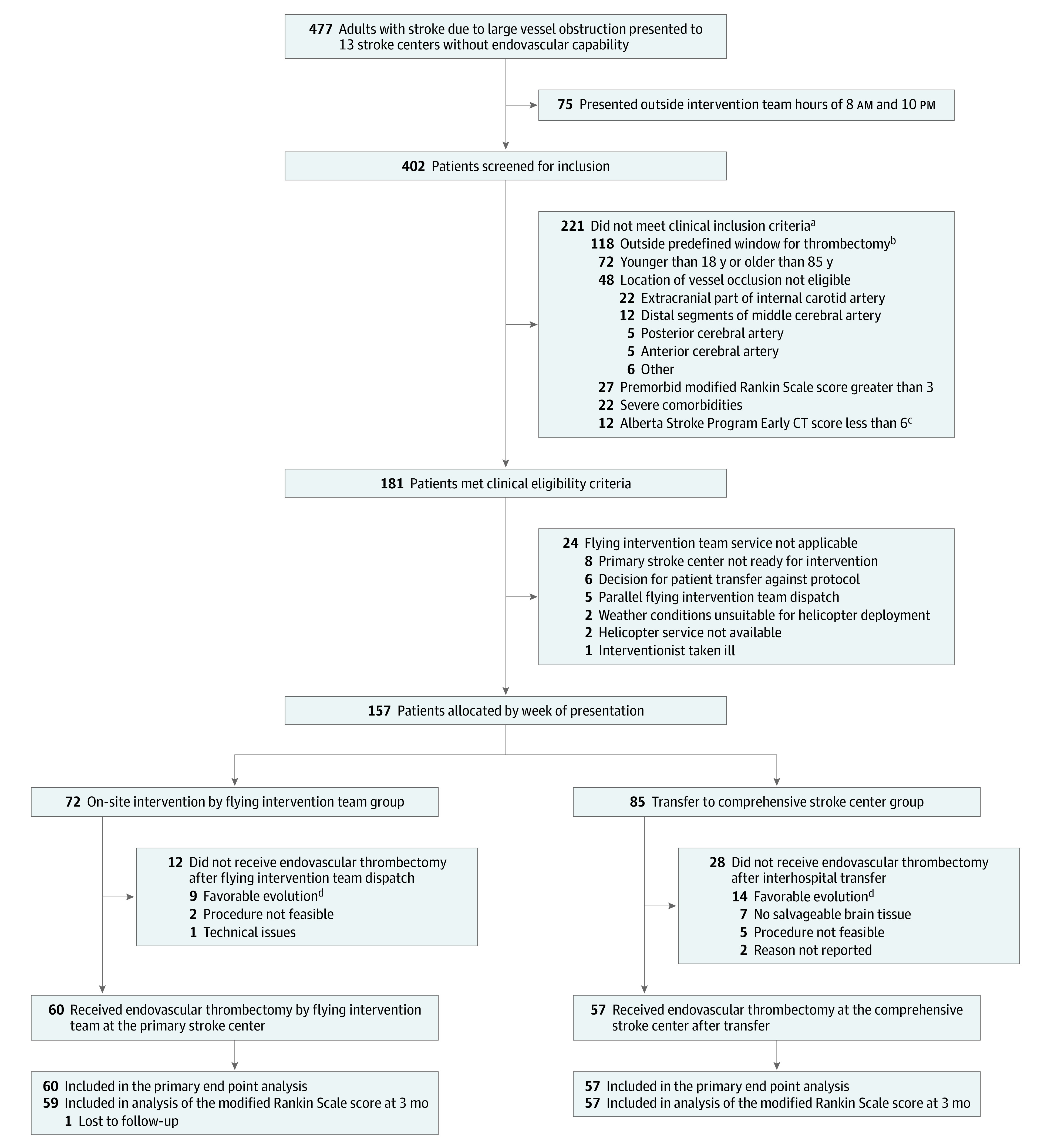
Design, setting, and participants: This was a nonrandomized controlled intervention study comparing 2 systems of care in alternating weeks. The study was conducted in a nonurban region in Germany including 13 primary telemedicine-assisted stroke centers within a telestroke network. A total of 157 patients with acute ischemic stroke for whom decision to pursue thrombectomy had been made and deployment of flying intervention team or patient interhospital transfer was initiated were enrolled between February 1, 2018, and October 24, 2019. The date of final follow-up was January 31, 2020.
Exposures: Deployment of a flying intervention team for EVT in a primary stroke center vs patient interhospital transfer for EVT to a referral center.
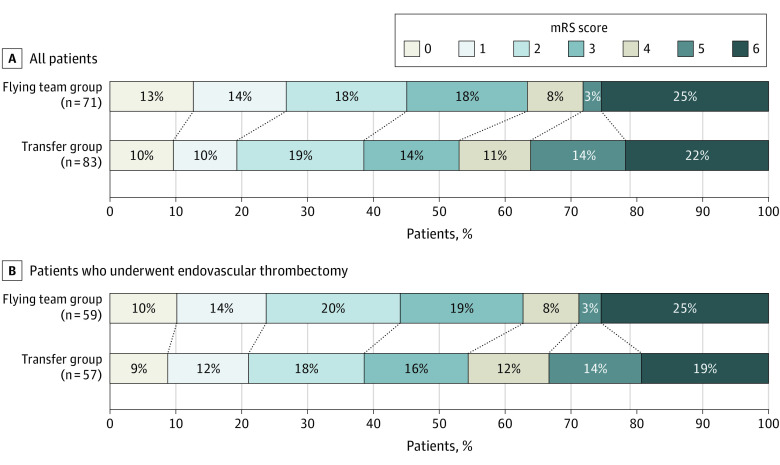
Main outcomes and measures: The primary outcome was time delay from decision to pursue thrombectomy to start of the procedure in minutes. Secondary outcomes included functional outcome after 3 months, determined by the distribution of the modified Rankin Scale score (a disability score ranging from 0 [no deficit] to 6 [death]).
Results: Among the 157 patients included (median [IQR] age, 75 [66-80] y; 80 [51%] women), 72 received flying team care and 85 were transferred. EVT was performed in 60 patients (83%) in the flying team group vs 57 (67%) in the transfer group. Median (IQR) time from decision to pursue EVT to start of the procedure was 58 (51-71) minutes in the flying team group and 148 (124-177) minutes in the transfer group (difference, 90 minutes [95% CI, 75-103]; P < .001). There was no significant difference in modified Rankin Scale score after 3 months between patients in the flying team (n = 59) and transfer (n = 57) groups who received EVT (median [IQR] score, 3 [2-6] vs 3 [2-5]; adjusted common odds ratio for less disability, 1.91 [95% CI, 0.96-3.88]; P = .07).
Conclusions and relevance: In a nonurban stroke network in Germany, deployment of a flying intervention team to local stroke centers, compared with patient interhospital transfer to referral centers, was significantly associated with shorter time to EVT for patients with acute ischemic stroke. The findings may support consideration of a flying intervention team for some stroke systems of care, although further research is needed to confirm long-term clinical outcomes and to understand applicability to other geographic settings.
Conflict of interest statement
Figures
Comment in
-
Strategic Opportunities to Improve Stroke Systems of Care.JAMA. 2022 May 10;327(18):1765-1767. doi: 10.1001/jama.2022.3820. JAMA. 2022. PMID: 35510400 No abstract available.
References
-
- Powers WJ, Rabinstein AA, Ackerson T, et al. Guidelines for the early management of patients with acute ischemic stroke: 2019 update to the 2018 guidelines for the early management of acute ischemic stroke: a guideline for healthcare professionals from the American Heart Association/American Stroke Association. Stroke. 2019;50(12):e344-e418. doi: 10.1161/STR.0000000000000211 - DOI - PubMed
-
- Turc G, Bhogal P, Fischer U, et al. European Stroke Organisation (ESO)—European Society for Minimally Invasive Neurological Therapy (ESMINT) guidelines on mechanical thrombectomy in acute ischaemic stroke endorsed by Stroke Alliance for Europe (SAFE). Eur Stroke J. 2019;4(1):6-12. doi: 10.1177/2396987319832140 - DOI - PMC - PubMed
Publication types
MeSH terms
LinkOut - more resources
Full Text Sources
Medical