


Circulating levels and prognostic cut-offs of sST2, hs-cTnT, and NT-proBNP in women vs. men with chronic heart failure
- PMID: 35510529
- PMCID: PMC9288762
- DOI: 10.1002/ehf2.13883
Circulating levels and prognostic cut-offs of sST2, hs-cTnT, and NT-proBNP in women vs. men with chronic heart failure
Abstract
Aims: To define plasma concentrations, determinants, and optimal prognostic cut-offs of soluble suppression of tumorigenesis-2 (sST2), high-sensitivity cardiac troponin T (hs-cTnT), and N-terminal pro-B-type natriuretic peptide (NT-proBNP) in women and men with chronic heart failure (HF).
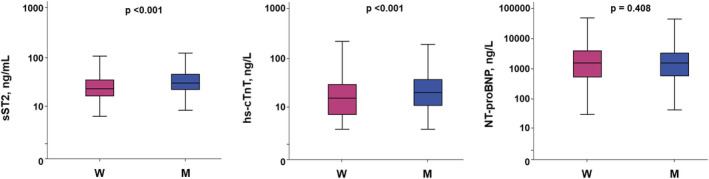
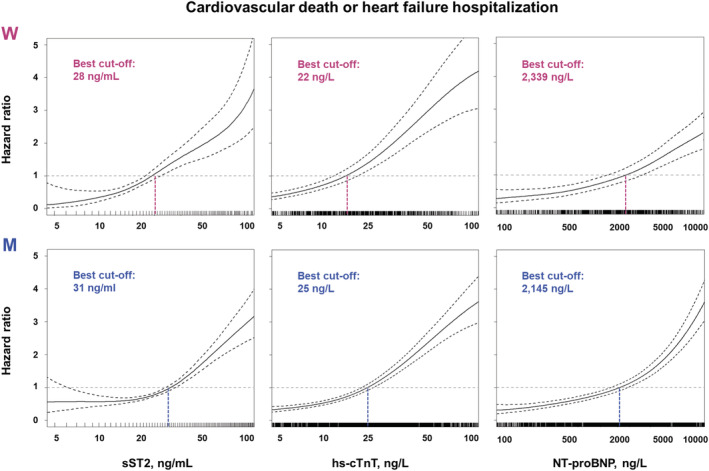
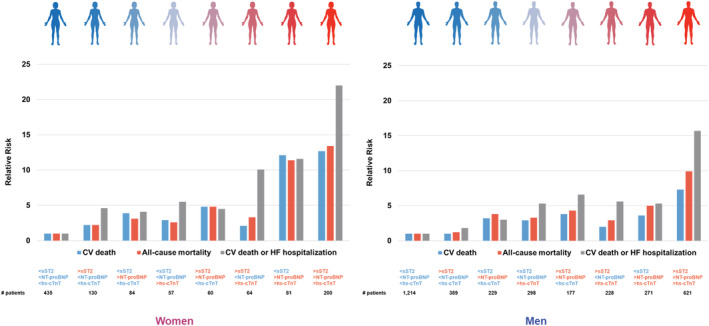
Methods and results: Individual data of patients from the Biomarkers In Heart Failure Outpatient Study (BIOS) Consortium with sST2, hs-cTnT, and NT-proBNP measured were analysed. The primary endpoint was a composite of 1 year cardiovascular death and HF hospitalization. The secondary endpoints were 5 year cardiovascular and all-cause death. The cohort included 4540 patients (age 67 ± 12 years, left ventricular ejection fraction 33 ± 13%, 1111 women, 25%). Women showed lower sST2 (24 vs. 27 ng/mL, P < 0.001) and hs-cTnT level (15 vs. 20 ng/L, P < 0.001), and similar concentrations of NT-proBNP (1540 vs. 1505 ng/L, P = 0.408). Although the three biomarkers were confirmed as independent predictors of outcome in both sexes, the optimal prognostic cut-off was lower in women for sST2 (28 vs. 31 ng/mL) and hs-cTnT (22 vs. 25 ng/L), while NT-proBNP cut-off was higher in women (2339 ng/L vs. 2145 ng/L). The use of sex-specific cut-offs improved risk prediction compared with the use of previously standardized prognostic cut-offs and allowed to reclassify the risk of many patients, to a greater extent in women than men, and for hs-cTnT than sST2 or NT-proBNP. Specifically, up to 18% men and up to 57% women were reclassified, by using the sex-specific cut-off of hs-cTnT for the endpoint of 5 year cardiovascular death.
Conclusions: In patients with chronic HF, concentrations of sST2 and hs-cTnT, but not of NT-proBNP, are lower in women. Lower sST2 and hs-cTnT and higher NT-proBNP cut-offs for risk stratification could be used in women.
Keywords: Chronic heart failure; High-sensitivity troponin T; NT-proBNP; Prognosis; Sex; Women; sST2.
© 2022 The Authors. ESC Heart Failure published by John Wiley & Sons Ltd on behalf of European Society of Cardiology.
Figures
References
-
- Bloom MW, Greenberg B, Jaarsma T, Januzzi JL, Lam CSP, Maggioni AP, Trochu JN, Butler J. Heart failure with reduced ejection fraction. Nat Rev Dis Primers. 2017; 3: 17058. - PubMed
-
- Murphy SP, Ibrahim NE, Januzzi JL Jr. Heart failure with reduced ejection fraction: a review. JAMA. 2020; 324: 488–504. - PubMed
-
- Gentile F, Ghionzoli N, Borrelli C, Vergaro G, Pastore MC, Cameli M, Emdin M, Passino C, Giannoni A. Epidemiological and clinical boundaries of heart failure with preserved ejection fraction. Eur J Prev Cardiol. 2021; zwab077. - PubMed
-
- Lam CSP, Arnott C, Beale AL, Chandramouli C, Hilfiker‐Kleiner D, Kaye DM, Ky B, Santema BT, Sliwa K, Voors AA. Sex differences in heart failure. Eur Heart J. 2019; 40: 3859–3868. - PubMed
MeSH terms
Substances
LinkOut - more resources
Full Text Sources
Medical
Research Materials
Miscellaneous
