. 2022 May 6;376(6593):630-635.
doi: 10.1126/science.abm4774. Epub 2022 May 5.

Idiosyncratic epistasis leads to global fitness-correlated trends

Affiliations

Idiosyncratic epistasis leads to global fitness-correlated trends

Christopher W Bakerlee et al. Science. .

Abstract

Epistasis can markedly affect evolutionary trajectories. In recent decades, protein-level fitness landscapes have revealed extensive idiosyncratic epistasis among specific mutations. By contrast, other work has found ubiquitous and apparently nonspecific patterns of global diminishing-returns and increasing-costs epistasis among mutations across the genome. Here, we used a hierarchical CRISPR gene drive system to construct all combinations of 10 missense mutations from across the genome in budding yeast and measured their fitness in six environments. We show that the resulting fitness landscapes exhibit global fitness-correlated trends but that these trends emerge from specific idiosyncratic interactions. We thus provide experimental validation of recent theoretical work arguing that fitness-correlated trends can emerge as the generic consequence of idiosyncratic epistasis.


Figures
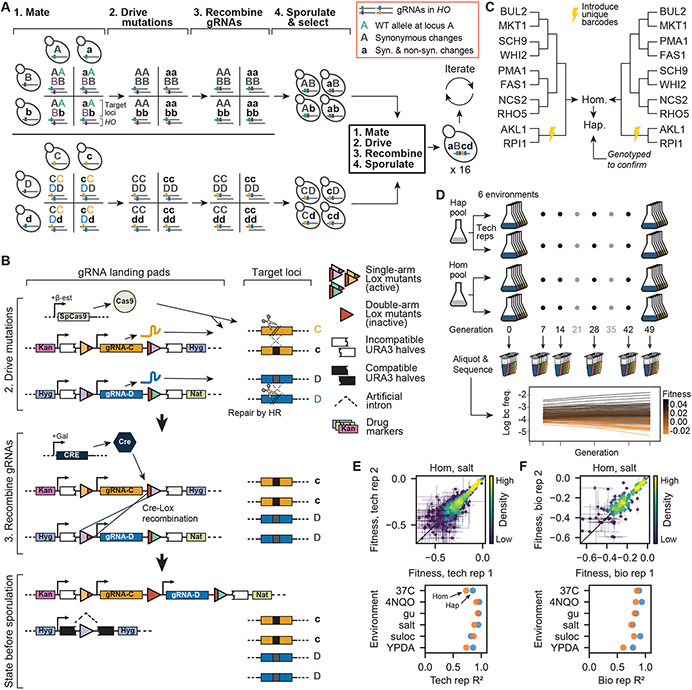
Fig. 1.
Fig. 1.. Recombining CRISPR-gene drive system.
(A) Experimental design. Strains of opposite mating type carrying known mutations and corresponding guide-RNAs (gRNAs) mate to form heterozygous diploids. Cas9 expression “drives” these mutations, and site-specific recombination links gRNAs. Homozygous diploids are sporulated, haploids with linked gRNAs are selected, and the process repeats, incorporating exponentially increasing numbers of mutations. (B) Recombining gene drive system. gRNAs targeting heterozygotic loci are flanked by selection markers and two of three orthogonal Lox sites (colored triangles), which are inactivated through recombination (red triangles). Cas9 “drives” targeted mutations, whereas Cre-Lox recombination brings like markers to the same chromosome and activates a URA3 gene interrupted by an artificial intron. Following sporulation, the chromosome with gRNAs is selected using the markers of interest whereas the other is counterselected using 5-FOA. (C) Cross design. A complete fitness landscape is produced in parallel by distinct cross designs that yield final homozygous diploids and haploids in biological replicates with unique DNA barcodes. (D) Bulk-fitness assays. Pooled strains are assayed in replicate for competitive fitness in several environments by sequencing barcodes to obtain strain frequencies over time. (E) Repeatability of technical replicate competitive fitness measurements. (F) Repeatability of biological replicate competitive fitness measurements.
Fig. 2.
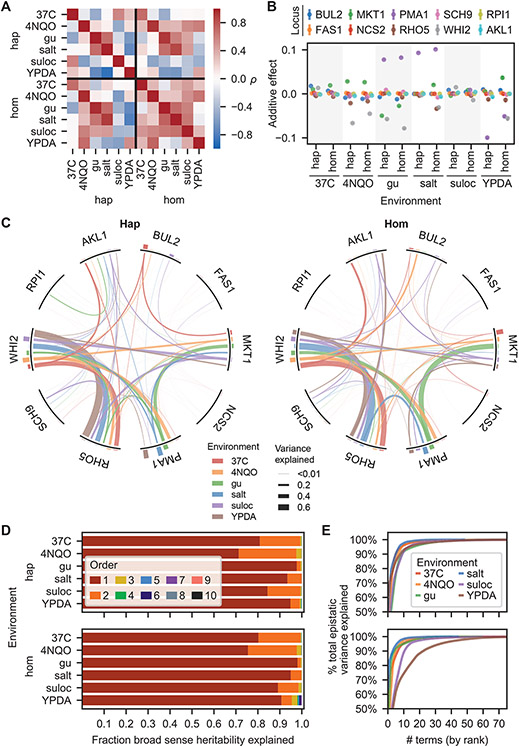
Fig. 2.. Fitness landscapes.
(A) Correlation in observed fitness (upper right) and predicted fitness (from inferred model, lower left, see SI section 5.1) across ploidies and environments. (B) Background-averaged additive effect of each locus across ploidies and environments. Error bars represent 95% confidence intervals. (C) Background-averaged pairwise epistatic effects between loci across ploidies and environments. Weights of edges connecting loci represent the proportion of pairwise variance explained by each interaction. Heights of bars on the perimeter correspond to the proportion of additive variance explained by each locus in each environment. (D) Variance partitioning of broad-sense heritability from additive and epistatic orders across ploidies and environments. (E) Cumulative distribution of the epistatic variance explained by rank-ordered epistatic terms of all orders.
Fig. 3.
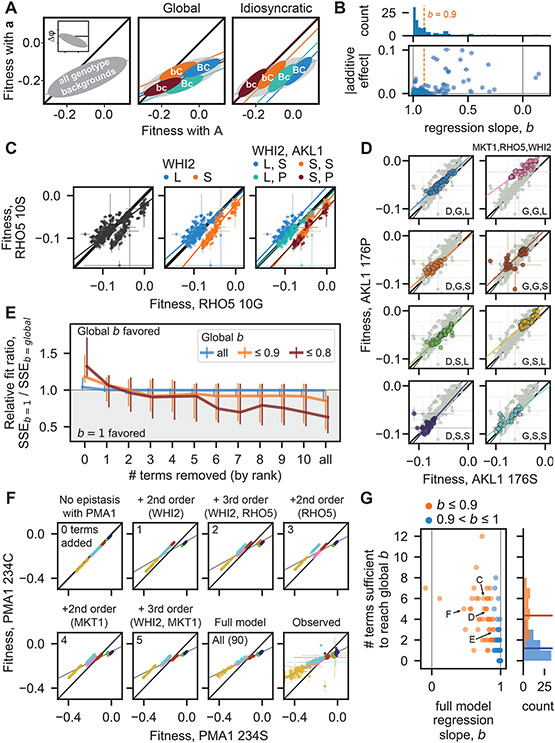
Fig. 3.. Fitness-correlated trends (FCTs).
(A) Schematic contrasting how global or idiosyncratic epistasis could produce FCTs. Inset shows FCT analyzed as the effect of a mutation (Δφ) on backgrounds of different fitnesses. (B) Histogram and scatterplot of regression slopes, b, between φMut and φWT, and corresponding absolute additive effects of mutations. Polarity adopted such that b ≤ 1. Total error bar length is twice the standard error of the slope. (C) Fitness effect of RHO5 mutation (G10S) (φMut versus φWT) in all haploid backgrounds at 37°C (left) and partitioned by genotypes at WHI2 (L262S) (middle) and WHI2 and AKL1 (S176P) (right). Initial SSEb=1 / SSEb=global is 1.21. (D) Fitness effect of AKL1 mutation in all homozygote backgrounds in the suloctidil environment, partitioned by genotypes at MKT1 (D30G), RHO5, and WHI2. Initial SSEb=1 / SSEb=global is 1.31. (E) Median relative fit ratio between regressions with fixed slope of b=1 and b=global, as function of number of epistatic terms removed from observed phenotypes. Vertical lines represent interquartile range. Polarity adopted such that b ≤ 1. (F) Inferred fitness effect of PMA1 S234C mutation in 4NQO environment across all haploid backgrounds. Epistatic terms interacting with PMA1 are completely removed from genotype fitnesses, then added back sequentially (from largest to smallest). Bottom-right: full-model (inferred) and observed genotype fitnesses, respectively. Grey line is regression slope. (G) Scatterplot and histograms of FCT regression slopes for all data, and number of epistatic terms sufficient to recapitulate them. Horizontal lines in histogram indicate means. Arrows, letters indicate populations presented in previous panels. Polarity adopted such that b ≤ 1.

References

    1. Kvitek DJ, Sherlock G, Reciprocal sign epistasis between frequently experimentally evolved adaptive mutations causes a rugged fitness landscape. PLoS Genet. 7, e1002056 (2011). - PMC - PubMed
    1. Romero PA, Arnold FH, Exploring protein fitness landscapes by directed evolution. Nat Rev Mol Cell Biol. 10, 866–876 (2009). - PMC - PubMed
    1. Flynn KM, Cooper TF, Moore FB-G, Cooper VS, The environment affects epistatic interactions to alter the topology of an empirical fitness landscape. PLoS Genet. 9, e1003426 (2013). - PMC - PubMed
    1. Costanzo M, VanderSluis B, Koch EN, Baryshnikova A, Pons C, Tan G, Wang W, Usaj M, Hanchard J, Lee SD, Pelechano V, Styles EB, Billmann M, van Leeuwen J, van Dyk N, Lin Z-Y, Kuzmin E, Nelson J, Piotrowski JS, Srikumar T, Bahr S, Chen Y, Deshpande R, Kurat CF, Li SC, Li Z, Usaj MM, Okada H, Pascoe N, San Luis B-J, Sharifpoor S, Shuteriqi E, Simpkins SW, Snider J, Suresh HG, Tan Y, Zhu H, Malod-Dognin N, Janjic V, Przulj N, Troyanskaya OG, Stagljar I, Xia T, Ohya Y, Gingras A-C, Raught B, Boutros M, Steinmetz LM, Moore CL, Rosebrock AP, Caudy AA, Myers CL, Andrews B, Boone C, A global genetic interaction network maps a wiring diagram of cellular function. Science. 353 (2016), doi: 10.1126/science.aaf1420. - DOI - PMC - PubMed
    1. Norris AD, Gracida X, Calarco JA, CRISPR-mediated genetic interaction profiling identifies RNA binding proteins controlling metazoan fitness. Elife. 6 (2017), doi: 10.7554/eLife.28129. - DOI - PMC - PubMed