


Coronary artery bypass grafting for coronary artery anomalies in infants and young children
- PMID: 35512199
- PMCID: PMC9387505
- DOI: 10.1093/icvts/ivac119
Coronary artery bypass grafting for coronary artery anomalies in infants and young children
Abstract
Objectives: Coronary artery bypass grafting (CABG) has been reported for coronary artery diseases in patients with Kawasaki disease and coronary artery complications after arterial switch operations for transposition of the great arteries. However, only a few studies have explored this modality for congenital coronary artery anomalies. As congenital coronary artery anomalies, particularly left coronary artery atresia and stenosis, are one of the reasons for sudden death, coronary revascularization is often required in infants and young children. Therefore, we aimed to investigate the outcome of CABG for such anomalies in infants and young children.
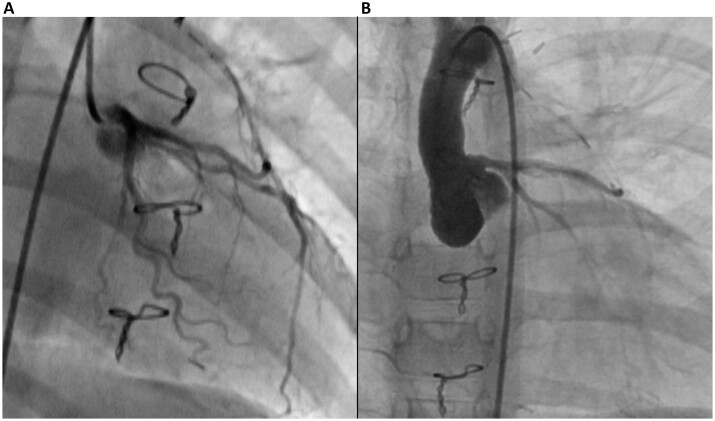
Methods: From 2014 to 2018, 3 infants and 2 children (median age: 10 months; range: 6-40 months) with coronary artery anomalies underwent CABG at our hospital. The indications for the procedure included left main coronary artery atresia and stenosis in 2 and 3 patients, respectively. Graft patency was evaluated postoperatively by contrast-enhanced computed tomography or coronary angiography, and postoperative outcomes (including death and cardiac events) were assessed during the follow-up period.
Results: No 30-day or in-hospital mortalities were noted. Postoperative examinations revealed patent grafts in all patients. They were discharged without any cardiac complications. Regarding the outcomes at the follow-up period, the graft patency rate was 80.0% (4/5 grafts), with no deaths or cardiac events.
Conclusions: CABG is a useful strategy for coronary revascularization in infants and young children with coronary artery anomalies. Although the mid-term outcomes and patency are satisfactory, careful follow-up is necessary because the long-term outcomes remain unknown.
Keywords: Congenital coronary artery anomalies; Coronary artery bypass grafting; Coronary revascularization; Internal thoracic artery; Paediatric cardiac surgery.
© The Author(s) 2022. Published by Oxford University Press on behalf of the European Association for Cardio-Thoracic Surgery.
Figures



Comment in
-
Coronary artery bypass grafting in infants and young children: default or alternative choice?Interact Cardiovasc Thorac Surg. 2022 Jul 9;35(2):ivac168. doi: 10.1093/icvts/ivac168. Interact Cardiovasc Thorac Surg. 2022. PMID: 35775945 Free PMC article. No abstract available.
References
-
- Kitamura S, Tsuda E, Kobayashi J, Nakajima H, Yoshikawa Y, Yagihara T. et al. Twenty-five-year outcome of pediatric coronary artery bypass surgery for Kawasaki disease. Circulation 2009;120:60–8. - PubMed
-
- Legendre A, Chantepie A, Belli E, Vouhé PR, Neville P, Dulac Y. et al. Outcome of coronary artery bypass grafting performed in young children. J Thorac Cardiovasc Surg 2010;139:349–53. - PubMed
-
- Yaku H, Nunn GR, Sholler GF.. Internal mammary artery grafting in a neonate for coronary hypoperfusion after arterial switch. Ann Thorac Surg 1997;64:543–4. - PubMed
MeSH terms
LinkOut - more resources
Full Text Sources
Medical
Research Materials
