The role of Lrp6-mediated Wnt/β-catenin signaling in the development and intervention of spinal neural tube defects in mice
- PMID: 35514236
- PMCID: PMC9194482
- DOI: 10.1242/dmm.049517
The role of Lrp6-mediated Wnt/β-catenin signaling in the development and intervention of spinal neural tube defects in mice
Abstract
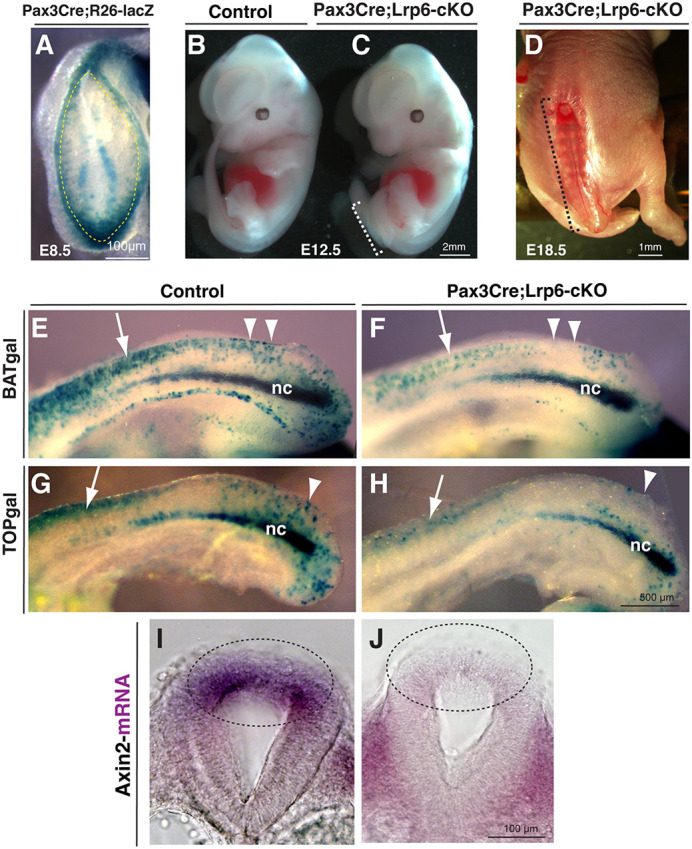
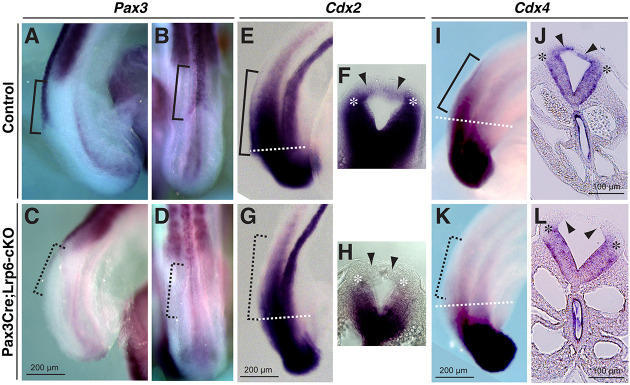
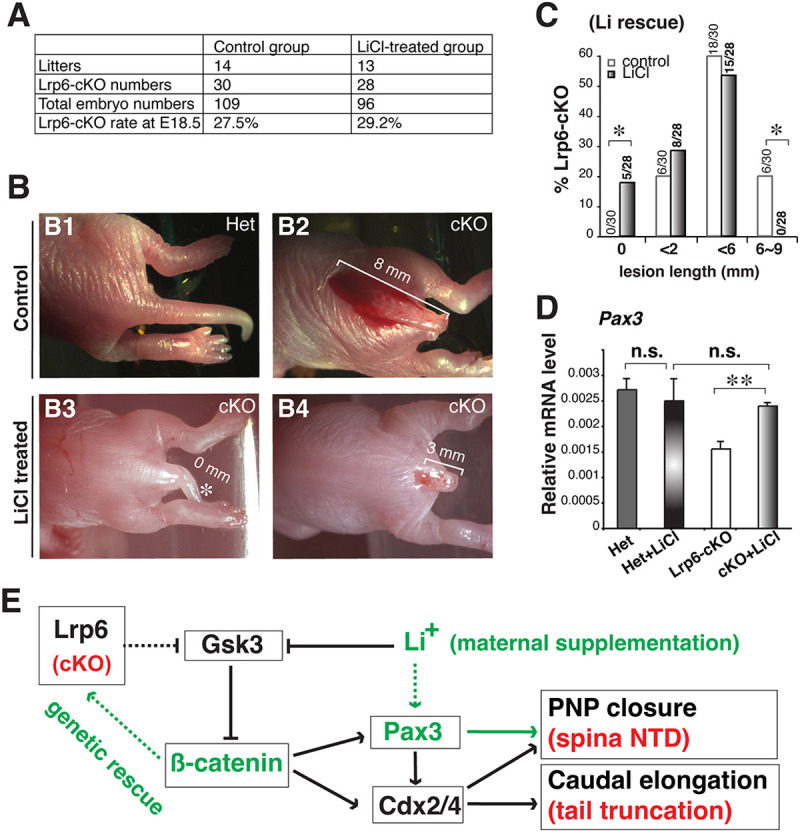
Neural tube defects (NTDs) are among the common and severe birth defects with poorly understood etiology. Mutations in the Wnt co-receptor LRP6 are associated with NTDs in humans. Either gain-of-function (GOF) or loss-of-function (LOF) mutations of Lrp6 can cause NTDs in mice. NTDs in Lrp6-GOF mutants may be attributed to altered β-catenin-independent noncanonical Wnt signaling. However, the mechanisms underlying NTDs in Lrp6-LOF mutants and the role of Lrp6-mediated canonical Wnt/β-catenin signaling in neural tube closure remain unresolved. We previously demonstrated that β-catenin signaling is required for posterior neuropore (PNP) closure. In the current study, conditional ablation of Lrp6 in dorsal PNP caused spinal NTDs with diminished activities of Wnt/β-catenin signaling and its downstream target gene Pax3, which is required for PNP closure. β-catenin-GOF rescued NTDs in Lrp6-LOF mutants. Moreover, maternal supplementation of a Wnt/β-catenin signaling agonist reduced the frequency and severity of spinal NTDs in Lrp6-LOF mutants by restoring Pax3 expression. Together, these results demonstrate the essential role of Lrp6-mediated Wnt/β-catenin signaling in PNP closure, which could also provide a therapeutic target for NTD intervention through manipulation of canonical Wnt/β-catenin signaling activities.
Keywords: Genetic rescue; Lrp6; Pharmacological intervention; Spinal neural tube defects; Wnt/β-catenin signaling.
© 2022. Published by The Company of Biologists Ltd.
Conflict of interest statement
Competing interests The authors declare no competing or financial interests.
Figures
References
-
- Allache, R., Lachance, S., Guyot, M. C., De Marco, P., Merello, E., Justice, M. J., Capra, V. and Kibar, Z. (2014). Novel mutations in Lrp6 orthologs in mouse and human neural tube defects affect a highly dosage-sensitive Wnt non-canonical planar cell polarity pathway. Hum. Mol. Genet. 23, 1687-1699. 10.1093/hmg/ddt558 - DOI - PMC - PubMed
-
- Bryja, V., Andersson, E. R., Schambony, A., Esner, M., Bryjova, L., Biris, K. K., Hall, A. C., Kraft, B., Cajanek, L., Yamaguchi, T. P.et al. (2009). The extracellular domain of Lrp5/6 inhibits noncanonical Wnt signaling in vivo. Mol. Biol. Cell 20, 924-936. 10.1091/mbc.e08-07-0711 - DOI - PMC - PubMed
Publication types
MeSH terms
Substances
Grants and funding
LinkOut - more resources
Full Text Sources
Medical
Molecular Biology Databases
Miscellaneous