


Evaluation of microleakage for three types of light cure orthodontic band cement
- PMID: 35514676
- PMCID: PMC9062255
- DOI: 10.1016/j.jobcr.2022.04.004
Evaluation of microleakage for three types of light cure orthodontic band cement
Abstract
Objective: The aim of this study was to compare the microleakage of three types of light cure orthodontic band cement (Resilience, Band-it and Transbond Plus) and to compare low and high curing light intensities at the enamel-cement and band-cement interfaces in the gingival and occlusal margins.
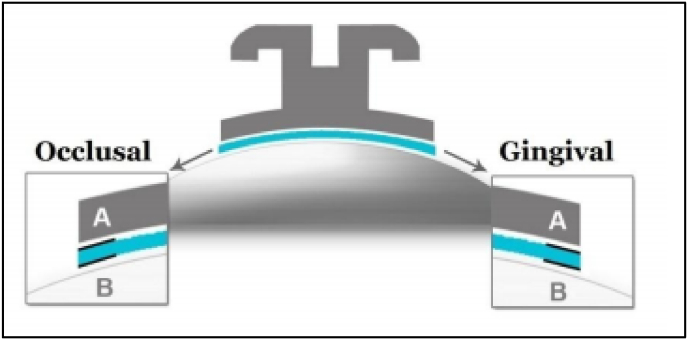
Materials and methods: Sixty extracted human premolars were divided into six groups (n = 10 specimens) according to the type of cement used and intensity of light cure. Microetched bands of upper premolars cemented to the teeth by Transbond Plus (3 M Unitek), Resilience (Orthotechnology) and Band-it (db Orthodontics). Three groups were cured by a standard mode light cure (over 900 mw/cm2) for 20 s, and the other three groups were cured with an extra mode light cure (over 2700 mw/cm2) for 6 s. The teeth were sealed by nail varnish and immersed for 24 h in 0.5% basic fuchsin solution. After that, the teeth were sectioned in the buccoligual direction, observed under a stereomicroscope, and then recorded for microleakage at the enamel-cement and band-cement interfaces in the gingival and occlusal margins. The statistical analysis was performed using Kruskal-Wallis and Mann-Whitney U tests, and the level of significance was set at P < 0.05.
Result: The microleakage scores showed no significant differences at the enamel-cement and band-cement interfaces among the three types of orthodontic band cement subjected to low- and high-intensity curing light.
Conclusions: The type of cement and intensity of light cure did not affect the amount of microleakage at either interface.
Keywords: Band cement; Light cure; Microleakage.
© 2022 Craniofacial Research Foundation. Published by Elsevier B.V. All rights reserved.
Conflict of interest statement
No Conflict of interest.
Figures




References
-
- Al Qassar S.S., Taqa A.A., Mohiaalden H.K. Can the static field improve orthodontic adhesive polymerization? J Int Dent Med Res. 2021;14(1):67–73.
-
- Fricker J.P. A 12-month clinical comparison of resin-modified light-activated adhesives for the cementation of orthodontic molar bands. Am J Orthod Dentofacial Orthop. 1997;112:239–243. - PubMed
-
- Millett D.T., Kamahli K., McColl J. Comparative laboratory investigation of dual-cured vs conventional glass ionomer cements for band cementation. Angle Orthod. 1998;68:345–350. - PubMed
-
- Millett D.T., Cummings A., Letters S., Roger E., Love J. Resin modified glass ionomer, modified composite or conventional glass ionomer for band cementation—an in vitro evaluation. Eur J Orthod. 2003;25:609–614. - PubMed
LinkOut - more resources
Full Text Sources
Miscellaneous
