


The Landscape of Immunotherapy Resistance in NSCLC
- PMID: 35515125
- PMCID: PMC9066487
- DOI: 10.3389/fonc.2022.817548
The Landscape of Immunotherapy Resistance in NSCLC
Erratum in
-
Erratum: The landscape of immunotherapy resistance in NSCLC.Front Oncol. 2023 Apr 4;13:1187021. doi: 10.3389/fonc.2023.1187021. eCollection 2023. Front Oncol. 2023. PMID: 37081979 Free PMC article.
Abstract
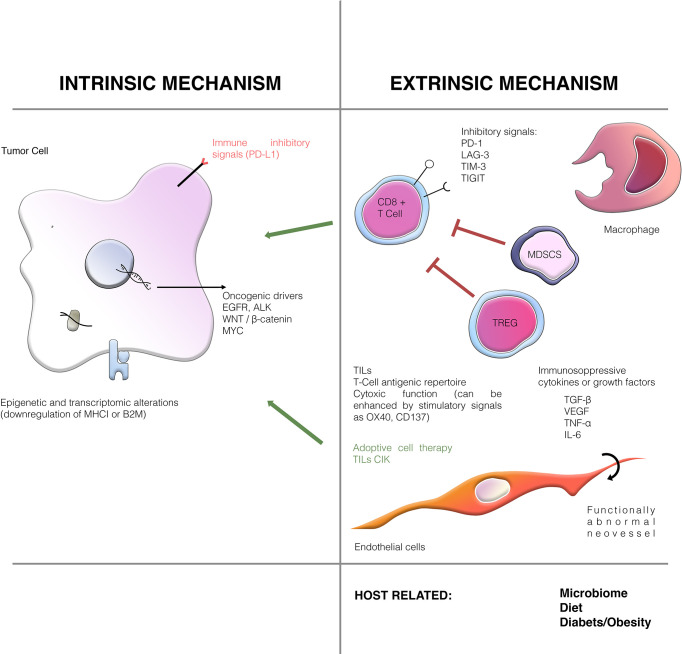
Lung cancer is the leading cause of cancer mortality worldwide. Immunotherapy has demonstrated clinically significant benefit for non-small-cell lung cancer, but innate (primary) or acquired resistance remains a challenge. Criteria for a uniform clinical definition of acquired resistance have been recently proposed in order to harmonize the design of future clinical trials. Several mechanisms of resistance are now well-described, including the lack of tumor antigens, defective antigen presentation, modulation of critical cellular pathways, epigenetic changes, and changes in the tumor microenvironment. Host-related factors, such as the microbiome and the state of immunity, have also been examined. New compounds and treatment strategies are being developed to target these mechanisms with the goal of maximizing the benefit derived from immunotherapy. Here we review the definitions of resistance to immunotherapy, examine its underlying mechanisms and potential corresponding treatment strategies. We focus on recently published clinical trials and trials that are expected to deliver results soon. Finally, we gather insights from recent preclinical discoveries that may translate to clinical application in the future.
Keywords: NSCLC; checkpoint inhibitor; immunotherapy; lung cancer; resistance.
Copyright © 2022 Frisone, Friedlaender, Addeo and Tsantoulis.
Conflict of interest statement
AF: Advisory board with Roche, Pfizer, Astellas, AstraZeneca, MSD, Sanofi, Novartis and BMS. AA: Advisory board: MSD Oncology, Roche, Takeada, Pfizer, Bristol-Myers Squibb, AstraZeneca, Eli-Lilly, Roche. Speaker Bureau: Eli-Lilly, AstraZeneca.PT: Advisory board with Astellas, Bayer, BMS, Ipsen, Janssen-Cilag, Merck, MSD, Pfizer, Roche and Sanofi. Travel and conference expenses from Lilly, Janssen-Cilag and Sanofi. The remaining author declares that the research was conducted in the absence of any commercial or financial relationships that could be construed as a potential conflict of interest.
Figures
References
-
- GLOBOCAN 2018. Available at: https://gco.iarc.fr/.
-
- Garon EB, Hellmann MD, Rizvi NA, Carcereny E, Leighl NB, Ahn MJ, et al. . Five-Year Overall Survival for Patients With Advanced Nonsmall-Cell Lung Cancer Treated With Pembrolizumab: Results From the Phase I KEYNOTE-001 Study. J Clin Oncol (2019) 37:2518–27. doi: 10.1200/JCO.19.00934 - DOI - PMC - PubMed
-
- Topalian SL, Hodi FS, Brahmer JR, Gettinger SN, Smith DC, McDermott DF, et al. . Five-Year Survival and Correlates Among Patients With Advanced Melanoma, Renal Cell Carcinoma, or Non-Small Cell Lung Cancer Treated With Nivolumab. JAMA Oncol (2019) 5:1411–20. doi: 10.1001/jamaoncol.2019.2187 - DOI - PMC - PubMed
-
- Reck M, Rodriguez-Abreu D, Robinson AG, Hui R, Csoszi T, Fulop A, et al. . Updated Analysis of KEYNOTE-024: Pembrolizumab Versus Platinum-Based Chemotherapy for Advanced Non-Small-Cell Lung Cancer With PD-L1 Tumor Proportion Score of 50% or Greater. J Clin Oncol (2019) 37:537–46. doi: 10.1200/JCO.18.00149 - DOI - PubMed
Publication types
LinkOut - more resources
Full Text Sources
