


Quantifying depression-related language on social media during the COVID-19 pandemic
- PMID: 35516163
- PMCID: PMC9052361
- DOI: 10.23889/ijpds.v5i4.1716
Quantifying depression-related language on social media during the COVID-19 pandemic
Abstract
Introduction: The COVID-19 pandemic had clear impacts on mental health. Social media presents an opportunity for assessing mental health at the population level.
Objectives: 1) Identify and describe language used on social media that is associated with discourse about depression. 2) Describe the associations between identified language and COVID-19 incidence over time across several geographies.
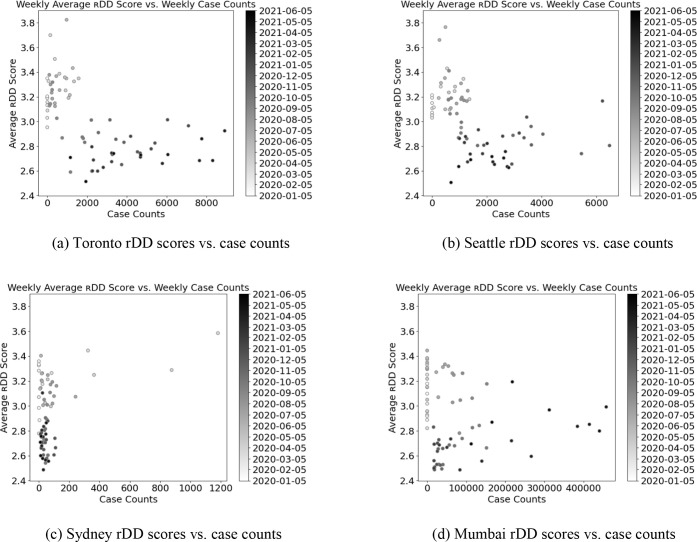
Methods: We create a word embedding based on the posts in Reddit's /r/Depression and use this word embedding to train representations of active authors. We contrast these authors against a control group and extract keywords that capture differences between the two groups. We filter these keywords for face validity and to match character limits of an information retrieval system, Elasticsearch. We retrieve all geo-tagged posts on Twitter from April 2019 to June 2021 from Seattle, Sydney, Mumbai, and Toronto. The tweets are scored with BM25 using the keywords. We call this score rDD. We compare changes in average score over time with case counts from the pandemic's beginning through June 2021.
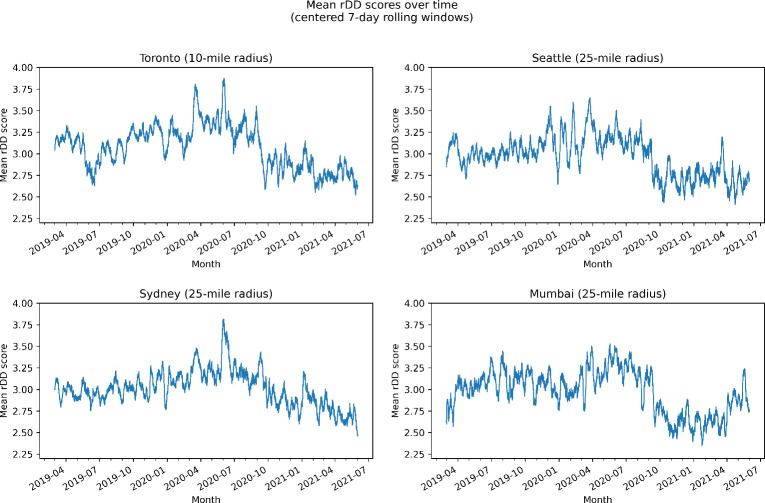
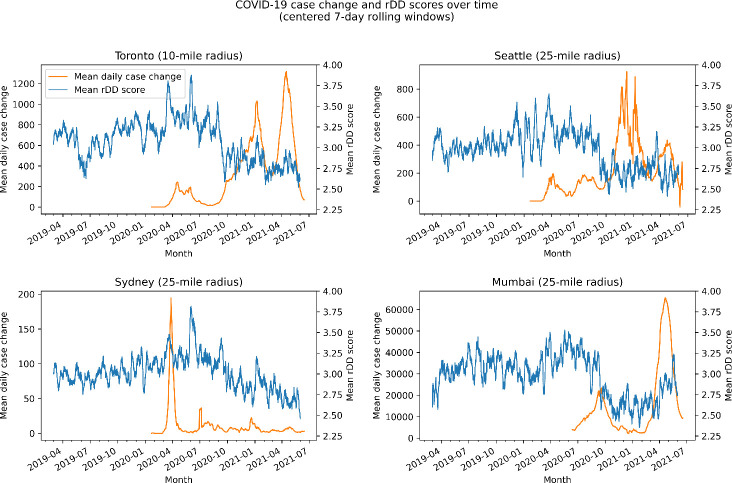
Results: We observe a pattern in rDD across all cities analyzed: There is an increase in rDD near the start of the pandemic which levels off over time. However, in Mumbai we also see an increase aligned with a second wave of cases.
Conclusions: Our results are concordant with other studies which indicate that the impact of the pandemic on mental health was highest initially and was followed by recovery, largely unchanged by subsequent waves. However, in the Mumbai data we observed a substantial rise in rDD with a large second wave. Our results indicate possible un-captured heterogeneity across geographies, and point to a need for a better understanding of this differential impact on mental health.
Keywords: COVID-19; Twitter; depression; information retrieval; machine learning; public health surveillance; social media.
Conflict of interest statement
Statement on conflicts of interest: The authors have no conflicts of interest to declare.
Figures
References
-
- Bueno-Notivol J., Gracia-García P., Olaya B., Lasheras I., R. López-Antón and Santabárbara J., “Prevalence of depression during the COVID-19 outbreak: A meta-analysis of community-based studies,” International journal of clinical and health psychology, vol. 21, p. 100196, 2021. 10.1016/j.ijchp.2020.07.007 - DOI - PMC - PubMed
-
- Ebrahimi O. V., Hoffart A. and Johnson S. U., “Physical distancing and mental health during the COVID-19 pandemic: Factors associated with psychological symptoms and adherence to pandemic mitigation strategies,” Clinical Psychological Science, vol. 9, p. 489–506, 2021. 10.1177/2167702621994545 - DOI
Publication types
LinkOut - more resources
Full Text Sources
Miscellaneous