Review
. 2020 Jun 8;10(37):21698-21723.
doi: 10.1039/d0ra03620j.

3D printing of biomass-derived composites: application and characterization approaches

Affiliations
Review

3D printing of biomass-derived composites: application and characterization approaches

Anqi Ji et al. RSC Adv. .

Abstract

Three-dimensional (3D) printing is an additive manufacturing technique with a wide range of 3D structure fabrication and minimal waste generation. Recently, lignocellulosic biomass and its derivatives have been used in 3D printing due to their renewable nature and sustainability. This review provides a summary of the development of different types of biomass and its components such as cellulose and lignin in 3D printing, brief data analysis and introduction to characterization methods of the 3D printed composites. Mechanical properties such as tensile properties, Izod impact properties, and flexural properties, thermal properties and morphological properties of 3D-printed composites are discussed. In addition, other available characterization methods of 3D-printed composites are reported. The future direction of biomass and its derivatives in the field of 3D printing is also discussed.


Conflict of interest statement

The authors declare no conflict of interest.

Figures
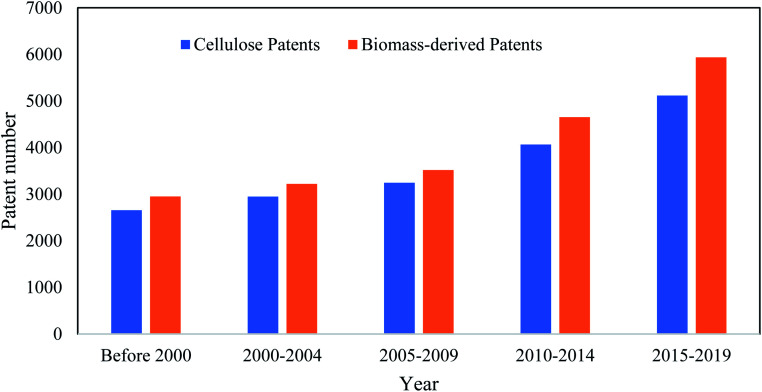
Fig. 1
Fig. 1. Number of patents for cellulose and biomass-derived in 3D printing.
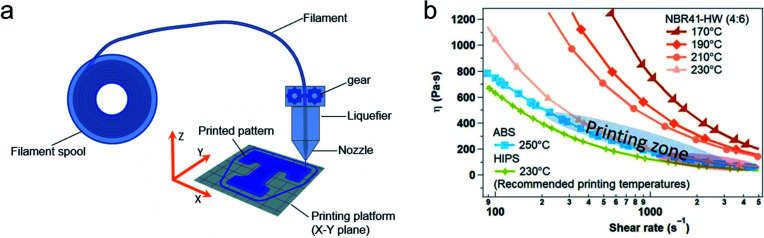
Fig. 2
Fig. 2. (a) Mechanism of FDM/FFF. (b) “Printing zone” defined in an FDM printing (ABS, HIPS and NBR41–HW represent acrylonitrile–butadiene–styrene, high impact polystyrene and acrylonitrile butadiene rubber with 41 mol% of nitrile contents, respectively). Reprinted with copyright permission from ref. 25. Copyright 2018 Science Advances.
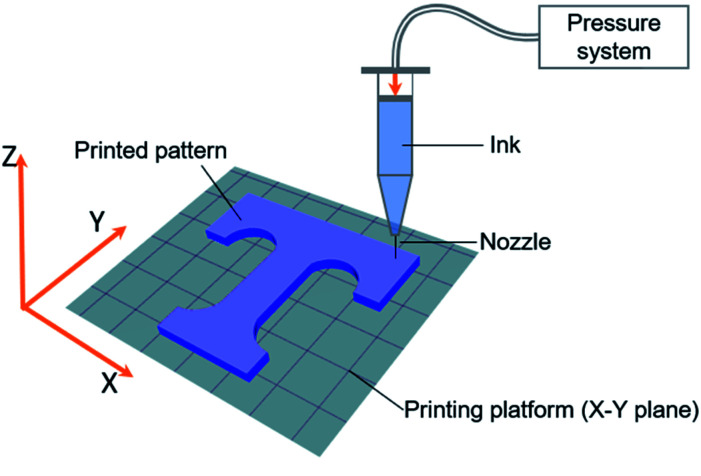
Fig. 3
Fig. 3. Mechanism of DIW.
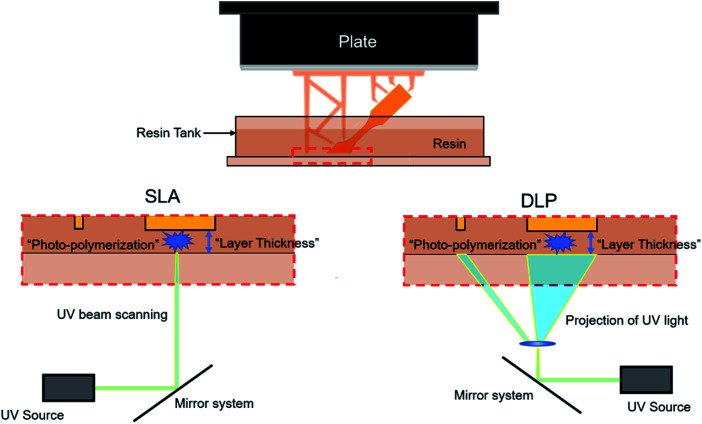
Fig. 4
Fig. 4. Mechanism of SLA/DLP. Redrawn based on ref. 86. Copyright 2019 ACS Omega.
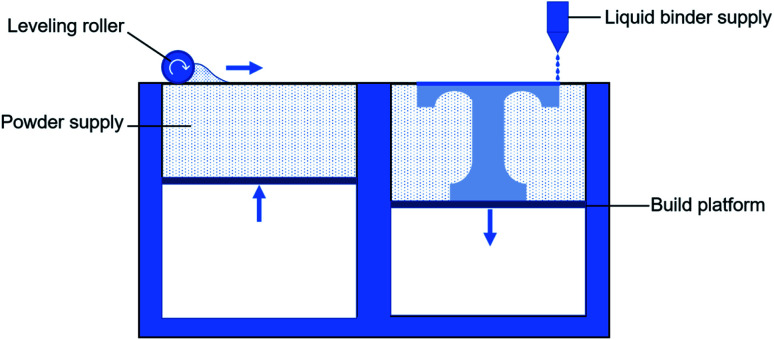
Fig. 5
Fig. 5. Mechanism of binder jetting.
Fig. 6
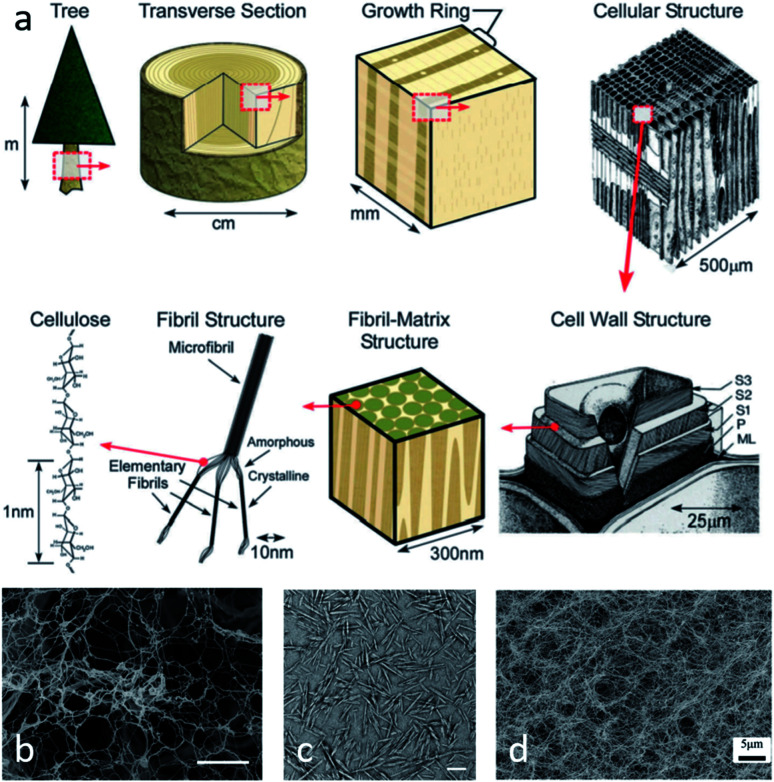
Fig. 6. (a) Schematic of the tree hierarchical structure illustrating the role of cellulose. Reprinted with permission from ref. 44. Copyright 2011 Chemical Society Reviews. (b) SEM image of the CNF, scale bar 6 μm. Reprinted with permission from ref. 30. Copyright 2019 Advanced Functional Materials. (c) TEM image of CNCs, scale bar 100 nm. Reprinted with permission from ref. 30. Copyright 2019 Advanced Functional Materials. (d) SEM image of BC produced by Komagataeibacter xylinus. Scale bar 5 μm. Reprinted with permission from ref. 46. Copyright 2017 RSC Advances.
Fig. 7
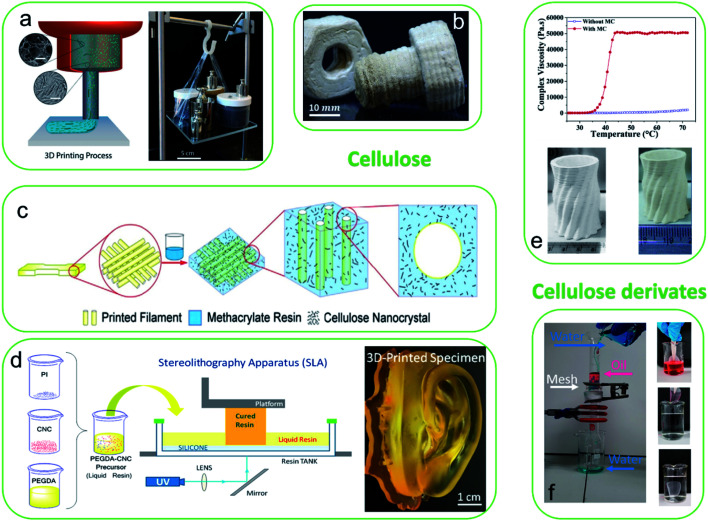
Fig. 7. Various studies on 3D printing of cellulose and cellulose derivates. (a) The alignment of cellulose nanofibers (CNF) and nanocrystals (CNC) controlled by the flow in a DIW printing (left), leading to a strong aerogel hook (right). Reprinted with permission from ref. 30. Copyright 2019 Advanced Functional Materials. (b) DCW printing of cellulose composites with other biomasses. Reprinted with permission from ref. 36. Copyright 2019 Advanced Materials Technologies. (c) Wood cell mimicking structure combined FDM printing structure with UV-cured resin and CNC. Reprinted with permission from ref. 67. Copyright 2018 Materials & Design. (d) SLA printing of CNC reinforced structure that can be used in medical fields. Reprinted with permission from ref. 39. Copyright 2017 ACS Applied Materials & Interfaces. (e) MC-assisted ceramic slurry showed unique rheology behavior on printing. Below two images showed the prototype (left) and the sintered counterpart (right). Reprinted with permission from ref. 76. Copyright 2019 Journal of Alloys and Compounds. (f) CA-based oil/water separation mesh and its anti-oil-fouling property. Reprinted with permission from ref. 77. Copyright 2019 ACS Applied Materials & Interfaces.
Fig. 8
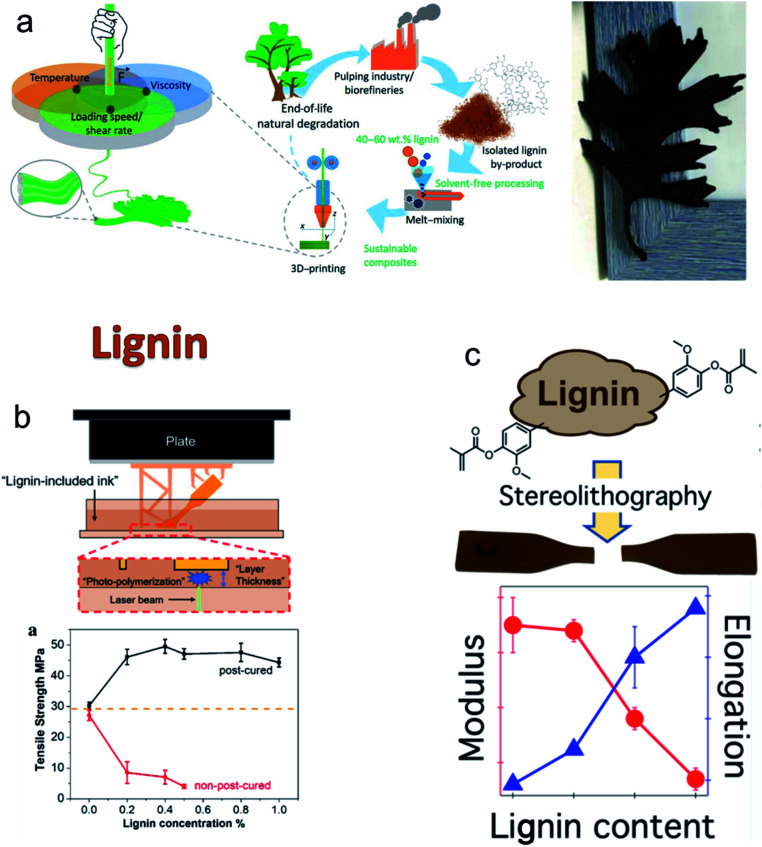
Fig. 8. Studies on lignin 3D printing. (a) FDM printing process of lignin-included composite that owns the highest reported lignin contents (60 wt%) and the printed oak leaf. Reprinted with permission from ref. 93 Copyright 2018 Science Advances. (b) SLA printing of lignin-included resin that showed an improvement of the tensile strength. Reprinted with permission from ref. 86. https://pubs.acs.org/doi/abs/10.1021/acsomega.9b02455, Copyright 2019 ACS Omega. Further permissions related to the material excerpted should be directed to the ACS. (c) Modified lignin in SLA printing can be printed with the highest concentration of 15 wt%. Reprinted with permission from ref. 41. Copyright 2018 ACS Applied Materials & Interfaces. Further permissions related to the material excerpted should be directed to the ACS.
Fig. 9
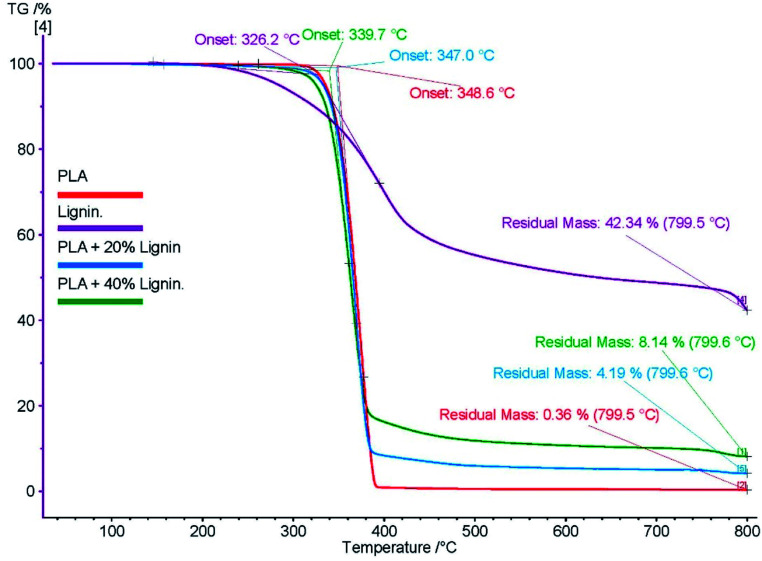
Fig. 9. TGA plots of lignin, PLA and PLA/lignin biocomposites. Reprinted with permission from ref. 87. Copyright 2019 Materials.
Fig. 10
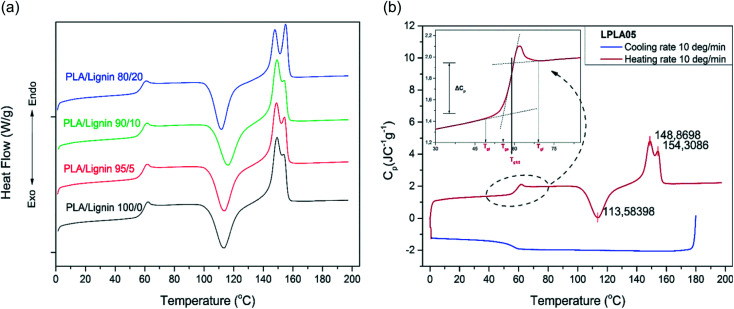
Fig. 10. (a) DSC thermographs of PLA/lignin bulk composites. (b) DSC thermograph of the sample with 5 wt% lignin. Quantities for characterization of the glass transition of the sample containing 5 wt% lignin: extrapolated onset temperature (Tge), half-step temperature (Tg1/2), change of the normalized heat capacity during the transition (ΔCp), initial (Tgi) and final (Tgf) temperatures of the glass transition. Reprinted with permission from ref. 140. Copyright 2017 Manufacturing Review.
Fig. 11
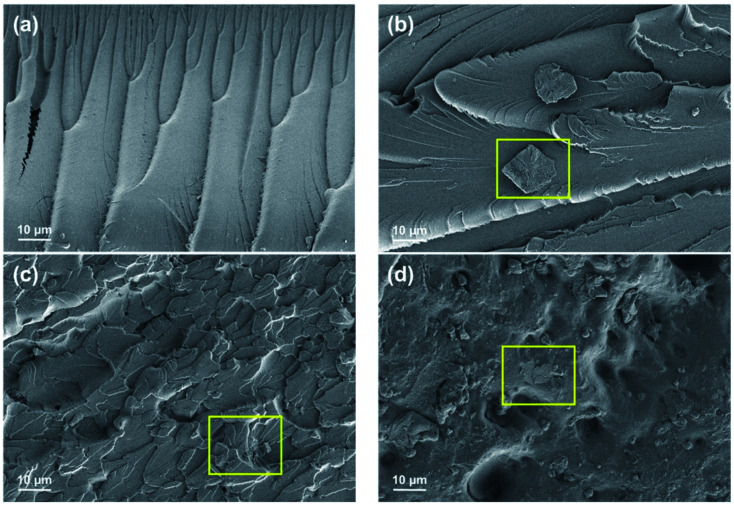
Fig. 11. Scanning electron microscopy (SEM) analysis of the fracture surface of tensile tested dogbones. Reprinted with permission from ref. 87. Copyright 2019 Materials.
Fig. 12
Fig. 12. Micrograph images of the fracture surface after tensile testing (a) photo-curable PU, (b) PU–graphene (PU–G), (c) PU-0.6% lignin/G, and (d) top surface of PU-0.6% lignin/G. Reprinted with permission from ref. 95. Copyright 2019 Polymers.
Fig. 13
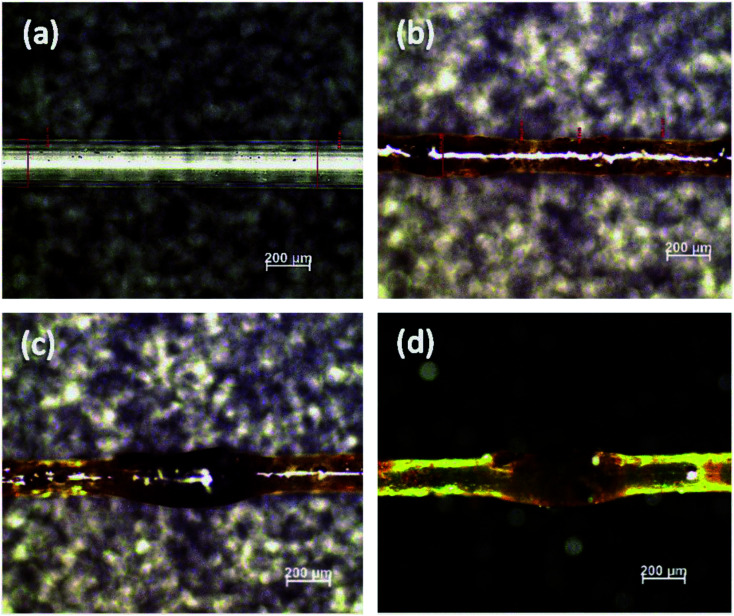
Fig. 13. Light micrographs of (a) individual PLA fibers extruded from 0.2 mm nozzle 20 mm s−1 printing speed; (b) individual PLA blends with 5 wt% lignin fibers extruded from 0.2 mm nozzle 20 mm s−1 printing speed; (c and d) individual PLA blends with 5 wt% lignin fibers extruded from 0.2 mm nozzle 60 mm s−1 printing speed. Reprinted with permission from ref. 140. Copyright 2017 Manufacturing Review.

References

    1. Diegel O., in Comprehensive Materials Processing, ed. S. Hashmi, C. J. V. Tyne, G. F. Batalha and B. Yilbas, Elsevier, 1st edn, 2014, vol. 10, ch. 2, pp. 3–18
    1. Wang X. Jiang M. Zhou Z. Gou J. Hui D. Composites, Part B. 2017;110:442–458. doi: 10.1016/j.compositesb.2016.11.034. - DOI
    1. ISO/ASTM52900-15, Standard Terminology for Additive Manufacturing – General Principles – Terminology, ASTM International, West Conshohocken, PA, 2015, https://www.astm.org/Standards/ISOASTM52900.htm
    1. Ligon S. C. Liska O. R. Stampfl J. Gurr M. Mülhaupt R. Chem. Rev. 2017;117:10212–10290. doi: 10.1021/acs.chemrev.7b00074. - DOI - PMC - PubMed
    1. Kodama H. Rev. Sci. Instrum. 1981;52:1770–1773. doi: 10.1063/1.1136492. - DOI