


The Roles of Optogenetics and Technology in Neurobiology: A Review
- PMID: 35517048
- PMCID: PMC9063564
- DOI: 10.3389/fnagi.2022.867863
The Roles of Optogenetics and Technology in Neurobiology: A Review
Abstract
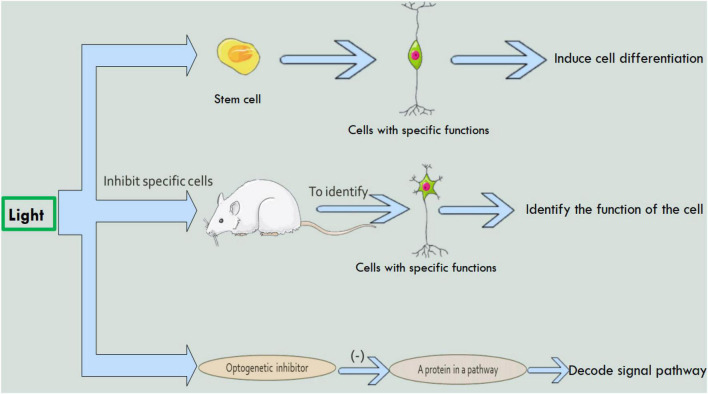
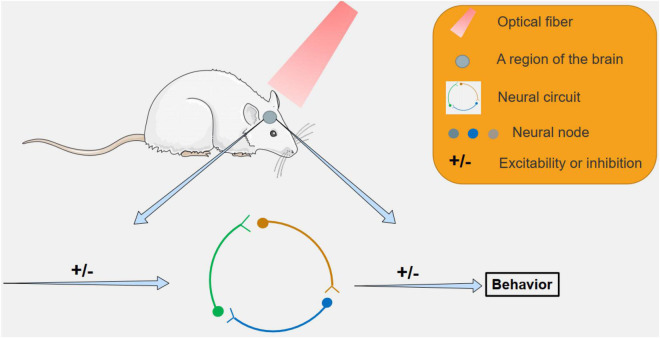
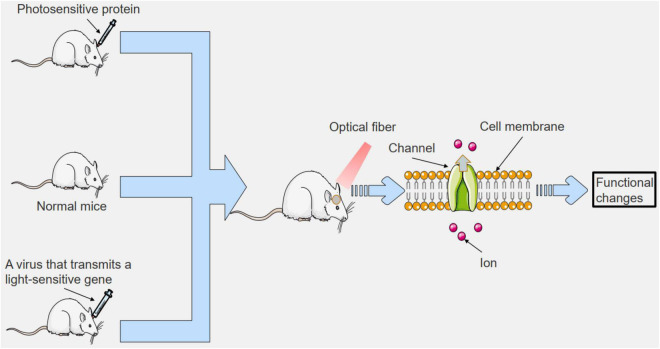
Optogenetic is a technique that combines optics and genetics to control specific neurons. This technique usually uses adenoviruses that encode photosensitive protein. The adenovirus may concentrate in a specific neural region. By shining light on the target nerve region, the photosensitive protein encoded by the adenovirus is controlled. Photosensitive proteins controlled by light can selectively allow ions inside and outside the cell membrane to pass through, resulting in inhibition or activation effects. Due to the high precision and minimally invasive, optogenetics has achieved good results in many fields, especially in the field of neuron functions and neural circuits. Significant advances have also been made in the study of many clinical diseases. This review focuses on the research of optogenetics in the field of neurobiology. These include how to use optogenetics to control nerve cells, study neural circuits, and treat diseases by changing the state of neurons. We hoped that this review will give a comprehensive understanding of the progress of optogenetics in the field of neurobiology.
Keywords: nanoparticles; nervous system; neural circuits; neurobiology; neuron; optogenetics.
Copyright © 2022 Chen, Li, Liang, Li, Zou, Xie, Liao, Yu, Lin, Huang, Li and Zhu.
Conflict of interest statement
The authors declare that the research was conducted in the absence of any commercial or financial relationships that could be construed as a potential conflict of interest.
Figures
References
-
- Adampourezare M., Dehghan G., Hasanzadeh M., Hosseinpoure Feizi M. A. (2021). Application of lateral flow and microfluidic bio-assay and biosensing towards identification of DNA-methylation and cancer detection: recent progress and challenges in biomedicine. Biomed Pharmacother 141:111845. 10.1016/j.biopha.2021.111845 - DOI - PubMed
-
- Altinoz M. A., Elmaci I., Hacimuftuoglu A., Ozpinar A., Hacker E., Ozpinar A. (2020). PPARdelta and its ligand erucic acid may act anti-tumoral, neuroprotective, and myelin protective in neuroblastoma, glioblastoma, and Parkinson’s disease. Mol. Aspects Med. 2020:100871. 10.1016/j.mam.2020.100871 - DOI - PubMed
Publication types
LinkOut - more resources
Full Text Sources
