


Tough, stretchable and compressive alginate-based hydrogels achieved by non-covalent interactions
- PMID: 35517309
- PMCID: PMC9054928
- DOI: 10.1039/d0ra03733h
Tough, stretchable and compressive alginate-based hydrogels achieved by non-covalent interactions
Abstract
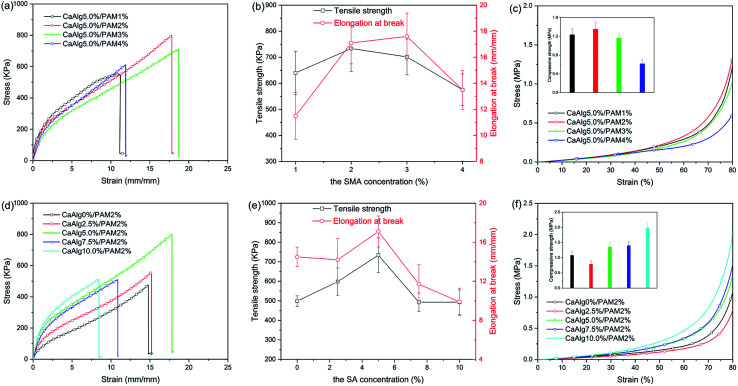
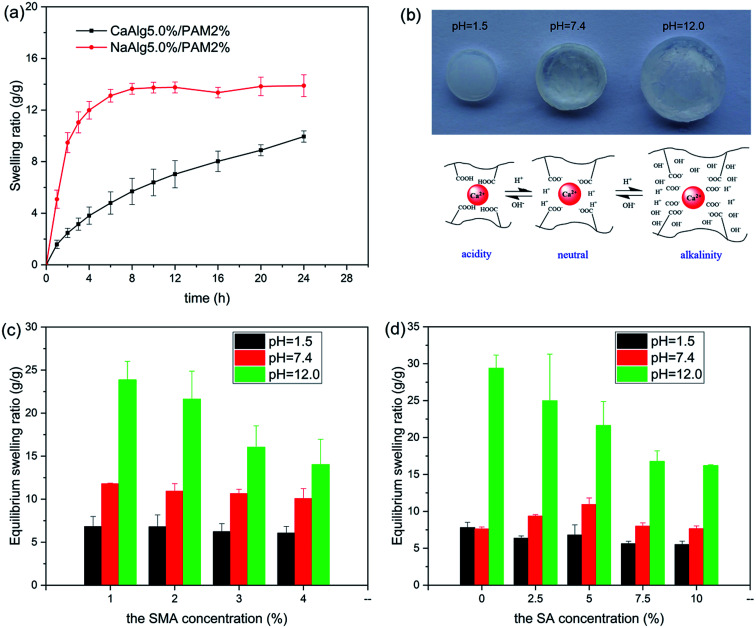
In this study, two alginate-based hydrogels with good mechanical strength, toughness and resilience were synthesized by hydrophobic interaction and coordination bonding. Sodium alginate/poly(acrylamide) semi-interpenetrating network (NaAlg/PAM semi-IPN) hydrogels were first synthesized through the micelle copolymerization of acrylamide and stearyl methacrylate in the presence of sodium alginate, then calcium alginate/poly(acrylamide) double network (CaAlg/PAM DN) hydrogels were prepared by immersing the as-prepared NaAlg/PAM semi-IPN hydrogels in a CaCl2 solution. FT-IR and XPS results revealed NaAlg/PAM semi-IPN hydrogels and CaAlg/PAM DN hydrogels were successfully synthesized through non-covalent interactions. The tensile strength of CaAlg/PAM DN hydrogels could reach 733.6 kPa, and their compressive strengths at 80% strain are significantly higher than those of the corresponding NaAlg/PAM semi-IPN hydrogels, which is attributed to the alginate network crosslinked by Ca2+. The dual physically crosslinked CaAlg/PAM DN hydrogels can achieve fast self-recovery, and good fatigue resistance, which is mainly assigned to energy dissipation through dynamic reversible non-covalent interactions in both networks. The self-healing ability, swelling behavior and morphology of the synthesized alginate-based hydrogels were also evaluated. This study offers a new avenue to design and construct hydrogels with high mechanical strength, high toughness and fast self-recovery properties, which broadens the current research and application of hydrogels.
This journal is © The Royal Society of Chemistry.
Conflict of interest statement
There is no conflict of interest.
Figures





References
-
- Gao C. Liu M. Chen J. Zhang X. Polym. Degrad. Stab. 2009;94:1405–1410. doi: 10.1016/j.polymdegradstab.2009.05.011. - DOI
LinkOut - more resources
Full Text Sources
Miscellaneous
