


The use of a stronger instructional design by implementing repetitive practice in simulation-based obstetric team training: trainees' satisfaction
- PMID: 35517385
- PMCID: PMC8936909
- DOI: 10.1136/bmjstel-2019-000434
The use of a stronger instructional design by implementing repetitive practice in simulation-based obstetric team training: trainees' satisfaction
Abstract
Objective: This study compares satisfaction levels from multiprofessional obstetric care teams about simulation-based obstetric team training courses with and without the instructional design feature repetitive practice.
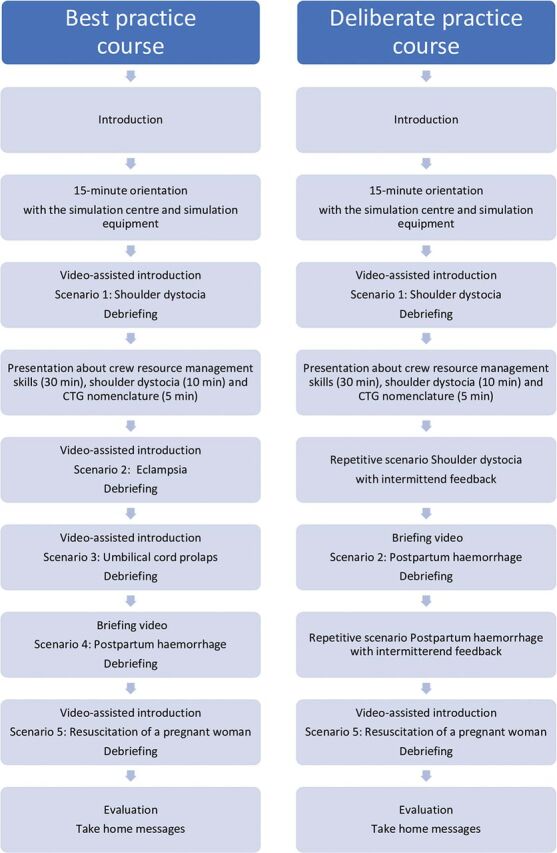
Methods: The present study is part of a multicentre cluster-randomised controlled trial (TOSTI trial) that investigated the effectiveness of a 1 day, multiprofessional, simulation-based obstetric team training. The initial training group received a training which was designed based on best practice. After 1 year, the control group received a training course in which the instructional design was changed by providing repetitive practice. All participants were asked to fill in a 29-item evaluation form with seven questions about baseline characteristics and 22 questions about training features. The questions about training features could be rated on a scale of 1 to 5. Finally, all participants were asked to rate the total training day on a scale of 1-10.
Results: The best practice group consisted of 471 trainees and the repetitive practice group of 549, including gynaecologists, residents, midwives and nurses. The best practice group rated the total training day significantly higher than the repetitive practice group (mean 8.8, SD 0.6 and mean 8.7, SD 0.6; p<0.003, Cohen's d=0.19). Several training features were also scored higher in the best practice group.
Conclusion: This study showed that obstetric healthcare professionals rated a simulation-based obstetric team training course, with and without repetition of scenarios, both high. The training without the repetitive elements gained higher scores for the total training dayand several, and several training features were scored higher. The difference between the mean scores and the effect sizes for the training features were small. This implies that repetitive practice can be integrated in simulation-based team training to optimise learning effects, with small effects on trainees satisfaction.
Keywords: instructional design; repetitive practice; simulation training; teamwork.
© Author(s) (or their employer(s)) 2019. No commercial re-use. See rights and permissions. Published by BMJ.
Conflict of interest statement
Competing interests: None declared.
Figures
References
-
- Block JH, Burns RB. Mastery learning. Rev Res Educ 1976;4:3–49.
LinkOut - more resources
Full Text Sources