


Angiotensin II Receptor Blocker Associated With Less Outcome Risk in Patients With Acute Kidney Disease
- PMID: 35517809
- PMCID: PMC9065477
- DOI: 10.3389/fphar.2022.714658
Angiotensin II Receptor Blocker Associated With Less Outcome Risk in Patients With Acute Kidney Disease
Abstract
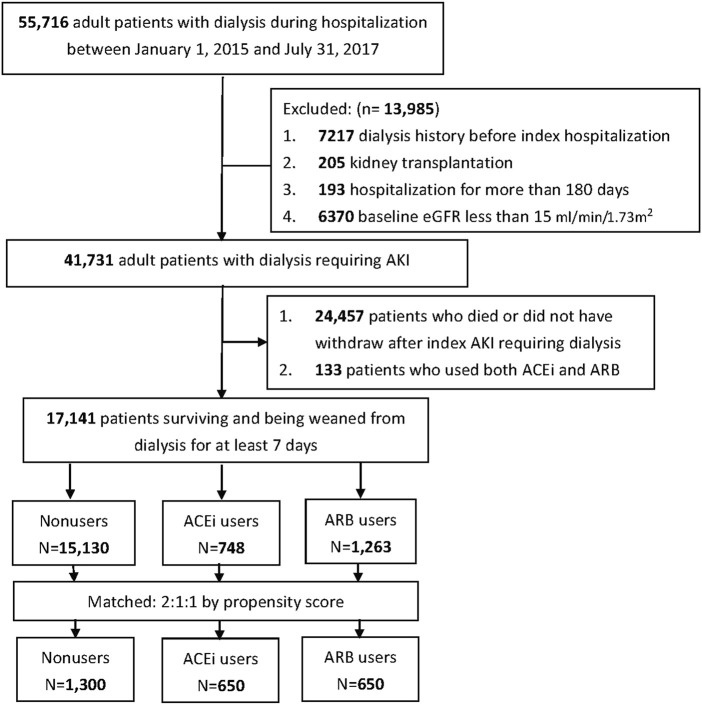
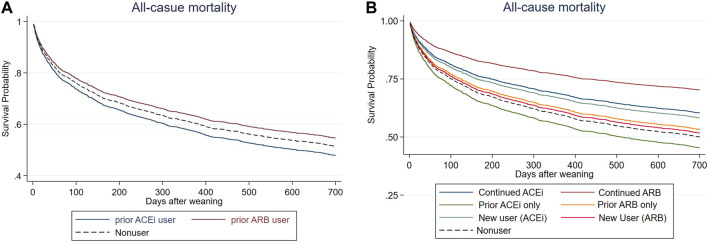
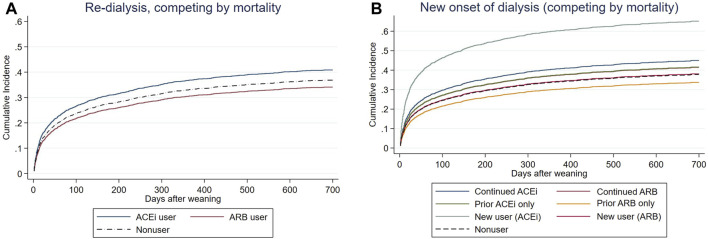
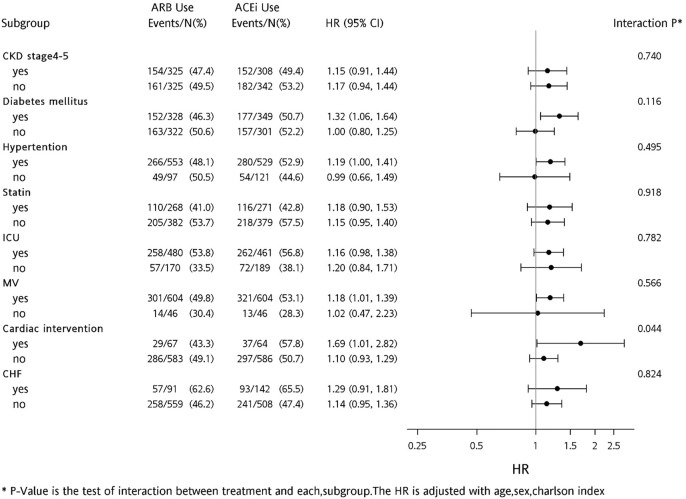
Objective: The aim of this study was to explore the respective use of angiotensin-converting-enzyme inhibitors (ACEis) or angiotensin receptor blockers (ARBs) on the outcomes of patients who could be weaned from dialysis-requiring acute kidney injury (AKI-D). Methods: This case-control study enrolled 41,731 patients who were weaned from AKI-D for at least 7 days from Taiwan's National Health Insurance Administration. We further grouped AKI-D patients according to ACEi and ARB use to evaluate subsequent risks of all-cause mortality and re-dialysis. The outcomes included the all-cause mortality and new-onset of end-stage kidney disease (ESKD; re-dialysis) following withdraw from AKI-D. Results: A total of 17,141 (41.1%) patients surviving AKI-D could be weaned from dialysis for at least 7 days. The overall events of mortality were 366 (48.9%) in ACEi users, 659 (52.1%) in ARB users, and 6,261 (41.3%) in ACEi/ARB nonusers, during a mean follow-up period of 1.01 years after weaning from AKI-D. In regard to all-cause of mortality, pre-dialysis ARB users had lower incidence than ACEi users [hazard ratio (HR 0.82), p = 0.017]. Compared with ACEi/ARB nonusers, continuing ARB users had a significantly low risk of long-term all-cause mortality (adjusted hazard ratio 0.51, p = 0.013) after propensity score matching. However, new users of ACEi at the acute kidney disease (AKD) period had a higher risk of re-dialysis after weaning than ACEi/ARB nonusers (aHR 1.82, p < 0.001), whereas neither ACEi nor ARB users confronted significantly increased risks of hyperkalemia after weaning. Conclusions: Compared with patients without ACEi/ARB, those continuing to use ARB before the event and after weaning had low all-cause mortality, while new users of ACEi at AKD had increased risk of re-dialysis. AKI-D patients continuing to use ACEi or ARB did not have higher risk of hyperkalemia. Future prospective randomized trials are expected to confirm these findings.
Keywords: ACEi; AKD; AKI; ARB; dialysis; hyperkalemia; mortality; weaning.
Copyright © 2022 Wu, Lin, Teng, Yang, Chou, Tsao, Chen, Chueh and Chen.
Conflict of interest statement
The authors declare that the research was conducted in the absence of any commercial or financial relationships that could be construed as a potential conflict of interest.
Figures
References
-
- Arora P., Rajagopalam S., Ranjan R., Kolli H., Singh M., Venuto R., et al. (2008). Preoperative Use of Angiotensin-Converting Enzyme Inhibitors/angiotensin Receptor Blockers Is Associated with Increased Risk for Acute Kidney Injury after Cardiovascular Surgery. Clin. J. Am. Soc. Nephrol. 3 (5), 1266–1273. 10.2215/CJN.05271107 - DOI - PMC - PubMed
-
- Brar S., Ye F., James M. T., Hemmelgarn B., Klarenbach S., Pannu N., et al. (2018). Chronic Disease: Association of Angiotensin-Converting Enzyme Inhibitor or Angiotensin Receptor Blocker Use with Outcomes after Acute Kidney Injury. JAMA Intern. Med. 178 (12), 1681–1690. 10.1001/jamainternmed.2018.4749 - DOI - PMC - PubMed
LinkOut - more resources
Full Text Sources
