


A Review on the Ethnopharmacology and Phytochemistry of the Neotropical Sages (Salvia Subgenus Calosphace; Lamiaceae) Emphasizing Mexican Species
- PMID: 35517814
- PMCID: PMC9061990
- DOI: 10.3389/fphar.2022.867892
A Review on the Ethnopharmacology and Phytochemistry of the Neotropical Sages (Salvia Subgenus Calosphace; Lamiaceae) Emphasizing Mexican Species
Abstract
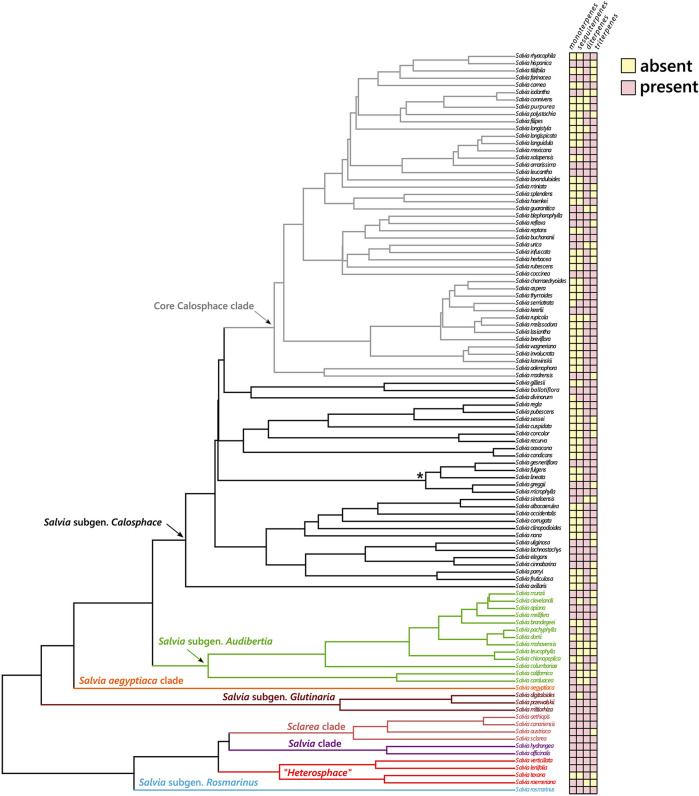
Salvia is the most diverse genus within the mint family (Lamiaceae), many of its species are well-known due to their medicinal and culinary uses. Most of the ethnopharmacological and phytochemical studies on Salvia are centred on species from the European and Asian clades. However, studies about the most diverse clade, the Neotropical sages (Salvia subgenus Calosphace; 587 spp.), are relatively scarce. This review aims to compile the information on the traditional medicinal uses, pharmacological and phytochemistry properties of the Neotropical sages. To do so, we carried out a comprehensive review of the articles available in different online databases published from the past to 2022 (i.e., PubMed, Scopus, and Web of Science, among others) and summarized the information in tables. To uncover phylogenetic patterns in the distribution of four different groups of metabolites (mono-, sesqui-, di-, and triterpenes), we generated presence-absence matrices and plotted the tip states over a dated phylogeny of Salvia. We found several studies involving Mexican species of Salvia, but only a few about taxa from other diversity centres. The main traditional uses of the Mexican species of Calosphace are medicinal and ceremonial. In traditional medicine 56 species are used to treat diseases from 17 categories according to the WHO, plus cultural-bound syndromes. Pharmacological studies reveal a wide range of biological properties (e.g., antinociceptive, anti-inflammatory, anxiolytic, cytotoxic, and antidiabetic, etc.) found in extracts and isolated compounds of 38 Neotropical sages. From extracts of these species, at least 109 compounds have been isolated, identified and evaluated pharmacologically; 73 of these compounds are clerodanes, 21 abietanes, six flavonoids, five sesquiterpenoids, and four triterpenoids. The most characteristic metabolites found in the Neotropical sages are the diterpenes, particularly clerodanes (e.g., Amarisolide A, Tilifodiolide), that are found almost exclusively in this group. The Neotropical sages are a promising resource in the production of herbal medication, but studies that corroborate the properties that have been attributed to them in traditional medicine are scarce. Research of these metabolites guided by the phylogenies is recommended, since closely related species tend to share the presence of similar compounds and thus similar medicinal properties.
Keywords: abietane; bioactive compounds; clerodane; diterpene; mexican traditional medicine.
Copyright © 2022 Ortiz-Mendoza, Aguirre-Hernández, Fragoso-Martínez, González-Trujano, Basurto-Peña and Martínez-Gordillo.
Conflict of interest statement
The authors declare that the research was conducted in the absence of any commercial or financial relationships that could be construed as a potential conflict of interest.
Figures
Similar articles
-
Medicinal plant complexes of Salvia subgenus Calosphace: an ethnobotanical study of new world sages.J Ethnopharmacol. 2013 Mar 7;146(1):214-24. doi: 10.1016/j.jep.2012.12.035. Epub 2013 Jan 3. J Ethnopharmacol. 2013. PMID: 23291572
-
Traditional uses, ten-years research progress on phytochemistry and pharmacology, and clinical studies of the genus Scutellaria.J Ethnopharmacol. 2021 Jan 30;265:113198. doi: 10.1016/j.jep.2020.113198. Epub 2020 Jul 30. J Ethnopharmacol. 2021. PMID: 32739568
-
The genus Inula and their metabolites: from ethnopharmacological to medicinal uses.J Ethnopharmacol. 2014 Jun 11;154(2):286-310. doi: 10.1016/j.jep.2014.04.010. Epub 2014 Apr 19. J Ethnopharmacol. 2014. PMID: 24754913
-
Ethnopharmacology, phytochemistry, and pharmacology of Chinese Salvia species: A review.J Ethnopharmacol. 2018 Oct 28;225:18-30. doi: 10.1016/j.jep.2018.06.029. Epub 2018 Jun 20. J Ethnopharmacol. 2018. PMID: 29935346 Review.
-
Lamiaceae in Mexican Species, a Great but Scarcely Explored Source of Secondary Metabolites with Potential Pharmacological Effects in Pain Relief.Molecules. 2021 Dec 16;26(24):7632. doi: 10.3390/molecules26247632. Molecules. 2021. PMID: 34946714 Free PMC article. Review.
Cited by
-
Salvia deserti Decne., an endemic and rare subshrub from Arabian desert: antidiabetic and antihyperlipidemic effects of leaf hydroethanolic extracts.Front Pharmacol. 2025 Feb 10;16:1537071. doi: 10.3389/fphar.2025.1537071. eCollection 2025. Front Pharmacol. 2025. PMID: 39995414 Free PMC article.
-
Three cytochrome P450 enzymes consecutively catalyze the biosynthesis of furanoclerodane precursors in Salvia species.Plant Commun. 2025 May 12;6(5):101286. doi: 10.1016/j.xplc.2025.101286. Epub 2025 Feb 18. Plant Commun. 2025. PMID: 39973010 Free PMC article.
-
Antihyperalgesic and Antiallodynic Effects of Amarisolide A and Salvia amarissima Ortega in Experimental Fibromyalgia-Type Pain.Metabolites. 2022 Dec 30;13(1):59. doi: 10.3390/metabo13010059. Metabolites. 2022. PMID: 36676984 Free PMC article.
-
Antibacterial Efficacy of Green Synthesized Silver Nanoparticles Using Salvia nubicola Extract against Ralstonia solanacearum, the Causal Agent of Vascular Wilt of Tomato.ACS Omega. 2023 Aug 17;8(34):31155-31167. doi: 10.1021/acsomega.3c03164. eCollection 2023 Aug 29. ACS Omega. 2023. PMID: 37663485 Free PMC article.
-
Screening of native wild Salvia nemorosa populations for chemical compositions, antioxidant activity and UHPLC-HRMS profiling.Sci Rep. 2024 Dec 30;14(1):32064. doi: 10.1038/s41598-024-83756-y. Sci Rep. 2024. PMID: 39738427 Free PMC article.
References
-
- Afonso A. F., Pereira O. R., Fernandes Â. S. F., Calhelha R. C., Silva A. M. S., Ferreira I. C. F. R., et al. (2019a). The Health-Benefits and Phytochemical Profile of Salvia Apiana and Salvia Farinacea Var. Victoria Blue Decoctions. Antioxidants (Basel). 8, 1–14. 10.3390/antiox8080241 - DOI - PMC - PubMed
-
- Afonso A. F., Pereira O. R., Fernandes Â., Calhelha R. C., Silva A. M. S., Ferreira I. C. F. R., et al. (2019b). Phytochemical Composition and Bioactive Effects of Salvia Africana, Salvia Officinalis 'Icterina' and Salvia Mexicana Aqueous Extracts. Molecules. 24, 1–13. 10.3390/molecules24234327 - DOI - PMC - PubMed
-
- Akhondzadeh S., Noroozian M., Mohammadi M., Ohadinia S., Jamshidi A. H., Khani M. (2003). Melissa Officinalis Extract in the Treatment of Patients with Mild to Moderate Alzheimer's Disease: a Double Blind, Randomised, Placebo Controlled Trial. J. Neurol. Neurosurg. Psychiatry. 74, 863–866. 10.1136/jnnp.74.7.863 - DOI - PMC - PubMed
Publication types
LinkOut - more resources
Full Text Sources
Miscellaneous
