


Team Training of Inter-Professional Students (TTIPS) for improving teamwork
- PMID: 35517834
- PMCID: PMC8936634
- DOI: 10.1136/bmjstel-2017-000194
Team Training of Inter-Professional Students (TTIPS) for improving teamwork
Abstract
Objective: In surgery, dysfunctional teamwork is perpetuated by a 'silo' mentality modelled by students. Interprofessional education using high-fidelity simulation-based training (SBT) may counteract such modelling. We sought to determine whether SBT of interprofessional student teams (1) changes long-term teamwork attitudes and (2) is an effective form of team training.
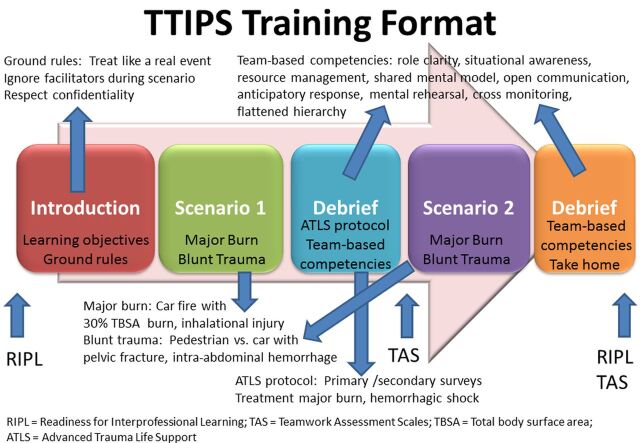
Design: A quasiexperimental, pre/postintervention comparison design was employed at an academic health sciences institution. High-fidelity simulation-based training of 42 interprofessional teams of third year surgery clerkship medical students and senior undergraduate nursing students was undertaken using a two-scenario format with immediate after action debriefing. Pre/postintervention TeamSTEPPS Teamwork Attitudes questionnaires (5 subscales, 30 items, Likert type) were given to the medical student and undergraduate nursing student classes. Pre/postsession Readiness for Inter-Professional Learning (RIPL; 19 items, Likert type) surveys and postscenario participant-rated and observer-rated Teamwork Assessment Scales (3 subscales, 11 items, Likert type) were given during each training session. Mean TeamSTEPPS Teamwork Attitudes Questionnaire, RIPL and Teamwork Assessment Scales scores were calculated; matched pre/postscore differences and trained versus non-trained TeamSTEPPS Teamwork Attitudes Questionnaire scores were compared using paired t-test or analysis of variance.
Results: Both student groups had 10 significantly improved RIPL items as well as TeamSTEPPS Teamwork Attitudes Questionnaire (TTAQ) mutual support subscales. Medical students had a significantly improved TTAQ team structure subscale. Over a simulation-based training session, each observer-rated Teamwork Assessment Scales subscale and two self-rated Teamwork Assessment Scales subscales significantly improved. Trained students had significantly higher TTAQ team structure subscales than non-trained students.
Conclusions: Interprofessional education using high-fidelity simulation-based training of students is effective at teaching teamwork, changing interprofessional attitudes and improving long-term teamwork attitudes.
Keywords: inter-professional education; simulation; surgery; teamwork; undergraduate medical education.
© Article author(s) (or their employer(s) unless otherwise stated in the text of the article) 2017. All rights reserved. No commercial use is permitted unless otherwise expressly granted.
Conflict of interest statement
Competing interests: John T. Paige: royalties from Oxford University Press as co-editor for Simulation in Radiology;research funding from Acell, Inc. (wound healing), LSU Board of Regents (software development), HRSA (inter-professional education and team training), SGEA (tool development)Deborah Garbee and Qingzhao Yu: research funding from HRSA (inter-professional education and team training) and SGEA (tool development)Vadym Rusnak: consultant Simulab, Inc., research funding LSU Board of Regents (software development).
Figures
References
-
- Bleakley A. You are who I say you are: the rhetorical construction of identity in the operating theatre. J Workplace Learn 2006;18:414–25. 10.1108/13665620610692980 - DOI
LinkOut - more resources
Full Text Sources