


Restoring Impaired Fertility Through Diet: Observations of Switching From High-Fat Diet During Puberty to Normal Diet in Adulthood Among Obese Male Mice
- PMID: 35518932
- PMCID: PMC9063411
- DOI: 10.3389/fendo.2022.839034
Restoring Impaired Fertility Through Diet: Observations of Switching From High-Fat Diet During Puberty to Normal Diet in Adulthood Among Obese Male Mice
Abstract
Background: Obesity is associated with a decrease in testicular function, yet the effects and mechanisms relative to different stages of sexual development remain unclear. The aim of this study is to determine whether high-fat diet-induced obesity impairs male fertility during puberty and in adulthood, and to ascertain its underlying mechanisms. This study aims to further reveal whether restoring to a normal diet can improve impaired fertility.
Methods: Male mice were divided into 6 groups: the group N and H exposed to a normal diet or high-fat diet during puberty. The group NN or NH were further maintained a normal diet or exposed to high-fat diet in adulthood, the group HH or HN were further maintained high-fat diet or switched to normal diet in adulthood. Metabolic parameters, fertility parameters, testicular function parameters, TUNEL staining and testicular function-related proteins were evaluated, respectively.
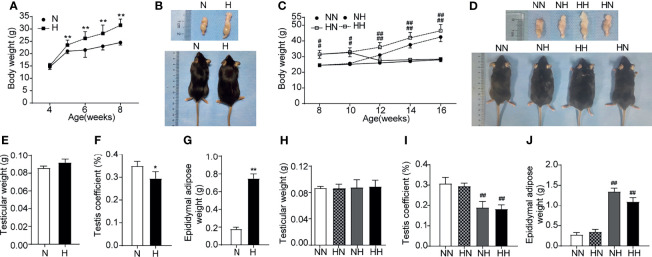
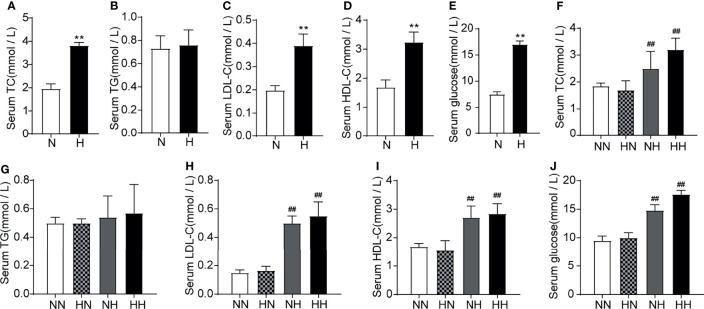
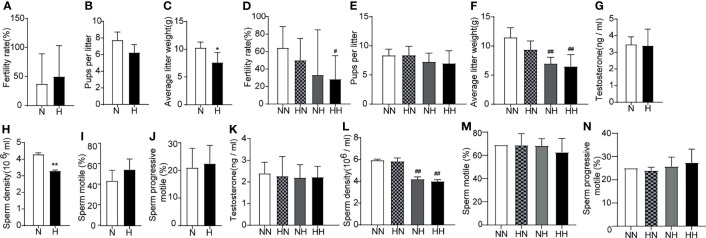
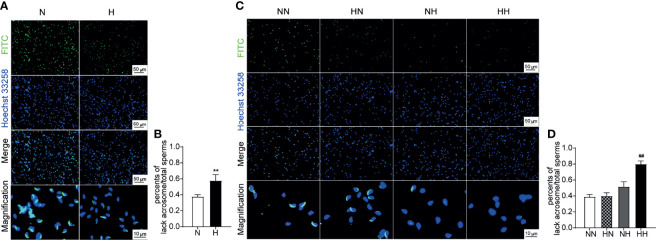
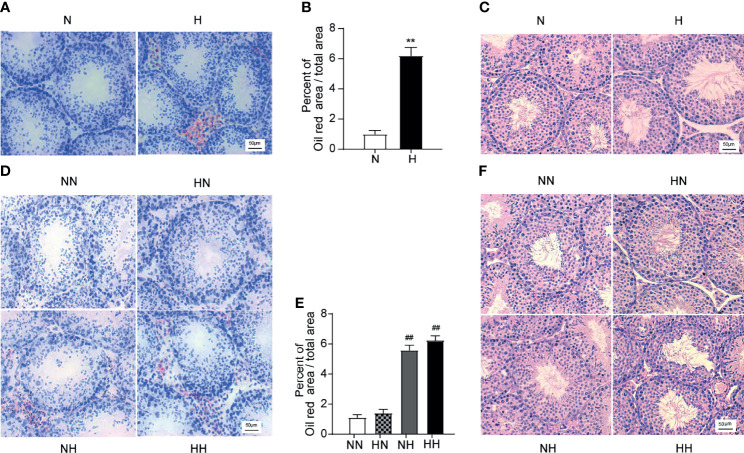
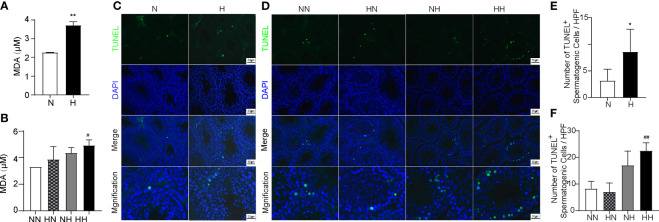
Results: The fertility of the mice in the high-fat diet group was impaired, which validated by declines in pregnancy rates and litter weight loss. Further analysis demonstrated the increased level of oxidative stress, the increased number of spermatogenic cell apoptosis and decreased number of sperm and decreased acrosome integrity. The expression of steroidogenic acute regulatory (StAR) and spermatogenesis related proteins (WT-1) decreased. Fertility among the HN group recovered, accompanied by the recovery of metabolism, fertility and testicular function parameters, StAR and WT-1 expression.
Conclusions: The findings suggest that high-fat diet-induced obesity impairs male fertility during puberty and in adulthood. The loss of acrosome integrity, the increase of oxidative stress, the increase of cells apoptosis and the down-regulation of StAR and WT-1 may be the underlying mechanisms. Switching from high-fat diets during puberty to normal diets in adulthood can improve male fertility.
Keywords: fertility; high fat diet; obesity; puberty; restoring to low fat diet; testis.
Copyright © 2022 Qi, Zhang, Sun, Luo, Guan and Yu.
Conflict of interest statement
The authors declare that the research was conducted in the absence of any commercial or financial relationships that could be construed as a potential conflict of interest.
Figures

Similar articles
-
Switching from high-fat diet to normal diet ameliorate BTB integrity and improve fertility potential in obese male mice.Sci Rep. 2023 Aug 29;13(1):14152. doi: 10.1038/s41598-023-41291-2. Sci Rep. 2023. PMID: 37644200 Free PMC article.
-
Diet-induced obesity in male C57BL/6 mice decreases fertility as a consequence of disrupted blood-testis barrier.PLoS One. 2015 Apr 17;10(4):e0120775. doi: 10.1371/journal.pone.0120775. eCollection 2015. PLoS One. 2015. PMID: 25886196 Free PMC article.
-
Diet during early life defines testicular lipid content and sperm quality in adulthood.Am J Physiol Endocrinol Metab. 2020 Dec 1;319(6):E1061-E1073. doi: 10.1152/ajpendo.00235.2020. Epub 2020 Oct 12. Am J Physiol Endocrinol Metab. 2020. PMID: 33044846
-
Exploring the impact of lipid stress on sperm cytoskeleton: insights and prospects.Nat Rev Urol. 2025 May;22(5):294-312. doi: 10.1038/s41585-024-00952-1. Epub 2024 Nov 11. Nat Rev Urol. 2025. PMID: 39528754 Review.
-
High-Fat Diet and Female Fertility.Endocrinology. 2017 Aug 1;158(8):2407-2419. doi: 10.1210/en.2017-00371. Endocrinology. 2017. PMID: 28586412 Free PMC article. Review.
Cited by
-
Zinc Improves Semen Parameters in High-Fat Diet-Induced Male Rats by Regulating the Expression of LncRNA in Testis Tissue.Biol Trace Elem Res. 2023 Oct;201(10):4793-4805. doi: 10.1007/s12011-022-03550-7. Epub 2023 Jan 5. Biol Trace Elem Res. 2023. PMID: 36600170
-
Integrated Multiomics Analyses Reveal Molecular Insights into How Intermittent Fasting Ameliorates Obesity and Increases Fertility in Male Mice.Nutrients. 2025 Mar 14;17(6):1029. doi: 10.3390/nu17061029. Nutrients. 2025. PMID: 40292466 Free PMC article.
-
Male aging in germ cells: What are we inheriting?Genet Mol Biol. 2025 Feb 18;47Suppl 1(Suppl 1):e20240052. doi: 10.1590/1678-4685-GMB-2024-0052. eCollection 2025. Genet Mol Biol. 2025. PMID: 39969160 Free PMC article.
References
MeSH terms
LinkOut - more resources
Full Text Sources
