


Lock-in functional near-infrared spectroscopy for measurement of the haemodynamic brain response
- PMID: 35519260
- PMCID: PMC9045899
- DOI: 10.1364/BOE.448038
Lock-in functional near-infrared spectroscopy for measurement of the haemodynamic brain response
Abstract
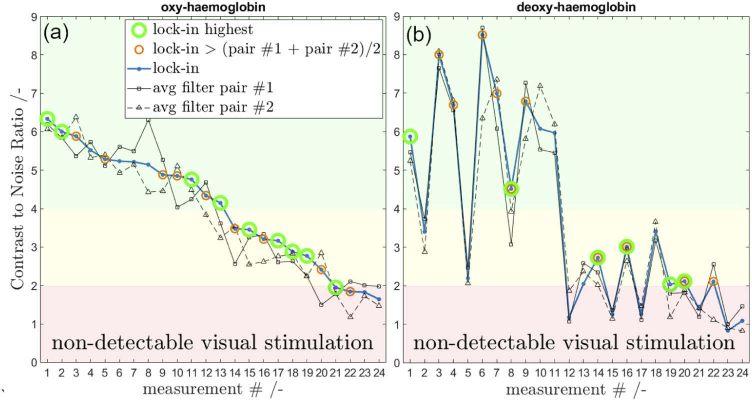
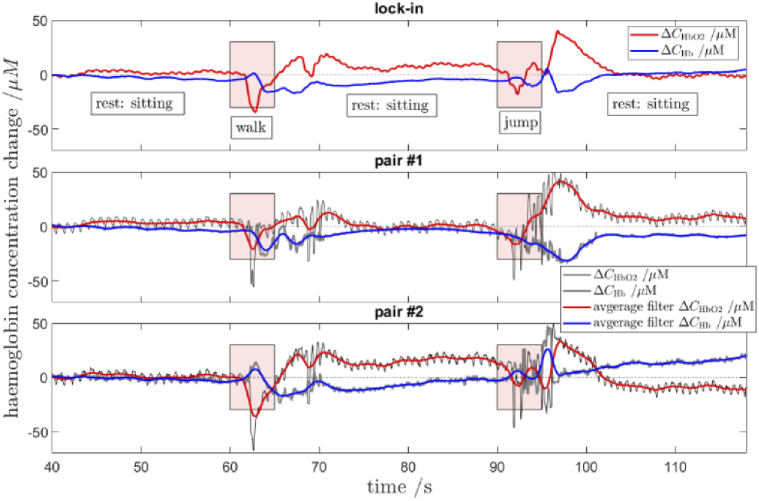
Here we show a method of the lock-in amplifying near-infrared signals originating within a human brain. It implies using two 90-degree rotated source-detector pairs fixed on a head surface. Both pairs have a joint sensitivity region located towards the brain. A direct application of the lock-in technique on both signals results in amplifying common frequency components, e.g. related to brain cortex stimulation and attenuating the rest, including all components not related to the stimulation: e.g. pulse, instrumental and biological noise or movement artefacts. This is a self-driven method as no prior assumptions are needed and the noise model is provided by the interfering signals themselves. We show the theory (classical modified Beer-Lambert law and diffuse optical tomography approaches), the algorithm implementation and tests on a finite element mathematical model and in-vivo on healthy volunteers during visual cortex stimulation. The proposed hardware and algorithm complexity suit the entire spectrum of (continuous wave, frequency domain, time-resolved) near-infrared spectroscopy systems featuring real-time, direct, robust and low-noise brain activity registration tool. As such, this can be of special interest in optical brain computer interfaces and high reliability/stability monitors of tissue oxygenation.
© 2022 Optica Publishing Group under the terms of the Optica Open Access Publishing Agreement.
Conflict of interest statement
The authors declare no conflicts of interest related to this article.
Figures


References
Associated data
LinkOut - more resources
Full Text Sources
Research Materials