


Enhanced reductive removal of ciprofloxacin in pharmaceutical wastewater using biogenic palladium nanoparticles by bubbling H2
- PMID: 35519754
- PMCID: PMC9055312
- DOI: 10.1039/d0ra03783d
Enhanced reductive removal of ciprofloxacin in pharmaceutical wastewater using biogenic palladium nanoparticles by bubbling H2
Abstract
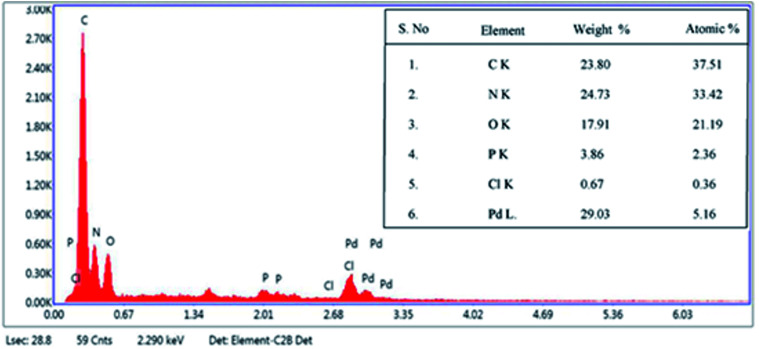
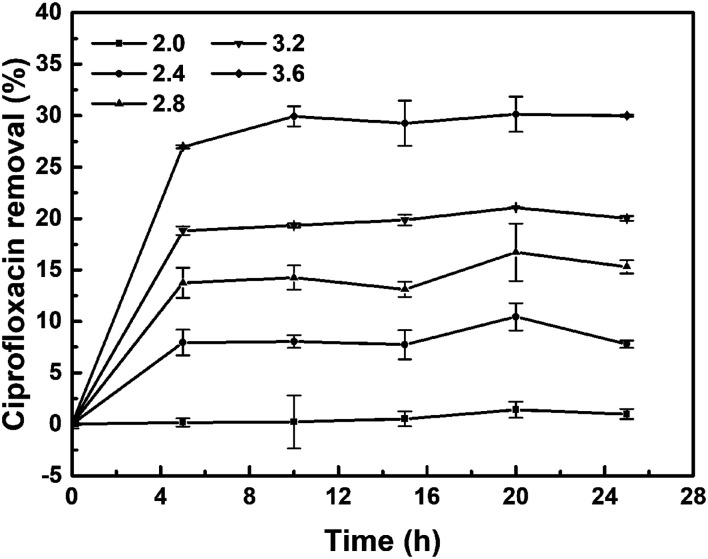
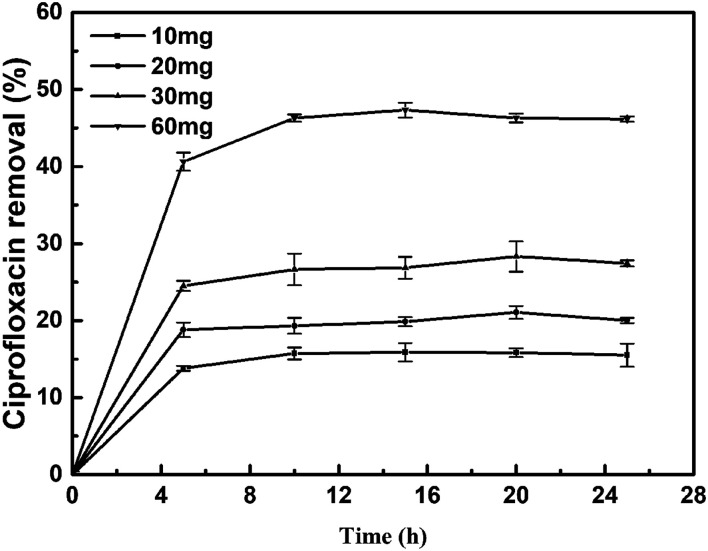
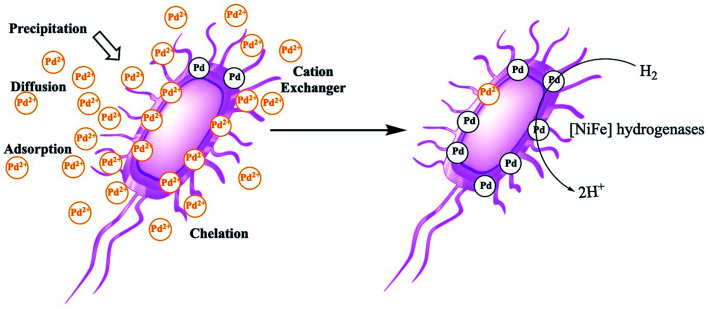
To treat waste with waste and efficiently remove the organic pollutant, waste palladiums(ii) were adsorbed and reduced on microorganism surface to catalyze the reductive removal of ciprofloxacin in pharmaceutical wastewater. By optimizing conditions such as pH and temperature, the amount of biogenic palladium adsorbed and reduced on E. coli reached 139.48 mg g-1 (Pd/microorganisms). Moreover, most of the Pd(ii) was reduced to nanometer-sized Pd(0) as characterized by TEM and SEM with EDXA. Using the obtained biogenic palladium, the reductive removal of ciprofloxacin is up to 87.70% at 25 °C, 3.03 folds of that achieved in the absence of H2. The results show that waste E. coli microorganisms can efficiently adsorb and remove waste Pd(ii) and produce Bio-Pd nanoparticle catalysts in the presence of H2. This biogenic palladium presents high catalytic activity and great advantages in the reductive degradation of ciprofloxacin. Our method can also be applied to other waste metal ions to prepare the biogenic metals, facilitate their recovery and reuse in degrading organic pollutants in wastewater to achieve "treating waste using waste".
This journal is © The Royal Society of Chemistry.
Conflict of interest statement
There are no conflicts to declare.
Figures





References
-
- Sattayarut V. Chanthad C. Khemthong P. Kuboon S. Wanchaem T. Phonyiem M. Obata M. Fujishige M. Takeuchi K. Wongwiriyapan W. Khanchaitit P. Endo M. Preparation and electrochemical performance of nitrogen-enriched activated carbon derived from silkworm pupae waste. RSC Adv. 2019;9:9878–9886. doi: 10.1039/C9RA01090D. - DOI - PMC - PubMed
-
- Noah N. F. M. Othman N. Jusoh N. Highly selective transport of palladium from electroplating wastewater using emulsion liquid membrane process. J. Taiwan Inst. Chem. Eng. 2016;64:134–141. doi: 10.1016/j.jtice.2016.03.047. - DOI
-
- Huang D. Li B. Ou J. Xue W. Li J. Li Z. Li T. Chen S. Deng R. Guo X. Megamerger of biosorbents and catalytic technologies for the removal of heavy metals from wastewater: preparation, final disposal, mechanism and influencing factors. J. Environ. Manage. 2020;261:109879. doi: 10.1016/j.jenvman.2019.109879. - DOI - PubMed
LinkOut - more resources
Full Text Sources
