


Post-acute sequelae of SARS-CoV-2 infection: relationship of central nervous system manifestations with physical disability and systemic inflammation
- PMID: 35521752
- PMCID: PMC9151630
- DOI: 10.1017/S0033291722001374
Post-acute sequelae of SARS-CoV-2 infection: relationship of central nervous system manifestations with physical disability and systemic inflammation
Erratum in
-
Post-acute sequelae of SARS-CoV-2 infection: relationship of central nervous system manifestations with physical disability and systemic inflammation - CORRIGENDUM.Psychol Med. 2022 Sep;52(12):2400. doi: 10.1017/S0033291722001799. Epub 2022 Jun 27. Psychol Med. 2022. PMID: 35757988 Free PMC article. No abstract available.
Abstract
Background: Despite the multitude of clinical manifestations of post-acute sequelae of SARS-CoV-2 infection (PASC), studies applying statistical methods to directly investigate patterns of symptom co-occurrence and their biological correlates are scarce.
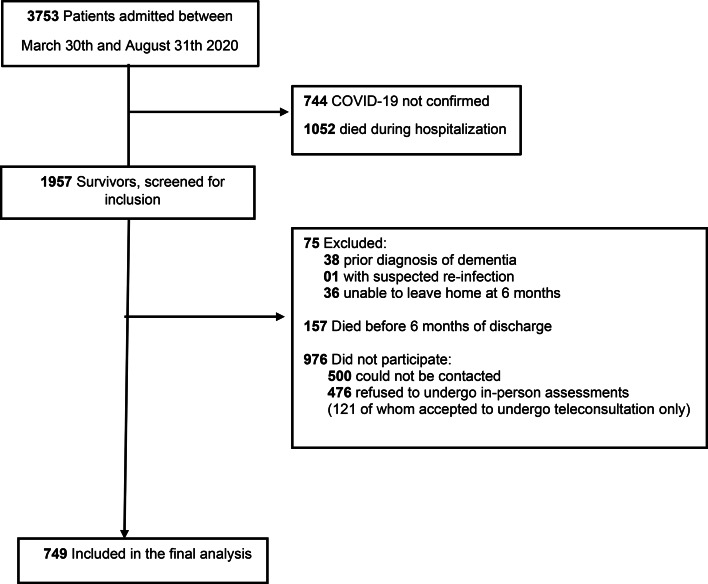
Methods: We assessed 30 symptoms pertaining to different organ systems in 749 adults (age = 55 ± 14 years; 47% female) during in-person visits conducted at 6-11 months after hospitalization due to coronavirus disease 2019 (COVID-19), including six psychiatric and cognitive manifestations. Symptom co-occurrence was initially investigated using exploratory factor analysis (EFA), and latent variable modeling was then conducted using Item Response Theory (IRT). We investigated associations of latent variable severity with objective indices of persistent physical disability, pulmonary and kidney dysfunction, and C-reactive protein and D-dimer blood levels, measured at the same follow-up assessment.
Results: The EFA extracted one factor, explaining 64.8% of variance; loadings were positive for all symptoms, and above 0.35 for 16 of them. The latent trait generated using IRT placed fatigue, psychiatric, and cognitive manifestations as the most discriminative symptoms (coefficients > 1.5, p < 0.001). Latent trait severity was associated with decreased body weight and poorer physical performance (coefficients > 0.240; p ⩽ 0.003), and elevated blood levels of C-reactive protein (coefficient = 0.378; 95% CI 0.215-0.541; p < 0.001) and D-dimer (coefficient = 0.412; 95% CI 0.123-0.702; p = 0.005). Results were similar after excluding subjects with pro-inflammatory comorbidities.
Conclusions: Different symptoms that persist for several months after moderate or severe COVID-19 may unite within one latent trait of PASC. This trait is dominated by fatigue and psychiatric symptoms, and is associated with objective signs of physical disability and persistent systemic inflammation.
Keywords: COVID-19; Chronic fatigue syndrome; long COVID; post-traumatic stress disorder.
Conflict of interest statement
Dr Ferreira received speaker fees from Medtronic, outside of the submitted work. Dr Burdmann received speaker fees from AstraZeneca and Fresenius, outside of the submitted work. Dr Guedes holds stock in Fleury Ltd., a clinical analysis lab, which is not the provider of tests for this study. The other authors have no conflicts of interest to disclose.
Figures
References
-
- Abel, K. M., Carr, M. J., Ashcroft, D. M., Chalder, T., Chew-Graham, C. A., Hope, H., … Pierce, M. (2021). Association of SARS-CoV-2 infection with psychological distress, psychotropic prescribing, fatigue, and sleep problems among UK primary care patients. JAMA Network Open, 4(11), e2134803. 10.1001/jamanetworkopen.2021.34803. - DOI - PMC - PubMed
-
- Ahmad, T., Pencina, M. J., Schulte, P. J., O'Brien, E., Whellan, D. J., Piña, I. L., … Felker, G. M. (2014). Clinical implications of chronic heart failure phenotypes defined by cluster analysis. Journal of the American College of Cardiology, 64(17), 1765–1774. 10.1016/j.jacc.2014.07.979. - DOI - PMC - PubMed
Publication types
MeSH terms
Substances
LinkOut - more resources
Full Text Sources
Medical
Research Materials
Miscellaneous
