


Single nucleotide polymorphisms located in TNFA, IL1RN, IL6R, and IL6 genes are associated with COVID-19 risk and severity in an Iranian population
- PMID: 35521908
- PMCID: PMC9347541
- DOI: 10.1002/cbin.11807
Single nucleotide polymorphisms located in TNFA, IL1RN, IL6R, and IL6 genes are associated with COVID-19 risk and severity in an Iranian population
Abstract
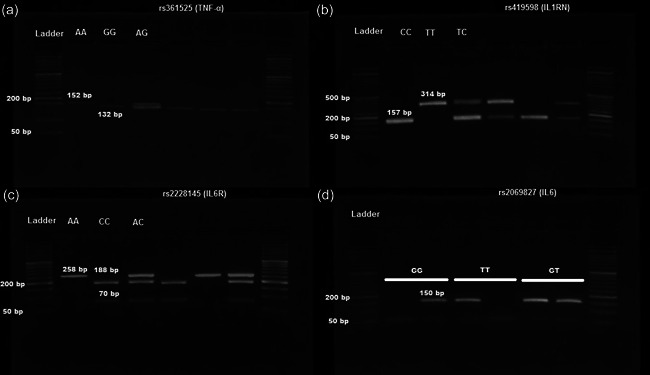
Cytokines play pivotal functions in coronavirus disease 2019 (COVID-19) pathogenesis. However, little is known about the rationale and importance of genetic variations associated with immune system responses, so-called "immunogenetic profiling." We studied whether polymorphisms of IL6, IL6R, TNFA, and IL1RN affect the disorder severity and outcome in patients infected with COVID19. We recruited 317 hospitalized patients with laboratory-confirmed COVID-19 from Bu-Ali hospital and 317 high-risk participants who had high exposure to COVID-19 patients but with a negative real-time-polymerase chain reaction (PCR) test. Multiple regression analyses were applied. We indicated that participants carrying the A allele in TNFA-rs361525, G>A (p < .004), the C allele in IL1RN-rs419598 T>C (p < .004), the A allele in IL6R-rs2228145, A>C (p = .047) are more susceptible to develop COVID-19. In contrast, those who carry the G allele of IL6-rs2069827, G>T (p = .01), are more protected from COVID-19. Also, we compared the various genotypes regarding the disorder severity and poor prognosis; we found that the AA genotype in TNFA is related to more aggressive illness and bad prognostic in contrast to the other inflammatory cytokines' genotypes. In addition, a high level of inflammatory indications, such as neutrophil-to-lymphocyte ratio and systemic immune-inflammation index, was observed in deceased patients compared with the survived subjects (p < .0001). We advised considering inflammatory cytokines polymorphisms as the main item to realize the therapeutic response against the acute respiratory distress syndrome induced by the SARS-CoV-2 virus.
Keywords: COVID-19; Clinical features; Pathogenesis; SARS-CoV-2; polymorphism; proinflammatory cytokine.
© 2022 International Federation for Cell Biology.
Conflict of interest statement
The authors declare no conflicts of interest.
Figures
References
-
- Brenner, E. J. , Ungaro, R. C. , Gearry, R. B. , Kaplan, G. G. , Kissous‐Hunt, M. , Lewis, J. D. , & Ruemmele, F. M. (2020). Corticosteroids, but not TNF antagonists, are associated with adverse COVID‐19 outcomes in patients with inflammatory bowel diseases: results from an international registry. Gastroenterology, 159(2), 481–491 .e483. - PMC - PubMed
-
- Carrol, E. D. , Payton, A. , Payne, D. , Miyajima, F. , Chaponda, M. , Mankhambo, L. A. , Banda, D. L. , Molyneux, E. M. , Cox, H. , Jacobson, G. , Carr, D. F. , Molyneux, M. E. , Stewart, J. P. , Quinn, J. P. , Hart, C. A. , & Ollier, W. E. (2011). The IL1RN promoter rs4251961 correlates with IL‐1 receptor antagonist concentrations in human infection and is differentially regulated by GATA‐1. The Journal of Immunology, 186(4), 2329–2335. - PubMed
MeSH terms
Substances
Grants and funding
LinkOut - more resources
Full Text Sources
Medical
Research Materials
Miscellaneous
