


Assessing Exposure to Unconventional Oil and Gas Development: Strengths, Challenges, and Implications for Epidemiologic Research
- PMID: 35522388
- PMCID: PMC9363472
- DOI: 10.1007/s40572-022-00358-4
Assessing Exposure to Unconventional Oil and Gas Development: Strengths, Challenges, and Implications for Epidemiologic Research
Abstract
Purpose of review: Epidemiologic studies have observed elevated health risks in populations living near unconventional oil and gas development (UOGD). In this narrative review, we discuss strengths and limitations of UOG exposure assessment approaches used in or available for epidemiologic studies, emphasizing studies of children's health outcomes.
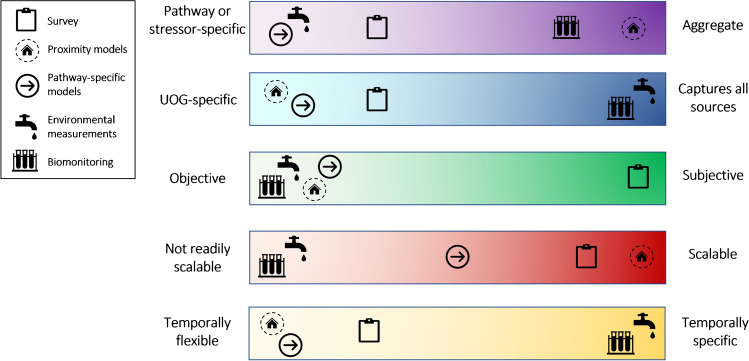
Recent findings: Exposure assessment challenges include (1) numerous potential stressors with distinct spatiotemporal patterns, (2) critical exposure windows that cover long periods and occur in the past, and (3) limited existing monitoring data coupled with the resource-intensiveness of collecting new exposure measurements to capture spatiotemporal variation. All epidemiologic studies used proximity-based models for exposure assessment as opposed to surveys, biomonitoring, or environmental measurements. Nearly all studies used aggregate (rather than pathway-specific) models, which are useful surrogates for the complex mix of potential hazards. Simple and less-specific exposure assessment approaches have benefits in terms of scalability, interpretability, and relevance to specific policy initiatives such as set-back distances. More detailed and specific models and metrics, including dispersion methods and stressor-specific models, could reduce exposure misclassification, illuminate underlying exposure pathways, and inform emission control and exposure mitigation strategies. While less practical in a large population, collection of multi-media environmental and biological exposure measurements would be feasible in cohort subsets. Such assessments are well-suited to provide insights into the presence and magnitude of exposures to UOG-related stressors in relation to spatial surrogates and to better elucidate the plausibility of observed effects in both children and adults.
Keywords: Children’s health; Epidemiologic studies; Exposure assessment; Unconventional oil and gas.
© 2022. The Author(s).
Conflict of interest statement
The authors declare no competing interests.
Figures
References
-
- US Energy Information Administration. U.S. annual estimated shale gas production. Available: https://www.eia.gov/dnav/ng/NG_ENR_SHALEGAS_A_EPG0_R5302_BCF_A.htm. Accessed August 2021.
-
- US Energy Information Administration. U.S. oil and natural gas wells by production rate. 2020. Viewable at: https://www.eia.gov/petroleum/wells/. Accessed August 2021.
-
- Hays J, Shonkoff SB. Toward an understanding of the environmental and public health impacts of unconventional natural gas development: a categorical assessment of the peer-reviewed scientific literature, 2009–2015. PLoS One. 2016;11(4):e0154164. doi: 10.1371/journal.pone.0154164. - DOI - PMC - PubMed
Publication types
MeSH terms
Grants and funding
LinkOut - more resources
Full Text Sources
Research Materials
Miscellaneous
