N-terminal alterations turn the gut hormone GLP-2 into an antagonist with gradual loss of GLP-2 receptor selectivity towards more GLP-1 receptor interaction
- PMID: 35523760
- PMCID: PMC9541843
- DOI: 10.1111/bph.15866
N-terminal alterations turn the gut hormone GLP-2 into an antagonist with gradual loss of GLP-2 receptor selectivity towards more GLP-1 receptor interaction
Abstract
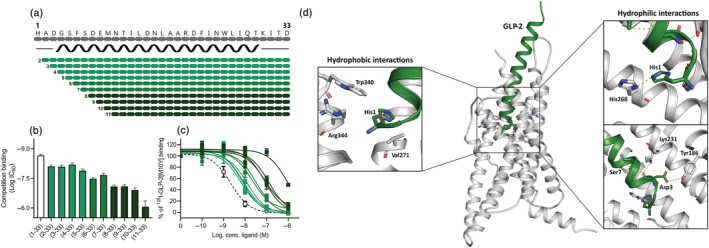
Background and purpose: To fully elucidate the regulatory role of the GLP-2 system in the gut and the bones, potent and selective GLP-2 receptor (GLP-2R) antagonists are needed. Searching for antagonist activity, we performed systematic N-terminal truncations of human GLP-2(1-33).
Experimental approach: COS-7 cells were transfected with the human GLP-2R and assessed for cAMP accumulation or competition binding using 125 I-GLP-2(1-33)[M10Y]. To examine selectivity, COS-7 cells expressing human GLP-1 or GIP receptors were assessed for cAMP accumulation.
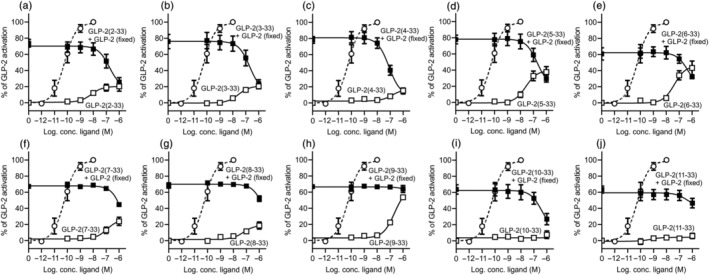
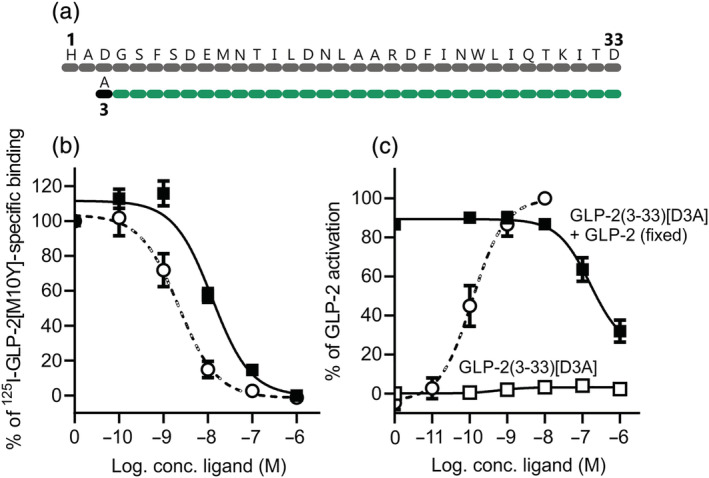
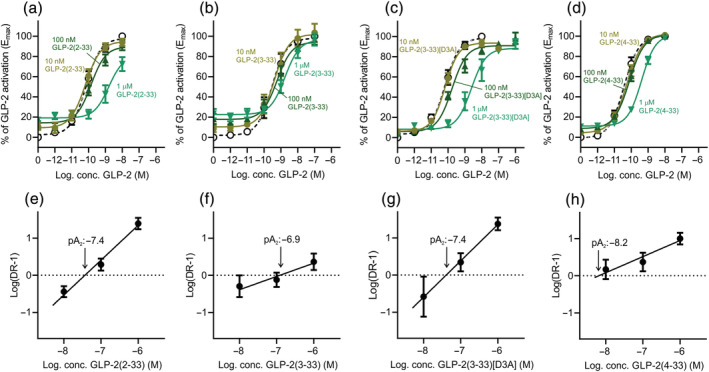
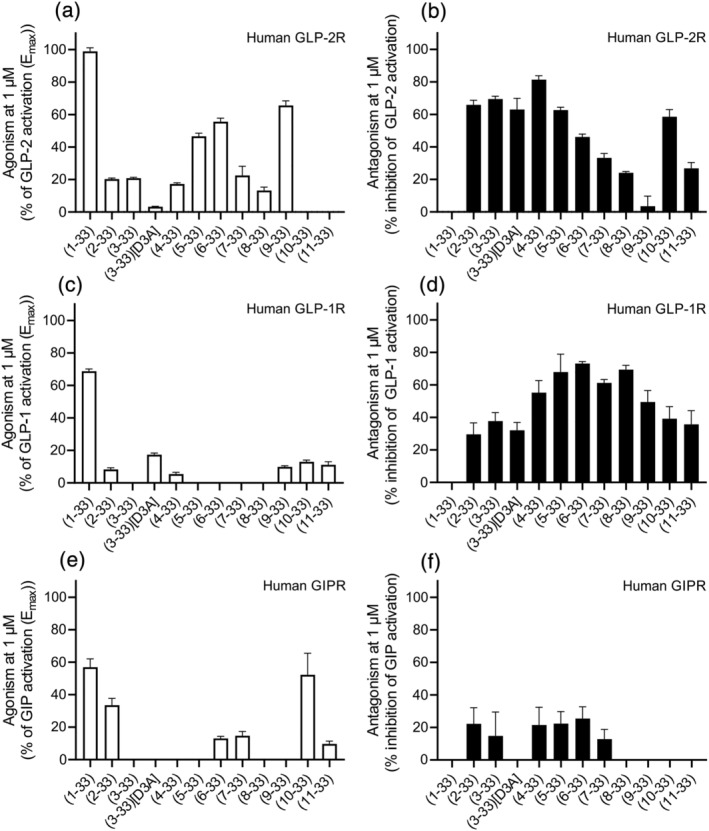
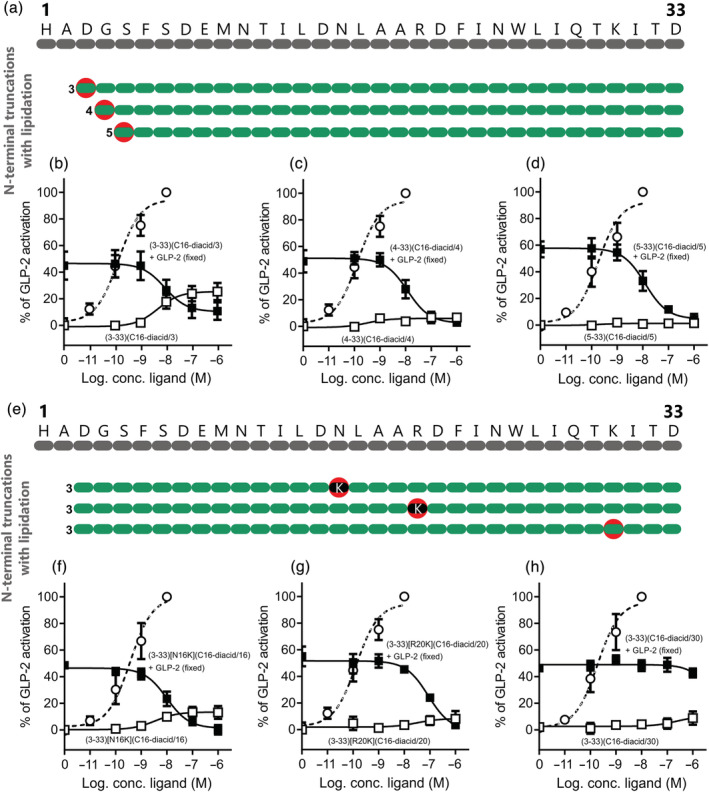
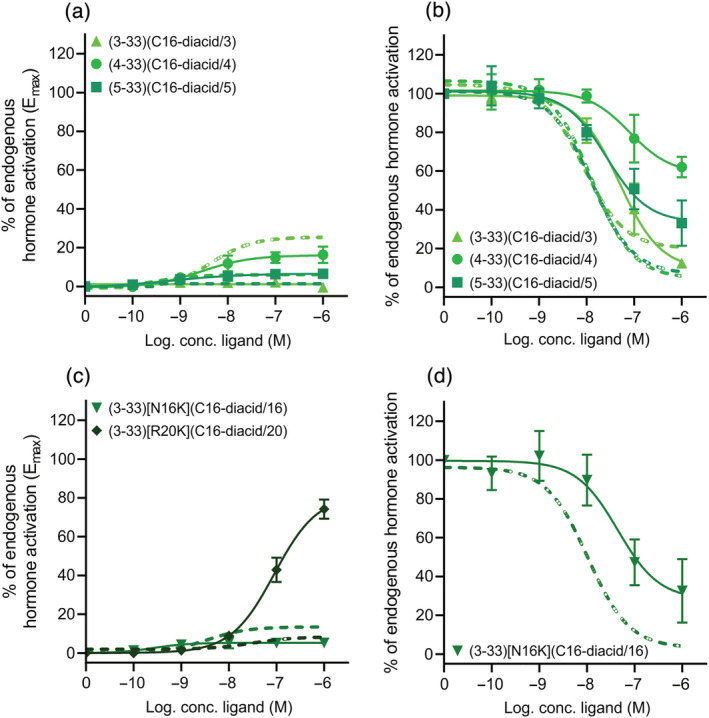
Key results: Affinity of the N-terminally truncated GLP-2 peptides for the GLP-2 receptor decreased with reduced N-terminal peptide length (Ki 6.5-871 nM), while increasing antagonism appeared with inhibitory potencies (IC50 ) values from 79 to 204 nM for truncation up to GLP-2(4-33) and then declined. In contrast, truncation-dependent increases in intrinsic activity were observed from an Emax of only 20% for GLP-(2-33) up to 46% for GLP-2(6-33) at 1 μM, followed by a decline. GLP-2(9-33) had the highest intrinsic efficacy (Emax 65%) and no antagonistic properties. Moreover, with truncations up to GLP-2(8-33), a gradual loss in selectivity for the GLP-2 receptor appeared with increasing GLP-1 receptor (GLP-1R) inhibition (up to 73% at 1 μM). Lipidation of the peptides improved antagonism (IC50 down to 7.9 nM) for both the GLP-2 and the GLP-1R.
Conclusion and implications: The N-terminus of GLP-2 is crucial for GLP-2R activity and selectivity. Our observations form the basis for the development of tool compounds for further characterization of the GLP-2 system.
Keywords: GLP-1 receptor; GLP-2; GLP-2 receptor; GPCR; N-terminus; antagonists; family B1 GPCR.
© 2022 The Authors. British Journal of Pharmacology published by John Wiley & Sons Ltd on behalf of British Pharmacological Society.
Conflict of interest statement
The authors declare that the research was conducted in the absence of any commercial or financial relationships that could be construed as a potential conflict of interest. MBNG, LSG, JJH and MMR are co‐founders of Antag Therapeutics ApS. MMR and JJH are also co‐founders of Bainan Biotech ApS.
Figures
References
-
- Alexander, S. P. , Fabbro, D. , Kelly, E. , Mathie, A. , Peters, J. A. , Veale, E. L. , Armstrong, J. F. , Faccenda, E. , Harding, S. D. , Pawson, A. J. , Southan, C. , Davies, J. A. , Boison, D. , Burns, K. E. , Dessauer, C. , Gertsch, J. , Helsby, N. A. , Izzo, A. A. , Koesling, D. , … Wong, S. S. (2021). THE CONCISE GUIDE TO PHARMACOLOGY 2021/22: Enzymes. British Journal of Pharmacology, 178(S1), S313–S411. 10.1111/bph.15542 - DOI - PubMed
-
- Alexander, S. P. H. , Christopoulos, A. , Davenport, A. P. , Kelly, E. , Mathie, A. , Peters, J. A. , Veale, E. L. , Armstrong, J. F. , Faccenda, E. , Harding, S. D. , Pawson, A. J. , Southan, C. , Davies, J. A. , Abbracchio, M. P. , Alexander, W. , al‐Hosaini, K. , Bäck, M. , Barnes, N. M. , Bathgate, R. , … Ye, R. D. (2021). THE CONCISE GUIDE TO PHARMACOLOGY 2021/22: G protein‐coupled receptors. British Journal of Pharmacology, 178(S1), S27–S156. 10.1111/bph.15538 - DOI - PubMed
-
- Askov‐Hansen, C. , Jeppesen, P. B. , Lund, P. , Hartmann, B. , Holst, J. J. , & Henriksen, D. B. (2013). Effect of glucagon‐like peptide‐2 exposure on bone resorption: Effectiveness of high concentration versus prolonged exposure. Regulatory Peptides, 181, 4–8. 10.1016/j.regpep.2012.11.002 - DOI - PubMed
Publication types
MeSH terms
Substances
LinkOut - more resources
Full Text Sources