. 2022 May 6;22(1):164.
doi: 10.1186/s12903-022-02201-6.

Prediction models for early diagnosis of actinomycotic osteomyelitis of the jaw using machine learning techniques: a preliminary study

Affiliations

Prediction models for early diagnosis of actinomycotic osteomyelitis of the jaw using machine learning techniques: a preliminary study

Sun-Gyu Choi et al. BMC Oral Health. .

Abstract

Background: This study aimed to develop and validate five machine learning models designed to predict actinomycotic osteomyelitis of the jaw. Furthermore, this study determined the relative importance of the predictive variables for actinomycotic osteomyelitis of the jaw, which are crucial for clinical decision-making.

Methods: A total of 222 patients with osteomyelitis of the jaw were analyzed, and Actinomyces were identified in 70 cases (31.5%). Logistic regression, random forest, support vector machine, artificial neural network, and extreme gradient boosting machine learning methods were used to train the models. The models were subsequently validated using testing datasets. These models were compared with each other and also with single predictors, such as age, using area under the receiver operating characteristic (ROC) curve (AUC).

Results: The AUC of the machine learning models ranged from 0.81 to 0.88. The performance of the machine learning models, such as random forest, support vector machine and extreme gradient boosting was significantly superior to that of single predictors. Presumed causes, antiresorptive agents, age, malignancy, hypertension, and rheumatoid arthritis were the six features that were identified as relevant predictors.

Conclusions: This prediction model would improve the overall patient care by enhancing prognosis counseling and informing treatment decisions for high-risk groups of actinomycotic osteomyelitis of the jaw.

Keywords: Actinomycosis; Machine learning; Osteomyelitis.


Conflict of interest statement

The authors declare that they have no competing interests.

Figures
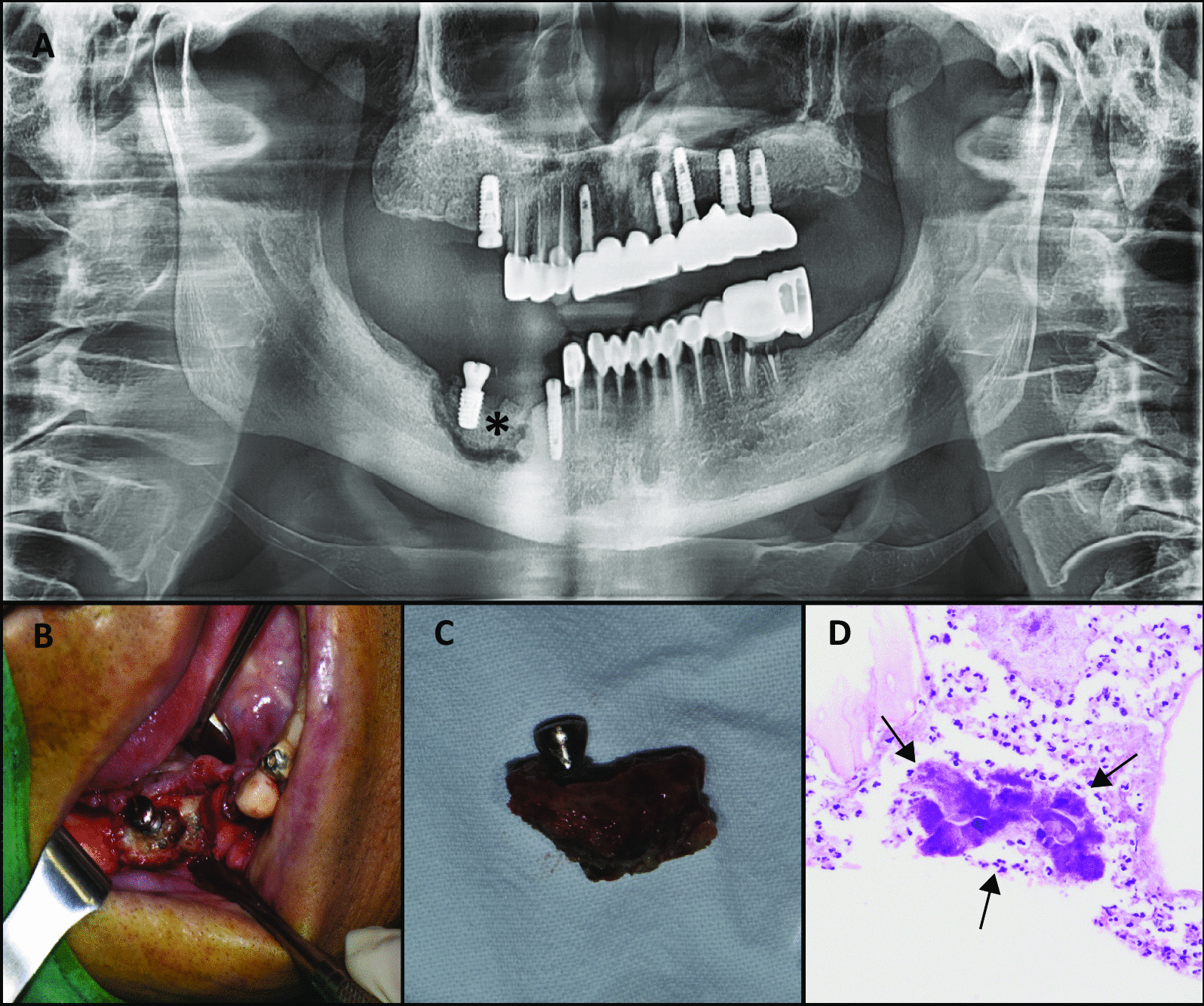
Fig. 1
Fig. 1
Representative case of actinomycotic osteomyelitis of the jaw (AOJ). a Preoperative panoramic view showing radiolucent and radiopaque areas in the right mandibular premolar region below the implant (asterisk). b Intraoperative clinical view showing sequestrum in the right mandibular premolar region. c Excised sequestrum and neighboring implant. d Histological examination showed the basophilic sulfur granule (black arrow) with radiating filament surrounded by mixed inflammatory cell infiltration (Hematoxylin–Eosin, × 400), consistent with AOJ. AOJ actinomycotic osteomyelitis of the jaw
Fig. 2
Fig. 2
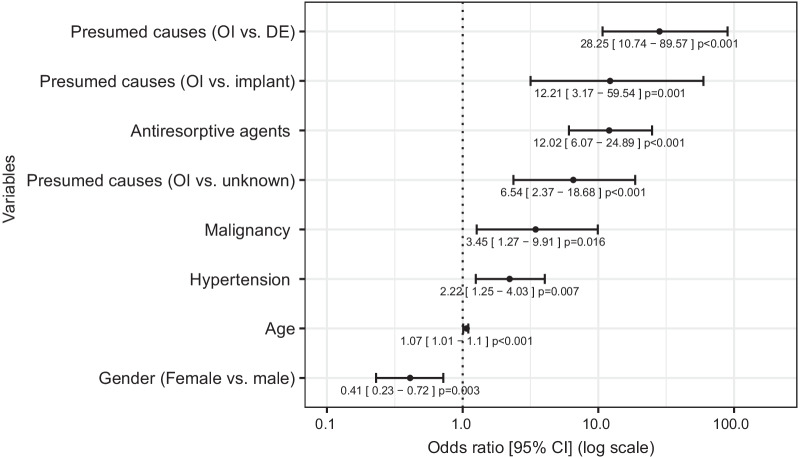
Univariate regression analysis to identify variables associated with the AOJ-positive group. Forest plots indicate the odds ratios and confidence intervals of the variables associated with the AOJ-positive group. Black dots indicate the odds ratios for the variables (p < 0.05) and error bars indicate 95% confidence intervals. AOJ actinomycotic osteomyelitis of the jaw, CI confidence interval, DE dental extraction, OI odontogenic infection
Fig. 3
Fig. 3
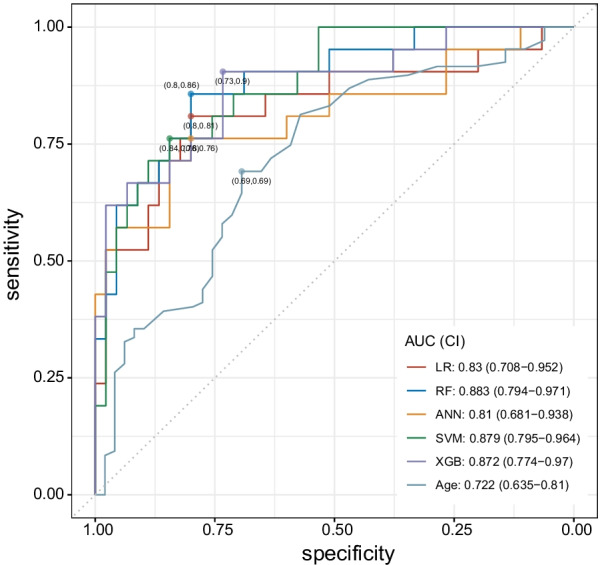
ROC curves of machine learning (ML) models and single predictor. AUC of RF, SVM, and XGB are significantly higher than single predictor (age). ANN artificial neural network, AUC area under the ROC curve, CI confidence interval, LR logistic regression, ML machine learning, RF random forest, ROC receiver operating characteristic, SVM support vector machine, XGB extreme gradient boosting
Fig. 4
Fig. 4
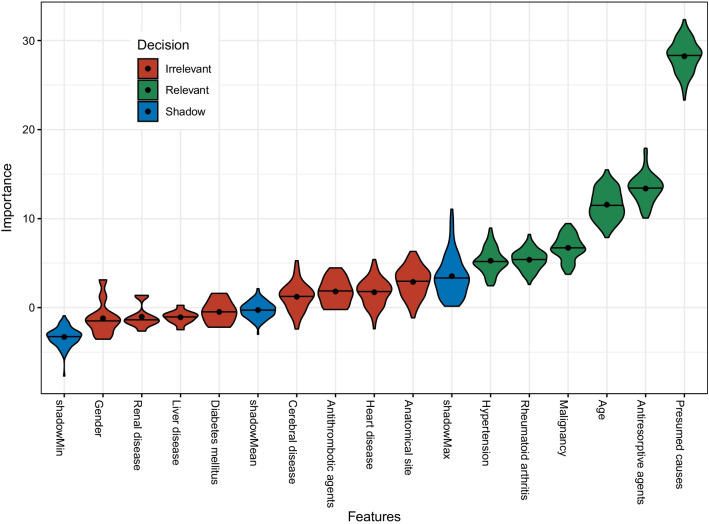
Relative feature importance computed using the Boruta algorithm. Blue violin plots correspond to the minimal, average, and maximum Z scores of a shadow attribute. Red and green violin plots represent the Z scores of the rejected and confirmed attributes, respectively. Black dots and horizontal lines inside each violin plot represent the mean and median values, respectively. All features that received a lower relative feature importance than that of the shadow feature were defined as irrelevant for prediction

References

    1. Valour F, Senechal A, Dupieux C, Karsenty J, Lustig S, Breton P, et al. Actinomycosis: etiology, clinical features, diagnosis, treatment, and management. Infect Drug Resist. 2014;7:183–197. - PMC - PubMed
    1. Nagler R, Peled M, Laufer D. Cervicofacial actinomycosis: a diagnostic challenge. Oral Surg Oral Med Oral Pathol Oral Radiol Endod. 1997;83:652–656. doi: 10.1016/S1079-2104(97)90313-9. - DOI - PubMed
    1. Miller M, Haddad AJ. Cervicofacial actinomycosis. Surg Oral Med Oral Pathol Oral Radiol Endod. 1998;85:496–508. doi: 10.1016/S1079-2104(98)90280-3. - DOI - PubMed
    1. Sezer B, Akdeniz BG, Günbay S, Hilmioğlu-Polat S, Başdemir G. Actinomycosis osteomyelitis of the jaws: report of four cases and a review of the literature. J Dent Sci. 2017;12:301–307. doi: 10.1016/j.jds.2013.02.031. - DOI - PMC - PubMed
    1. Gannepalli A, Ayinampudi BK, Baghirath PV, Reddy GV. Actinomycotic osteomyelitis of maxilla presenting as oroantral fistula: a rare case report. Case Rep Dent. 2015;2015:1–5. - PMC - PubMed

LinkOut - more resources