. 2022 May 6;22(1):182.
doi: 10.1186/s12890-022-01964-6.

Smoking related attention alteration in chronic obstructive pulmonary disease-smoking comorbidity

Affiliations

Smoking related attention alteration in chronic obstructive pulmonary disease-smoking comorbidity

Feiyan Zeng et al. BMC Pulm Med. .

Abstract

Background: Chronic obstructive pulmonary disease (COPD) is a respiratory disease that causes a wide range of cognitive impairments. Although COPD-Smoking comorbidity is common, the relationship between smoking and cognitive function in COPD-Smoking comorbidity remains unclear. This study aimed to investigate the effect of smoking on cognitive function like attention in COPD-Smoking patients.

Methods: In this study, we used the Montreal Cognitive Assessment (MoCA) scale and resting-state functional magnetic resonance imaging (fMRI) to explore the effect of smoking on attention in patients with COPD.

Results: Behavioral analysis revealed that among patients with COPD the smokers had a shorter course of COPD and showed a worse attention performance than the non-smokers. Resting-state fMRI analysis revealed that among patients with COPD smokers showed lower regional homogeneity (ReHo) value of the fusiform gyrus than non-smokers. Importantly, the ReHo of the fusiform gyrus is positively associated with attention and mediates the effect of smoking on attention in COPD.

Conclusions: In summary, our study provides behavioral and neurobiological evidence supporting the positive effect of smoking on attention in COPD. This may be helpful for understanding and treating COPD and even other diseases comorbid with smoking.

Keywords: Attention ability; Chronic obstructive pulmonary disease (COPD); Comorbidity; Functional magnetic resonance imaging (fMRI); Nicotine; Smoking.


Conflict of interest statement

All authors claim that there are no conflicts of interest.

Figures
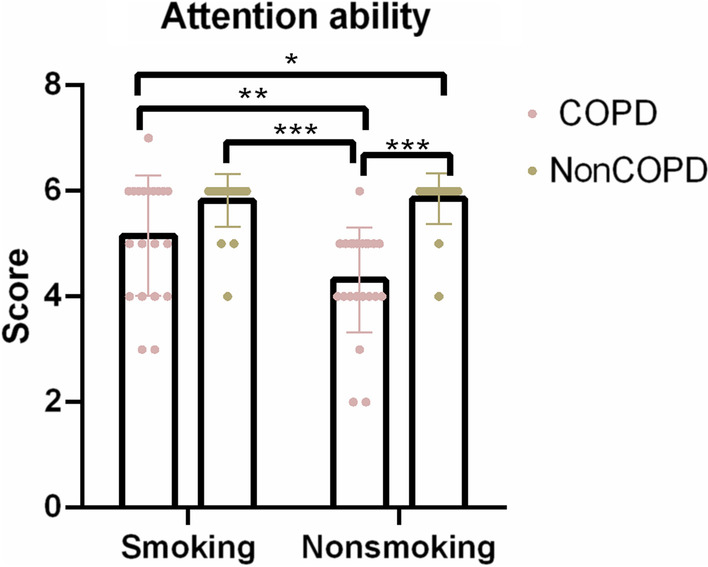
Fig. 1
Fig. 1
The attention ability scores of the four groups (COPD-Smoking/COPD-Nonsmoking/NonCOPD-Smoking/NonCOPD-NonSmoking) were compared. The p values were adjusted by Bonferroni’s correction for multiple comparisons. (*p < 0.05; **p < 0.01; ***p < 0.001)
Fig. 2
Fig. 2
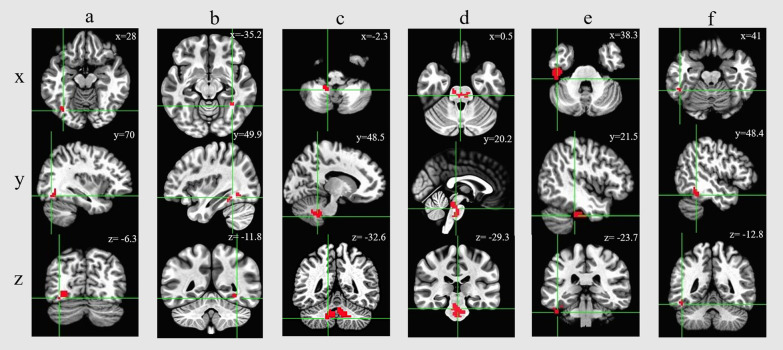
The differences in the ReHo between the COPD and NonCOPD groups are shown in axial, sagittal, and coronal sections. Six clusters were found on whole-brain T-test analysis, and the red areas indicate higher ReHo values. a Left fusiform gyrus; b Right fusiform gyrus; c Left anterior cerebellum; d Pons; e left inferior temporal gyrus (cluster-1); f Left inferior temporal gyrus (cluster-2)
Fig. 3
Fig. 3
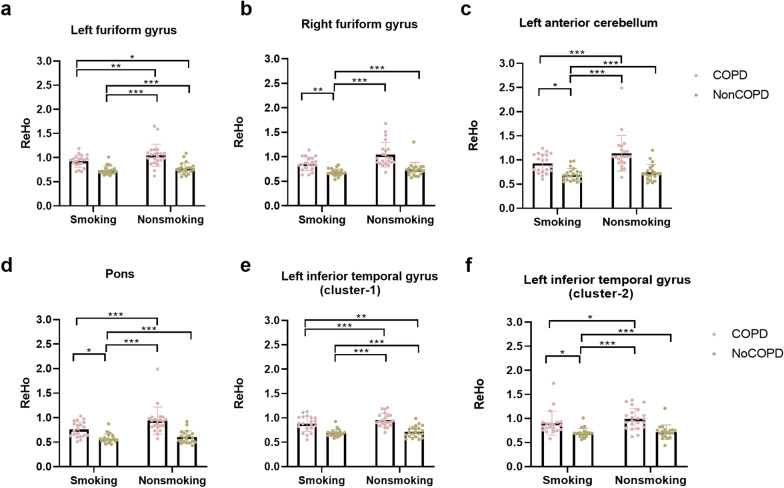
The ReHo values of the four groups (COPD-Smoking/COPD-Nonsmoking/NonCOPD-Smoking/NonCOPD-NonSmoking) were compared in six brain regions. The p values were adjusted by Bonferroni’s correction for multiple comparisons. a Left fusiform gyrus; b Right fusiform gyrus; c Left anterior cerebellum; d Pons; e Left inferior temporal gyrus (cluster-1); f Left inferior temporal gyrus (cluster-2). (*p < 0.05; **p < 0.01; ***p < 0.001)
Fig. 4
Fig. 4
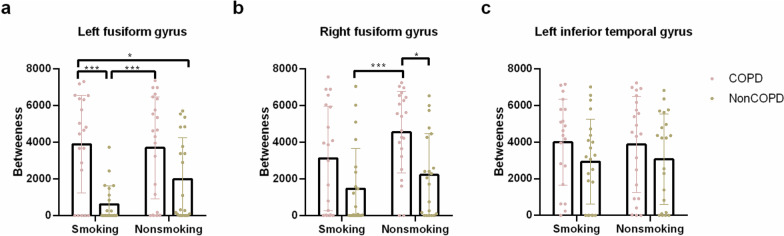
The node betweenness centrality of the four groups (COPD-Smoking/COPD-Nonsmoking/NonCOPD-Smoking/NonCOPD-NonSmoking) was compared in the a left fusiform gyrus, b right fusiform gyrus, and c left inferior temporal gyrus. The p value was corrected by Bonferroni’s multiple comparisons test. (*p < 0.05; **p < 0.01; ***p < 0.001)
Fig. 5
Fig. 5
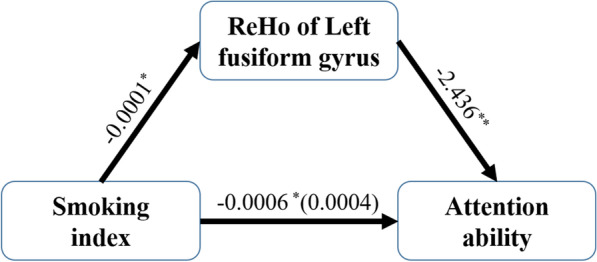
The ReHo of the left fusiform gyrus completely mediates the influence of smoking on attention ability. The regression coefficient is shown in the figure. (*p < 0.05; **p < 0.01)

References

    1. Spilling CA, et al. Contributions of cardiovascular risk and smoking to chronic obstructive pulmonary disease (COPD)-related changes in brain structure and function. Int J Chron Obstruct Pulmon Dis. 2019;14:1855–1866. doi: 10.2147/COPD.S213607. - DOI - PMC - PubMed
    1. Peiffer G, et al. COPD, anxiety-depression and cognitive disorders: Does inflammation play a major role? Rev Mal Respir. 2021;38(4):357–371. doi: 10.1016/j.rmr.2021.03.004. - DOI - PubMed
    1. Martinez CH, et al. Chronic obstructive pulmonary disease, cognitive impairment, and development of disability: the health and retirement study. Ann Am Thorac Soc. 2014;11(9):1362–1370. doi: 10.1513/AnnalsATS.201405-187OC. - DOI - PMC - PubMed
    1. Roncero C, et al. Cognitive status among patients with chronic obstructive pulmonary disease. Int J COPD. 2016;11(1):543. doi: 10.2147/COPD.S100850. - DOI - PMC - PubMed
    1. Borson S. Modeling the impact of COPD on the brain. Int J COPD, 2008;3(3). - PMC - PubMed