


Reliability of the heart rate variability threshold during treadmill exercise
- PMID: 35524470
- PMCID: PMC9320995
- DOI: 10.1111/cpf.12760
Reliability of the heart rate variability threshold during treadmill exercise
Abstract
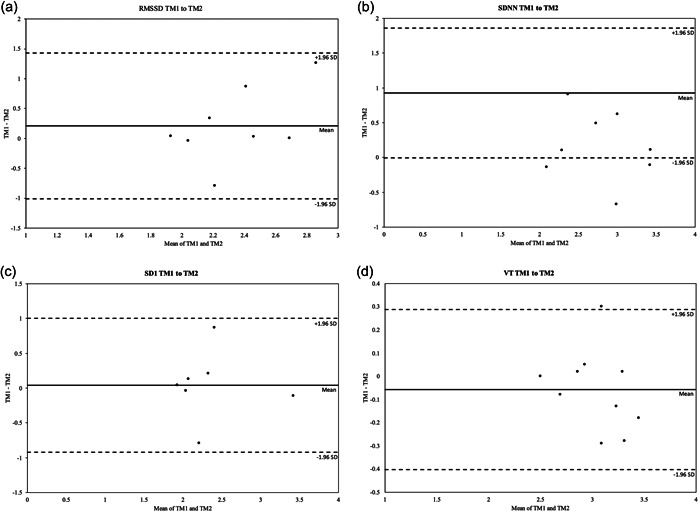
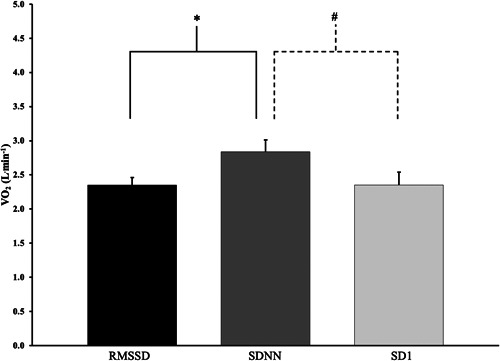
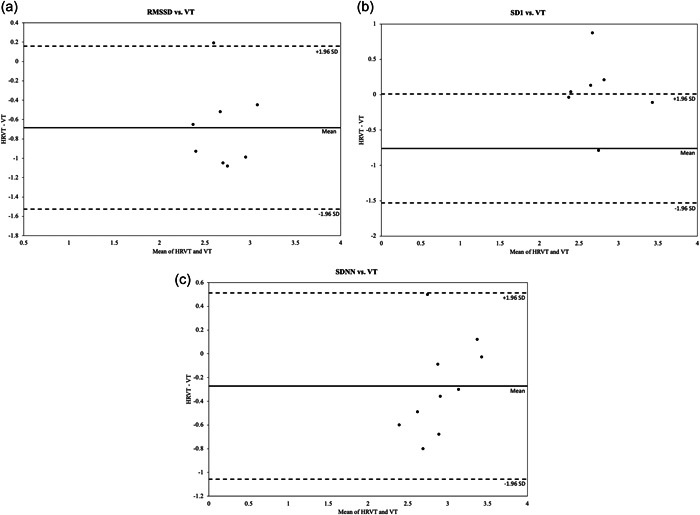
The heart rate variability threshold (HRVT) is a clinical parameter used to gain insight into autonomic balance. Prior validation of the HRVT has been with cycle ergometry, with no studies examining the viability of treadmill exercise. The purpose of this study was to examine the reliability of the HRVT during treadmill exercise, and to compare the HRVT to the ventilatory threshold (VT). Ten healthy, college-aged males completed two maximal graded exercise tests on a treadmill. A Polar RS800CX watch was used for heart rate and HRVT data. The HRVT was determined from three HRV variables including the root mean square of successive differences of continuous R-R intervals (RMSSD), the standard deviation of normal R-R intervals (SDNN) and the standard deviation of instantaneous beat intervals (SD1). A metabolic cart was utilized to determine the VT. Results showed no difference between the HRVT (2.4 ± 0.6 and 2.2 ± 0.3 for RMSSD, 2.8 ± 0.5 and 2.7 ± 0.5 for SDNN and 2.4 ± 0.6 and 2.3 ± 0.6 for SD1) or the VT (3.0 ± 0.3 and 3.1 ± 0.3) between trials. When compared to the VT, averaged HRVT values for RMSSD (2.3 ± 0.3) and SD1 (2.3 ± 0.5) were lower than averaged VT (2.8 ± 0.4, p < 0.05). The averaged HRVT from SDNN (2.8 ± 0.5) did not differ from the VT. These results suggest that treadmill is a viable mode for HRVT determination, and that HRVT determined by SDNN may be a better comparison to the VT.
Keywords: V-slope method; autonomic activity; graded exercise test; root mean square of successive differences of continuous R−R intervals; standard deviation of instantaneous beat intervals; ventilatory threshold.
© 2022 The Authors. Clinical Physiology and Functional Imaging published by John Wiley & Sons Ltd on behalf of Scandinavian Society of Clinical Physiology and Nuclear Medicine.
Conflict of interest statement
The authors declare no conflicts of interest.
Figures
References
-
- Amann, M. , Subudhi, A.W. & Foster, C. (2006) Predictive validity of ventilatory and lactate thresholds for cycling time trial performance. Scandinavian Journal of Medicine & Science in Sports, 16, 27–34. - PubMed
-
- Anosov, O. , Patzak, A. , Kononovich, Y. & Persson, P.B. (2000) High‐frequency oscillations of the heart rate during ramp load reflect the human anaerobic threshold. European Journal of Applied Physiology and Occupational Physiology, 83, 388–394. - PubMed
-
- Barbosa, M.P. , da Silva, N.T. , de Azevedo, F.M. , Pastre, C.M. & Vanderlei, L.C. (2016) Comparison of Polar(R) RS800G3 heart rate monitor with Polar(R) S810i and electrocardiogram to obtain the series of RR intervals and analysis of heart rate variability at rest. Clinical Physiology and Functional Imaging, 36, 112–117. - PubMed
-
- Beaver, W.L. , Wasserman, K. & Whipp, B.J. (1986) A new method for detecting anaerobic threshold by gas exchange. Journal of Applied Physiology (1985), 60, 2020–2027. - PubMed
-
- Candido, N. , Okuno, N.M. , da Silva, C.C. , Machado, F.A. & Nakamura, F.Y. (2015) Reliability of the heart rate variability threshold using visual inspection and Dmax methods. International Journal of Sports Medicine, 36, 1076–1080. - PubMed
