


Nearest neighbor rules for RNA helix folding thermodynamics: improved end effects
- PMID: 35524574
- PMCID: PMC9122537
- DOI: 10.1093/nar/gkac261
Nearest neighbor rules for RNA helix folding thermodynamics: improved end effects
Abstract
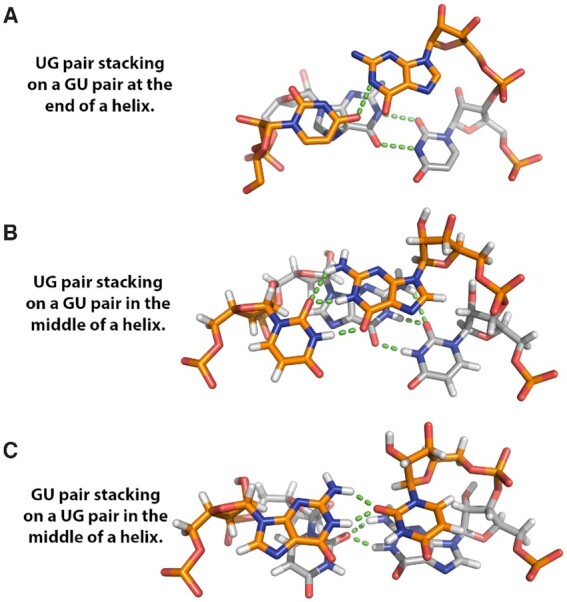
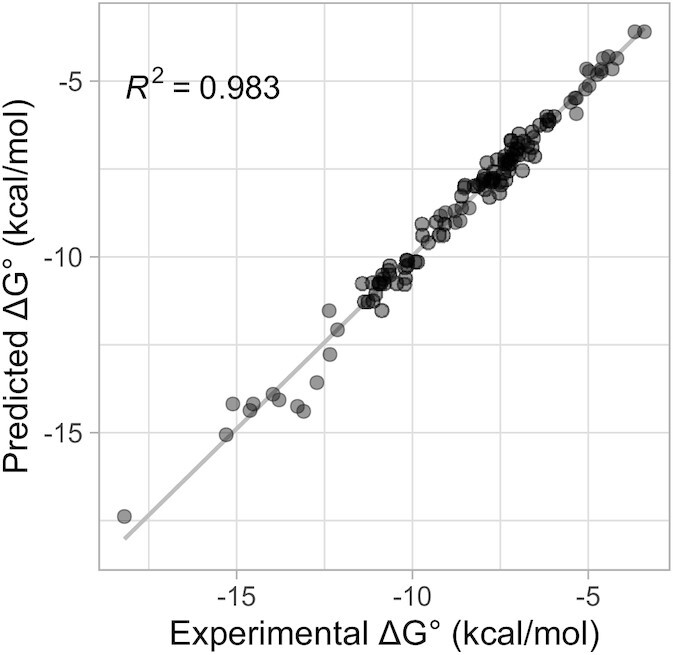
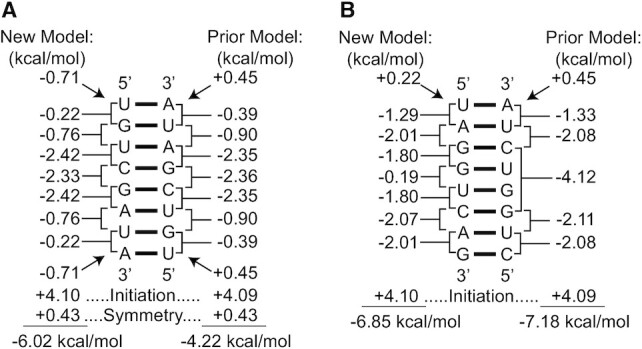
Nearest neighbor parameters for estimating the folding stability of RNA secondary structures are in widespread use. For helices, current parameters penalize terminal AU base pairs relative to terminal GC base pairs. We curated an expanded database of helix stabilities determined by optical melting experiments. Analysis of the updated database shows that terminal penalties depend on the sequence identity of the adjacent penultimate base pair. New nearest neighbor parameters that include this additional sequence dependence accurately predict the measured values of 271 helices in an updated database with a correlation coefficient of 0.982. This refined understanding of helix ends facilitates fitting terms for base pair stacks with GU pairs. Prior parameter sets treated 5'GGUC3' paired to 3'CUGG5' separately from other 5'GU3'/3'UG5' stacks. The improved understanding of helix end stability, however, makes the separate treatment unnecessary. Introduction of the additional terms was tested with three optical melting experiments. The average absolute difference between measured and predicted free energy changes at 37°C for these three duplexes containing terminal adjacent AU and GU pairs improved from 1.38 to 0.27 kcal/mol. This confirms the need for the additional sequence dependence in the model.
© The Author(s) 2022. Published by Oxford University Press on behalf of Nucleic Acids Research.
Figures
References
Publication types
MeSH terms
Substances
Grants and funding
LinkOut - more resources
Full Text Sources
Miscellaneous
