. 2022 Jun 21;48(4):860-870.
doi: 10.1093/schbul/sbac017.

The Important Role of Motivation and Pleasure Deficits on Social Functioning in Patients With Schizophrenia: A Network Analysis

Affiliations

The Important Role of Motivation and Pleasure Deficits on Social Functioning in Patients With Schizophrenia: A Network Analysis

Hui-Xin Hu et al. Schizophr Bull. .

Abstract

Negative symptoms, particularly the motivation and pleasure (MAP) deficits, are associated with impaired social functioning in patients with schizophrenia (SCZ). However, previous studies seldom examined the role of the MAP on social functioning while accounting for the complex interplay between other psychopathology. This network analysis study examined the network structure and interrelationship between negative symptoms (at the "symptom-dimension" and "symptom-item" levels), other psychopathology and social functioning in a sample of 269 patients with SCZ. The psychopathological symptoms were assessed using the Clinical Assessment Interview for Negative Symptoms (CAINS) and the Positive and Negative Syndrome Scale (PANSS). Social functioning was evaluated using the Social and Occupational Functioning Assessment Scale (SOFAS). Centrality indices and relative importance of each node were estimated. The network structures between male and female participants were compared. Our resultant networks at both the "symptom-dimension" and the "symptom-item" levels suggested that the MAP factor/its individual items were closely related to social functioning in SCZ patients, after controlling for the complex interplay between other nodes. Relative importance analysis showed that MAP factor accounted for the largest proportion of variance of social functioning. This study is among the few which used network analysis and the CAINS to examine the interrelationship between negative symptoms and social functioning. Our findings supported the pivotal role of the MAP factor to determine SCZ patients' social functioning, and as a potential intervention target for improving functional outcomes of SCZ.

Keywords: motivation and pleasure dimension; negative symptoms; network analysis; schizophrenia; social functioning.


Figures

Fig. 1.
Fig. 1.
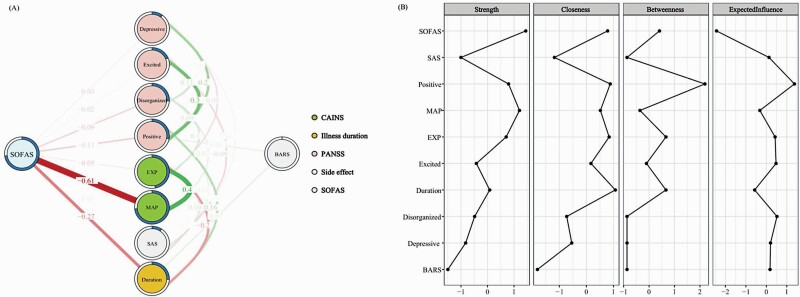
(A) Regularized partial correlation flow network of social functioning, negative symptoms, other psychopathology and illness-related variables at the “symptom-dimension” level in SCZ patients (N = 269). Each node represents a variable. Each edge represents the partial correlation between two nodes controlled for all other nodes. The value of each edge represents the strength of the correlations. Green edges (for the online version) or positive edge values (for the print version) represent positive associations, whereas red edges (for the online version) or negative edge values (for the print version) represent negative associations. Thicker edges (positive and negative) signify stronger partial correlations. The pie chart surrounding each node represents node predictability. The value of each edge represents the strength of the correlations. (B) The standardized centrality estimates of the network in SCZ patients.Note: SCZ, schizophrenia; SOFAS, the Social and Occupational Functioning Assessment Scale; CAINS, the Clinical Assessment Interview for Negative Symptoms; MAP, Motivation and Pleasure factor of the CAINS; EXP, Expressivity factor of the CAINS; PANSS, the Positive and Negative Syndrome Scale; SAS, the Simpson-Angus Extrapyramidal Side Effects Scale; BARS, the Barnes Akathisia Rating Scale.
Fig. 2.
Fig. 2.
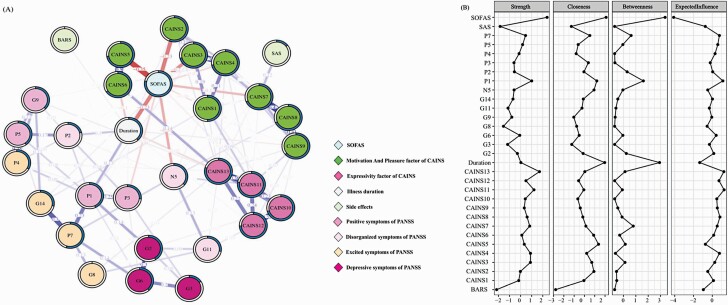
(A) Regularized Partial Correlation Network of social functioning, negative symptoms, other psychopathology and illness-related variables at the “symptom-item” level in SCZ patients (N = 269). Each node represents a variable. The value of each edge represents the strength of the correlations. Each edge represents the partial correlation between two nodes controlled for all other nodes. Blue edges (for the online version) or positive edge values (for the print version) represent positive associations, whereas red edges (for the online version) or negative edge values (for the print version) represent negative associations. Thicker edges (positive and negative) signify stronger partial correlations. The pie chart surrounding each node represents node predictability. The value of each edge represents the strength of the correlations. (B) The standardized centrality estimates of the network in SCZ patients.Note: SCZ, schizophrenia; SOFAS, the Social and Occupational Functioning Assessment Scale; CAINS, the Clinical Assessment Interview for Negative Symptoms; SAS, the Simpson-Angus Extrapyramidal Side Effects Scale; BARS, the Barnes Akathisia Rating Scale; PANSS, the Positive and Negative Syndrome Scale.

References

    1. Carpenter WT, Buchanan RW. Schizophrenia. New Engl J Med. 1994;330(10):681–690. - PubMed
    1. Kirkpatrick B, Fenton WS, Carpenter WT, Marder SR. The NIMH-MATRICS consensus statement on negative symptoms. Schizophr Bull. 2006;32(2):214–219. - PMC - PubMed
    1. Blanchard JJ, Cohen AS. The structure of negative symptoms within schizophrenia: implications for assessment. Schizophr Bull. 2006;32(2):238–245. - PMC - PubMed
    1. Messinger JW, Trémeau F, Antonius D, et al. . Avolition and expressive deficits capture negative symptom phenomenology: Implications for DSM-5 and schizophrenia research. Clin Psychol Rev. 2011;31(1):161–168. - PMC - PubMed
    1. Strauss GP, Ahmed AO, Young JW, Kirkpatrick B. Reconsidering the latent structure of negative symptoms in schizophrenia: a review of evidence supporting the 5 consensus domains. Schizophr Bull. 2019;45(4):725–729. - PMC - PubMed

Publication types