


Toward more efficient ergothioneine production using the fungal ergothioneine biosynthetic pathway
- PMID: 35525939
- PMCID: PMC9077841
- DOI: 10.1186/s12934-022-01807-3
Toward more efficient ergothioneine production using the fungal ergothioneine biosynthetic pathway
Abstract
Background: Ergothioneine (ERG) is a potent histidine-derived antioxidant that confers health-promoting effects. Only certain bacteria and fungi can biosynthesize ERG, but the ERG productivity in natural producers is low. ERG overproduction through genetic engineering represents an efficient and cost-effective manufacturing strategy.
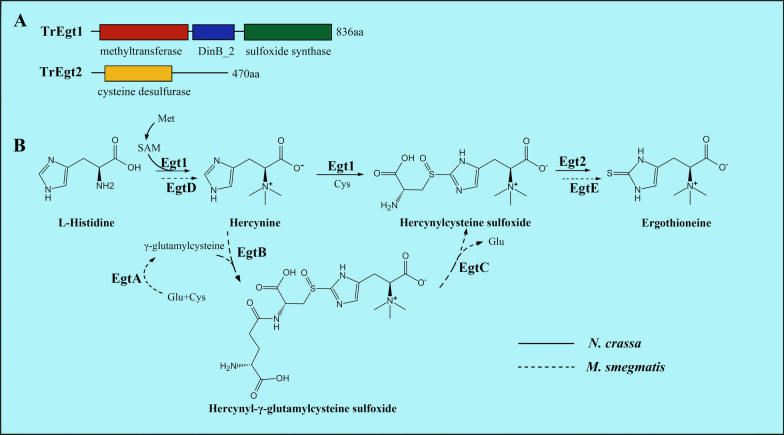
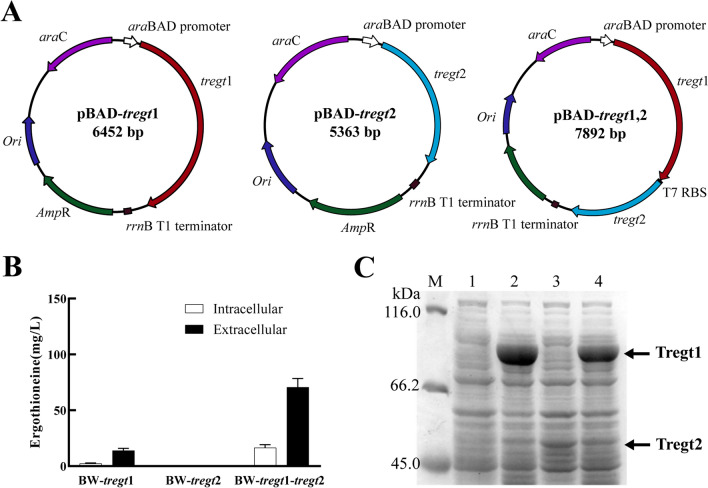
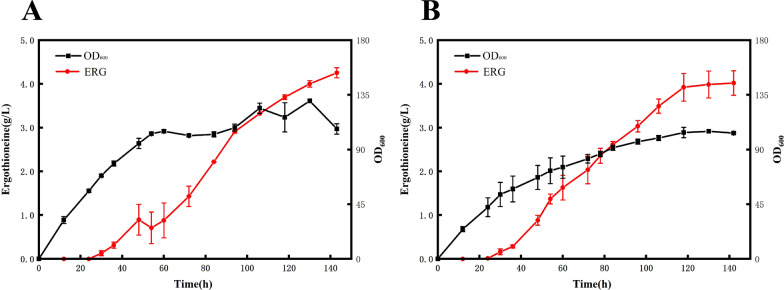
Results: Here, we showed that Trichoderma reesei can synthesize ERG during conidiogenesis and hyphal growth. Co-expression of two ERG biosynthesis genes (tregt1 and tregt2) from T. reesei enabled E. coli to generate 70.59 mg/L ERG at the shaking flask level after 48 h of whole-cell biocatalysis, whereas minor amounts of ERG were synthesized by the recombinant E. coli strain bearing only the tregt1 gene. By fed-batch fermentation, the extracellular ERG production reached 4.34 g/L after 143 h of cultivation in a 2-L jar fermenter, which is the highest level of ERG production reported thus far. Similarly, ERG synthesis also occurred in the E. coli strain engineered with the two well-characterized genes from N. crassa and the ERG productivity was up to 4.22 g/L after 143 h of cultivation under the above-mentioned conditions.
Conclusions: Our results showed that the overproduction of ERG in E. coli could be achieved through two-enzymatic steps, demonstrating high efficiency of the fungal ERG biosynthetic pathway. Meanwhile, this work offers a more promising approach for the industrial production of ERG.
Keywords: Biosynthesis; Ergothioneine; Escherichia coli; Heterologous expression; Neurospora crassa; Trichoderma reesei.
© 2022. The Author(s).
Conflict of interest statement
The authors declare that they have no competing interests.
Figures

References
-
- Franzoni F, Colognato R, Galetta F, Laurenza I, Barsotti M, Di Stefano R, Bocchetti R, Regoli F, Carpi A, Balbarini A, et al. An in vitro study on the free radical scavenging capacity of ergothioneine: comparison with reduced glutathione, uric acid and trolox. Biomed Pharmacother. 2006;60:453–457. doi: 10.1016/j.biopha.2006.07.015. - DOI - PubMed
-
- D'Onofrio N, Servillo L, Giovane A, Casale R, Vitiello M, Marfella R, Paolisso G, Balestrieri ML. Ergothioneine oxidation in the protection against high-glucose induced endothelial senescence: Involvement of SIRT1 and SIRT6. Free Radic Biol Med. 2016;96:211–222. doi: 10.1016/j.freeradbiomed.2016.04.013. - DOI - PubMed
MeSH terms
Substances
Grants and funding
- 30970073/the National Natural Science Foundation of China
- 30970073/the National Natural Science Foundation of China
- 30970073/the National Natural Science Foundation of China
- DY135-B2-02/the Program of China Ocean Mineral Resources R&D Association
- DY135-B2-02/the Program of China Ocean Mineral Resources R&D Association
LinkOut - more resources
Full Text Sources
Other Literature Sources
