


Beyond the clinical context: the process of losing oneself living with Huntington's disease
- PMID: 35526033
- PMCID: PMC9077866
- DOI: 10.1186/s13023-022-02330-9
Beyond the clinical context: the process of losing oneself living with Huntington's disease
Abstract
Background: People with Huntington's disease (HD) have increased functional and cognitive dependence. While numerous clinical, genetic, and therapeutic management studies have been carried out, few studies have investigated the disease from the personal experience and the context of people living with HD. To better serve these patients, our purpose is to understand, from the perspective of the patient and their families, how people with HD cope with their daily lives outside the clinical setting.
Methods: Thirty-three affected or at-risk people participated in this study. Participants were interviewed at their homes on distinct occasions during a family visit. We analyzed the data using Grounded Theory, which allowed us to understand how people live with the disease on their own terms.
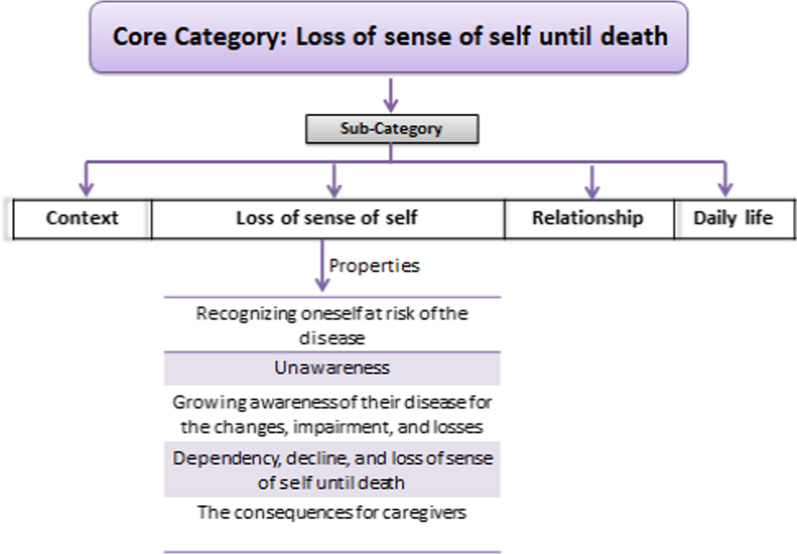
Results: Living with HD is a process that begins with acceptance or denial that one is at risk for the disease or, growing awareness of the condition due to motor, behavioral, and cognitive changes, and, finally, loss of autonomy with physical dependence on another person, and loss of sense of self and family.
Conclusion: While the daily life of patients before disease onset was characterized by physical and mental/cognitive independence, with HD they become increasingly trapped in their bodies, and their complications are due to the lack of effective curable therapy.
Keywords: Grounded theory; Loss of autonomy; Loss of sense of self; Neurodegenerative condition; Physical dependence on another person.
© 2022. The Author(s).
Conflict of interest statement
The authors declare that they have no competing interests.
Figures
References
-
- Caron NS, Wright GEB, Hayden MR. Huntington disease. 1998 Oct 23 [Updated 2020 Jun 11]. In: Adam MP, Ardinger HH, Pagon RA, et al., editors. GeneReviews®. University of Washington, Seattle; 1993–2021. https://www.ncbi.nlm.nih.gov/books/NBK1305/.
Publication types
MeSH terms
LinkOut - more resources
Full Text Sources
Medical
