Review
. 2022 May 8;7(1):11.
doi: 10.1186/s41181-022-00163-2.

Potential PET tracers for imaging of tumor-associated macrophages

Affiliations
Review

Potential PET tracers for imaging of tumor-associated macrophages

Bruna Fernandes et al. EJNMMI Radiopharm Chem. .

Abstract

The increasing incidence of cancer over the years is one of the most challenging problems in healthcare. As cancer progresses, the recruitment of several immune cells is triggered. Infiltration of tumor-associated macrophages (TAMs) is correlated with poor patient prognosis. Since TAMs constitute a big portion of the tumor mass, targeting these cells seems to be an attractive approach for cancer immunotherapy. Additionally, TAM assessment using non-invasive imaging techniques, such as positron emission tomography (PET), might provide a better understanding of the role of TAMs in cancer, and a means for tumor profile characterization, patient selection for individualized immunotherapy and treatment monitoring. Imaging of TAMs using PET tracers is still in its infancy. TAMs have several characteristics that could be exploited as potential targets for imaging. Various PET tracers for these TAM biomarkers have been developed, although often in the context of (neuro)inflammatory diseases rather than cancer. Since macrophages in inflammatory diseases express similar biomarkers as TAMs, these PET tracers could potentially also be applied for the assessment of TAMs in the tumor microenvironment. Therefore, the present review provides an overview of the TAM biomarkers, for which potential PET tracers are available and discusses the status of these tracers.

Keywords: M1-like; M2-like; PET imaging; Tumor microenvironment; Tumor-associated macrophages.


Conflict of interest statement

The authors declare that they have no competing interests.

Figures

Fig. 1
Fig. 1
The main biomarkers expressed by TAM phenotypes, for which PET tracers are available. For each biomarker, the available PET tracers are indicated. CSF-1R: colony stimulating factor 1 receptor; CD: cluster of differentiation; CCR2: C–C chemokine receptor type 2; FR: folate receptor; Arg1: arginase 1; IL: interleukin; TNF-α: tumoral necrose factor α; TGF-β: transforming growth factor β
Fig. 2
Fig. 2
Structures of representative receptor ligands of the CSF-1R. The positions of the CSF-1R ligands that have been radiolabeled and evaluated as candidate PET tracers are highlighted in red. CSF-1R: colony stimulating factor 1 receptor
Fig. 3
Fig. 3
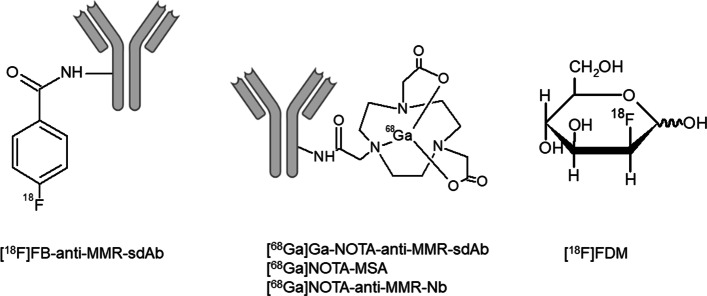
Structures of representative candidate tracers for the CD206 receptor
Fig. 4
Fig. 4
Representative in vivo PET/CT images of [64Cu]Cu@CuOx-ECL1i. Images of [64Cu]Cu@CuOx-ECL1i in KPPC mice, KPPC mice with 50-fold blocking dose, and [64Cu]Cu@CuOx-NT in KPPC mice were performed at 24 h post injection (yellow arrow: pancreas/pancreatic tumor). Reprinted (adapted) with permission from X. Zang et al. ACS Nano 2021 (Zhang et al. 2021). Copyright © 2021 American Chemical Society
Fig. 5
Fig. 5
Structures of representative candidate tracers for FRβ. FRβ: folate receptor β
Fig. 6
Fig. 6
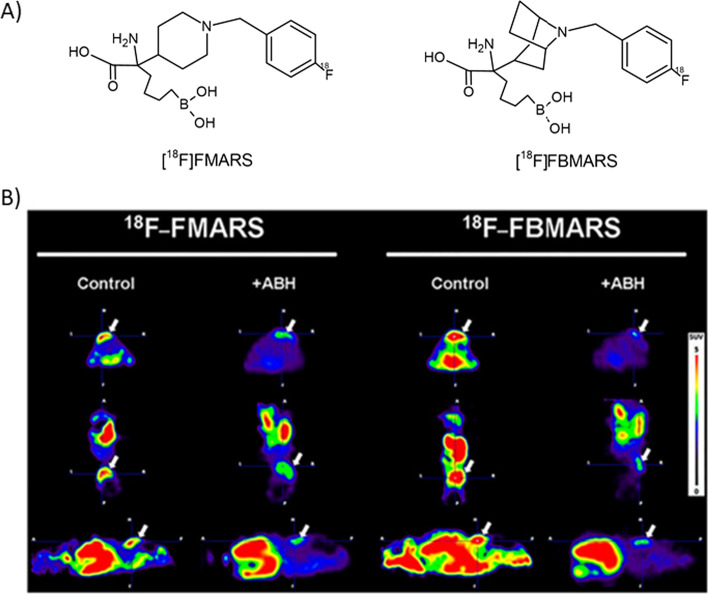
Structures (a) and PET images (b) of representative candidate tracers for arginase. PET images at 40–90 min post injections of [18F]FMARS and [18F]FBMARS in PC3 tumor (arrows; axial, coronal, and sagittal views from top to bottom) of mice without (control) and with coinjection of ABH (5 mM). ABH: (2(S)-amino-6-boronohexanoic acid. This research was originally published in JNM. G.S. Clemente, et al. J. Nucl. Med. 2021 (Clemente et al. 2021). Copyright © 2021 by the Society of Nuclear Medicine and Molecular Imaging

References

    1. Biodistribution, tumor detection, and radiation dosimentry of [18F]-AZAFOL as positron emission tomography (PET) tracer in folate receptor positive cancer imaging. 2017 [cited 28 Jul 2021]. https://clinicaltrials.gov/ct2/show/NCT03242993.
    1. Baggiolini M. Chemokines and leukocyte traffic. Nature. 1998;392(6676):565–568. doi: 10.1038/33340. - DOI - PubMed
    1. Bigalke B, et al. PET/CT and MR imaging biomarker of lipid-rich plaques using [64Cu]-labeled scavenger receptor (CD68-Fc) Int J Cardiol. 2014;177(1):287–291. doi: 10.1016/j.ijcard.2014.09.017. - DOI - PubMed
    1. Blykers A, et al. PET imaging of macrophage mannose receptor–expressing macrophages in tumor stroma using 18F-radiolabeled camelid single-domain antibody fragments. J Nucl Med. 2015;56(8):1265–1271. doi: 10.2967/jnumed.115.156828. - DOI - PubMed
    1. Boss SD, et al. Reduced 18F-folate conjugates as a new class of PET tracers for folate receptor imaging. Bioconj Chem. 2018;29(4):1119–1130. doi: 10.1021/acs.bioconjchem.7b00775. - DOI - PubMed

LinkOut - more resources