


Validation and comparison of fall screening tools for predicting future falls among older adults
- PMID: 35526339
- PMCID: PMC10543920
- DOI: 10.1016/j.archger.2022.104713
Validation and comparison of fall screening tools for predicting future falls among older adults
Abstract
Background: Falls are the leading cause of injuries among older adults in the United States (US). Falls are preventable and clinicians are advised to screen for fall risk yearly. There are many falls screening tools and not all have been validated for their ability to predict future falls.
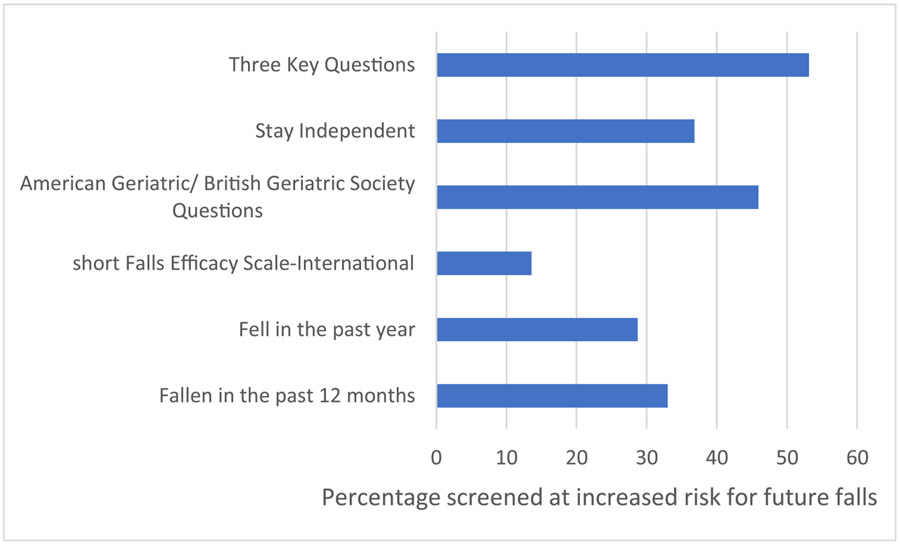
Methods: We enrolled 1905 community-dwelling older adults into a 13-month study using a probability-based representative panel of the US population recruited from NORC at the University of Chicago's National Frame. Respondents completed a baseline survey, 11 monthly fall calendars, and a final survey. The baseline survey included six falls screening tools (the Stay Independent, Three Key Questions (3KQ), a modified American Geriatric/British Geriatric tool, the short Falls Efficacy-1[FES-I]) and two single screening questions ("I have fallen in the past year" and "How many times did you fall in the past 12 months?"). The baseline and final survey collected demographic and health information, including falls. Sensitivity, specificity, positive and negative likelihood ratios, and corresponding 95% confidence intervals were calculated in SAS using weighted proportions.
Results: There were 1563 respondents who completed the final survey (completion rate 82%). Sensitivity estimates ranged from 22.5% for the short FES-I to 68.7% for the 3KQ. Specificity estimates ranged from 57.9% for the 3KQ to 89.4% for the short FES-I.
Conclusions: Falls screening tools have varying sensitivity and specificity for predicting the occurrence of a fall in the following 12 months.
Keywords: Accidental falls; Older adults; Screen; Sensitivity and specificity.
Copyright © 2022. Published by Elsevier B.V.
Conflict of interest statement
Declaration of Competing Interest
None of the authors have relevant financial interests, activities, relationships, or affiliations, or other potential conflicts of interest to report.
Figures
References
-
- Ambrose AF, Paul G, & Hausdorff JM (2013). Risk factors for falls among older adults: A review of the literature. Maturitas, 75(1), 51–61. - PubMed
-
- American Geriatrics Society. (2001). British geriatrics society, and american academy of orthopaedic surgeons panel on falls prevention. Guideline for the prevention of falls in older persons. Journal of the American Geriatrics Society, 49(5), 664–672. - PubMed
-
- Bergen G, Stevens MR, & Burns ER (2016). Falls and fall injuries among adults aged ≥65 years - United States, 2014. MMWR Morbidity and Mortality Weekly Report, 65(37), 993–998. - PubMed
Publication types
MeSH terms
Grants and funding
LinkOut - more resources
Full Text Sources
Medical
Miscellaneous
