[Proteomics of serum exosomes in children in the acute stage of Kawasaki disease: a prospective study]
- PMID: 35527414
- PMCID: PMC9044997
- DOI: 10.7499/j.issn.1008-8830.2110110
[Proteomics of serum exosomes in children in the acute stage of Kawasaki disease: a prospective study]
Abstract
Objectives: To study the biological processes and functions of serum exosomes in children in the acute stage of Kawasaki disease (KD), so as to provide new biomarkers for the early diagnosis of KD.
Methods: In this prospective study, 13 children with KD who were treated in Children's Hospital of Soochow University from June 2019 to August 2020 were enrolled as the KD group, and 13 children who were hospitalized due to bacterial infection during the same period were enrolled as the control group. Whole blood was collected on the next morning after admission, serum samples were obtained by centrifugation, and exosomes were extracted through ultracentrifugation. Serum exosomes were analyzed by label-free quantitative proteomics, and differentially expressed proteins (DEPs) were screened out for functional enrichment analysis. A protein-protein interaction (PPI) network was plotted, and unique proteins were validated by targeted proteomics.
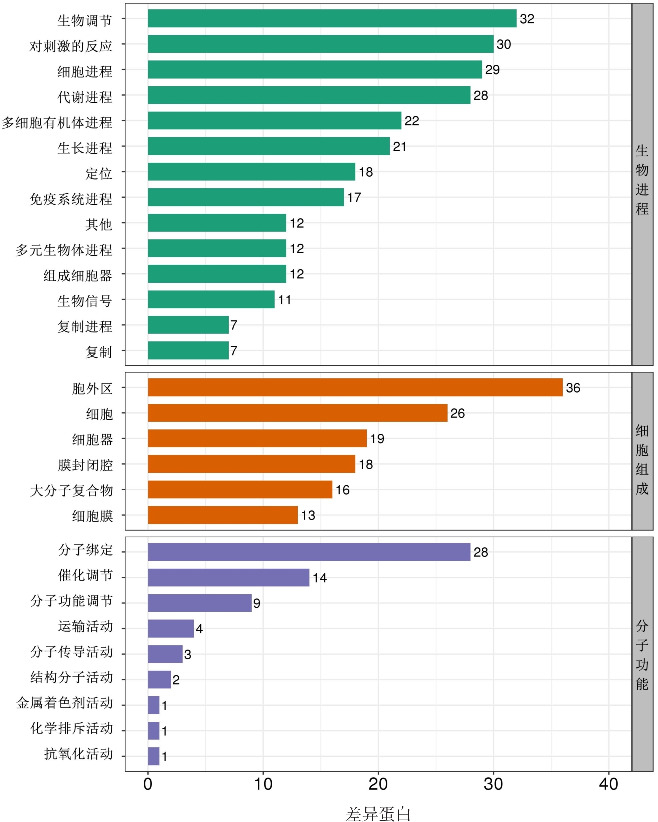
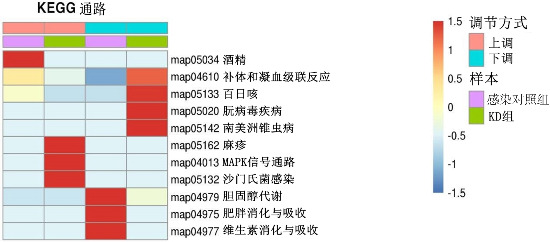
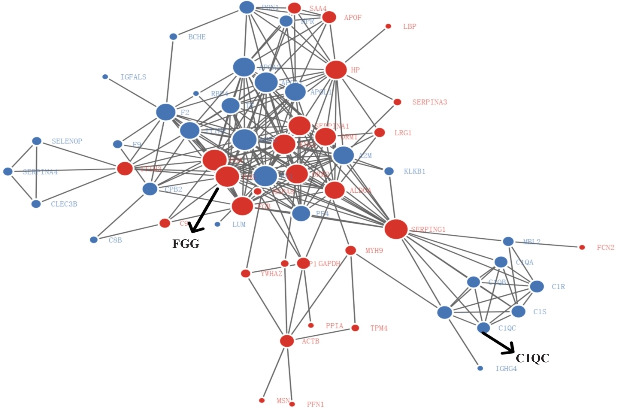
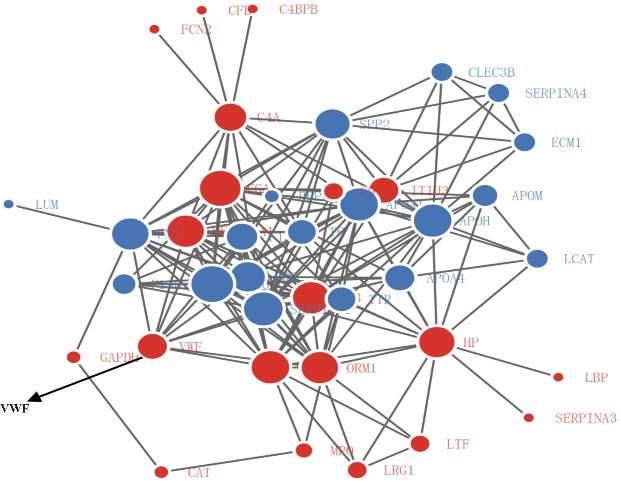
Results: A total of 131 DEPs were screened out for the two groups, among which 27 proteins were detected in both groups. There were 48 unique DEPs in the KD group, among which 23 were upregulated and 25 were downregulated, and these proteins acted on "complement and coagulation cascades" and "the MAPK signaling pathway". Validation by targeted proteomics showed that FGG, SERPING1, C1R, C1QA, IGHG4, and C1QC proteins were quantifiable in the KD group. A total of 29 proteins were only expressed in the control group, among which 12 were upregulated and 17 were downregulated. Four proteins were quantifiable based on targeted proteomics, i.e., VWF, ECM1, F13A1, and TTR. A PPI network was plotted for each group. In the KD group, FGG and C1QC had close interaction with other proteins, while in the control group, VWF had close interaction with other proteins.
Conclusions: The serum exosomes FGG and C1QC in children in the acute stage of KD are expected to become the biomarkers for the early diagnosis of KD. For children with unexplained fever, detection of FGG, C1QC1, and VWF may help with etiological screening.
目的: 筛选急性期川崎病(Kawasaki disease,KD)患儿血清外泌体蛋白,分析其生物学过程及功能,以期为早期临床诊断KD提供新的生物标志物。方法: 前瞻性选取2019年6月至2020年8月于苏州大学附属儿童医院治疗的KD患儿(n=13)纳入KD组;同期选取因细菌感染入该院治疗的患儿(n=13)纳入感染对照组。采集两组患儿入院次日清晨空腹全血,离心后获得血清标本,超高速离心提取外泌体,采用非标记定量蛋白质组学技术对血清外泌体蛋白进行分析,筛选差异蛋白并进行功能富集分析,绘制蛋白质互作网络图像,通过靶向蛋白组学技术验证特有蛋白。结果: 两组共筛选出131种差异蛋白,其中27种蛋白为两组共有。48种蛋白为KD组特有,其中上调蛋白23种,下调蛋白25种。这些蛋白作用于补体和凝血级联、MAPK信号通路。靶向蛋白质组学技术验证显示,KD组中FGG、SERPING1、C1R、C1QA、IGHG4、C1QC蛋白可定量。29种蛋白仅在感染对照组中表达,其中上调蛋白12种,下调蛋白17种。感染对照组中通过靶向蛋白质组学技术验证可定量4种蛋白,分别为VWF、ECM1、F13A1、TTR。两组分别绘制蛋白质互作网络图像,KD组中FGG及C1QC与其他蛋白互作关系紧密;感染对照组中VWF与其他蛋白互作关系紧密。结论: 急性期KD患儿血清外泌体蛋白FGG及C1QC有望作为早期诊断KD的新的生物标志物。对于不明原因发热的患儿,检测蛋白FGG、C1QC及VWF可能有助于病因筛查。.
Keywords: Biomarker; Child; Kawasaki disease; Proteomics; Serum exosome.
Figures
Similar articles
-
New biomarkers of Kawasaki disease identified by urine proteomic analysis.FEBS Open Bio. 2018 Dec 20;9(2):265-275. doi: 10.1002/2211-5463.12563. eCollection 2019 Feb. FEBS Open Bio. 2018. PMID: 30761252 Free PMC article.
-
Proteomics study of serum exosomes in Kawasaki disease patients with coronary artery aneurysms.Cardiol J. 2019;26(5):584-593. doi: 10.5603/CJ.a2018.0032. Epub 2018 Apr 3. Cardiol J. 2019. PMID: 29611167 Free PMC article.
-
Plasma Exosomal-Derived SERPINA1 and GNAI2 Downregulation as Potential Diagnostic Biomarkers of Kawasaki Disease with Coronary Artery Aneurysms.Int J Mol Sci. 2025 Mar 16;26(6):2668. doi: 10.3390/ijms26062668. Int J Mol Sci. 2025. PMID: 40141310 Free PMC article.
-
Proteomics approach for biomarker discovery in Kawasaki disease.Expert Rev Clin Immunol. 2024 Dec;20(12):1449-1460. doi: 10.1080/1744666X.2024.2383236. Epub 2024 Aug 2. Expert Rev Clin Immunol. 2024. PMID: 39041312 Review.
-
Upcoming biomarkers for the diagnosis of Kawasaki disease: A review.Clin Biochem. 2015 Nov;48(16-17):1188-94. doi: 10.1016/j.clinbiochem.2015.02.013. Epub 2015 Mar 4. Clin Biochem. 2015. PMID: 25749557 Review.
References
MeSH terms
Substances
LinkOut - more resources
Full Text Sources
Medical
Research Materials
Miscellaneous