


Serological Surveillance of the H1N1 and H3N2 Swine Influenza A Virus in Chinese Swine between 2016 and 2021
- PMID: 35528158
- PMCID: PMC9071888
- DOI: 10.1155/2022/5833769
Serological Surveillance of the H1N1 and H3N2 Swine Influenza A Virus in Chinese Swine between 2016 and 2021
Abstract
Background: Swine influenza A virus (IAV-S) is a common cause of respiratory disease in pigs and poses a major public health threat. However, little attention and funding have been given to such studies. The aim of this study was to assess the prevalence of the Eurasian avian-like H1N1 (EA H1N1), 2009 pandemic H1N1 (pdm/09 H1N1), and H3N2 subtype antibodies in unvaccinated swine populations through serological investigations. Such data are helpful in understanding the prevalence of the IAV-S.
Methods: A total of 40,343 serum samples from 17 regions in China were examined using hemagglutination inhibition (HI) tests against EA H1N1, pdm/09 H1N1, and H3N2 IAV-S from 2016 to 2021. The results were analyzed based on a reginal distribution, seasonal distribution, and in different breeding stages.
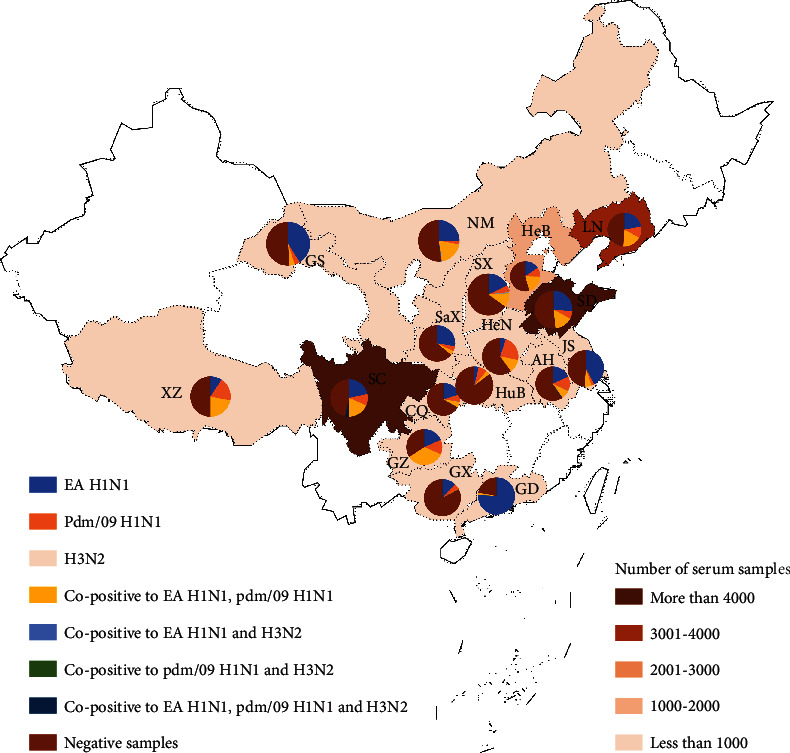
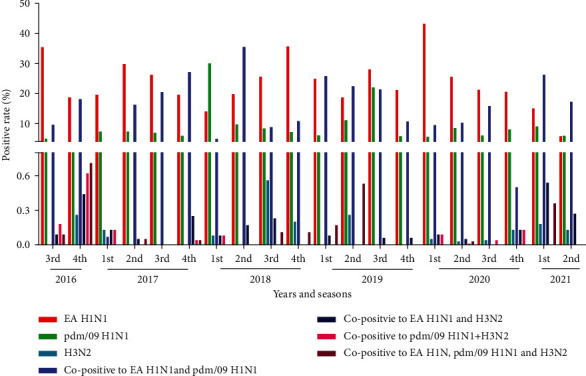
Results: A total of 19,682 serum samples out of the 40,343 were positive for IAV-S (48.79%). The positivity rates to the EA H1N1 subtype, pdm/09 H1N1 subtype, and H3N2 subtype were 24.75% (9,986/40,343), 7.94% (3,205/40,343), and 0.06% (24/40,343), respectively. The occurrences of coinfections from two or more subtypes were also detected. In general, the positivity rates of serum samples were related to the regional distribution and feeding stages.
Conclusions: The results of this study showed that the anti-EA H1N1 subtype and pdm/09 H1N1 subtype antibodies were readily detected in swine serum samples. The EA H1N1 subtype has become dominant in the pig population. The occurrences of coinfections from two or more subtypes afforded opportunities for their reassortment to produce new viruses. Our findings emphasized the need for continuous surveillance of influenza viruses.
Copyright © 2022 Yuzhong Zhao et al.
Conflict of interest statement
The authors declare that they have no competing interests.
Figures
References
-
- Jo S. K., Kim H. S., Cho S. W., Seo S. H. Pathogenesis and inflammatory responses of swine H1N2 influenza viruses in pigs. Virus Research . 2007;129(1):64–70. - PubMed
MeSH terms
LinkOut - more resources
Full Text Sources
Medical
