Editorial
. 2022 Mar 7;32(2):523-528.
doi: 10.1007/s40670-022-01525-w. eCollection 2022 Apr.

A Competency-Guided Approach to Optimizing a Physician-Scientist Curriculum

Affiliations
Editorial

A Competency-Guided Approach to Optimizing a Physician-Scientist Curriculum

Lourdes Estrada et al. Med Sci Educ. .

Abstract

Physician-scientists are uniquely positioned to achieve significant biomedical advances to improve the human condition. Their clinical and scientific training allows them to bridge fields and contribute to cutting-edge, clinically relevant research. The need for a highly skilled physician-scientist workforce has never been more acute. We propose a competency-guided program design (CGPD) framework that focuses on core skills to enhance the physician-scientist training curriculum. In partnership with clinical and graduate curricula, the CGPD framework can be employed as a tool to meaningfully integrate physician-scientist training, address barriers to attract and sustain the physician-scientist workforce, and avoid overprogramming that detracts from a solid foundation of clinical and graduate research training.


Conflict of interest statement

Conflict of InterestThe authors declare no competing interests.

Figures
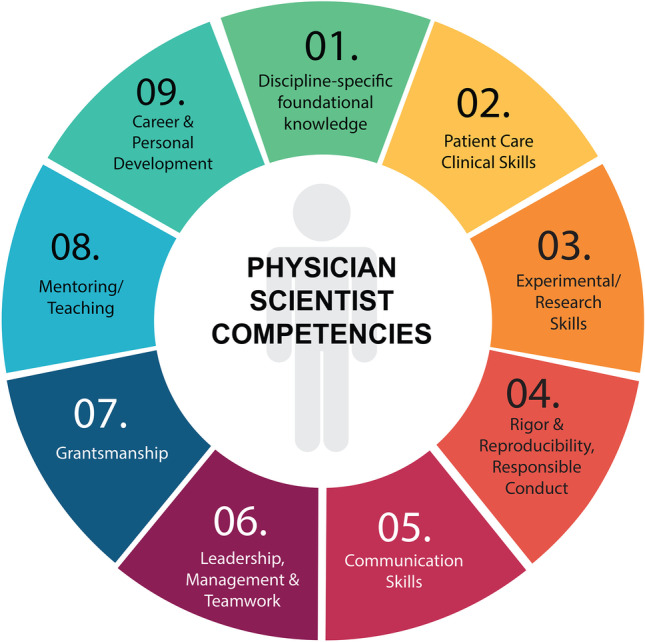
Fig. 1
Fig. 1
Proposed nine core competencies for physician-scientists
Fig. 2
Fig. 2
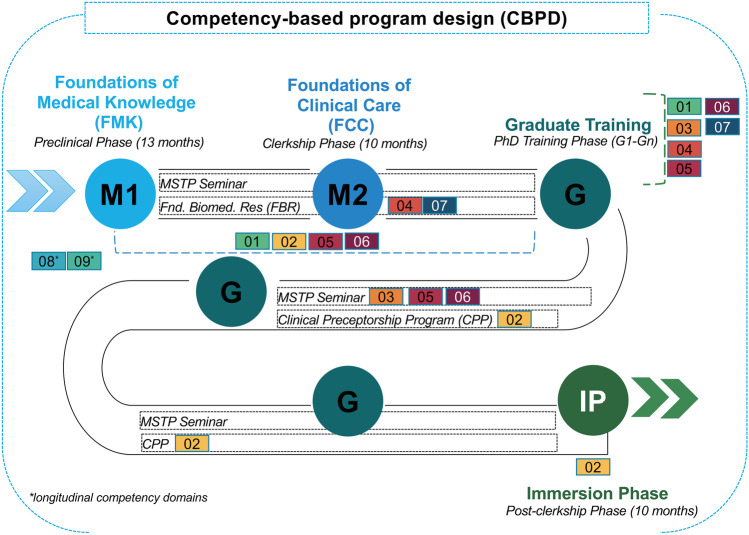
Mapping of the competency domains on the Vanderbilt MSTP Curriculum. The Vanderbilt MSTP integrates rigorous clinical and doctoral graduate training in a 7-year training program. In the first two years (medical school years 1 and 2, M1 and M2), our trainees follow the VUSM C2.0 curriculum with all MD pathway students. During these two years, training is focused on the depicted core competencies (numbers correlating to core competency domain in Fig. 1). After a dedicated time for United States Medical Licensing Examination (USLME) Step 1/2 study time, our trainees enter graduate school (G1–Gn) in one of the 16 doctoral programs affiliated with our MSTP. After completion of their doctoral graduate program requirements, including thesis defense, our students return to one final year of medical school training (immersion phase, IP). Two competency domains are highlighted as longitudinal as these are integrated throughout training for physician-scientists: mentoring/teaching (08) and career and personal development (09). The map also highlights several important MSTP-specific courses that have been designed using the CGPD framework: (a) MSTP Seminar Series, (b) Foundations of Biomedical Research, and (c) Clinical Preceptorship Program (CPP). CPP provides MSTP students with exposure to clinical medicine during the period of research training to practice clinical skills developed during the clerkship M2 year, explore subspecialties of interest to help determine a target residency track, and identify potential clinical mentorship in the area of their future clinical training [11]
Fig. 3
Fig. 3
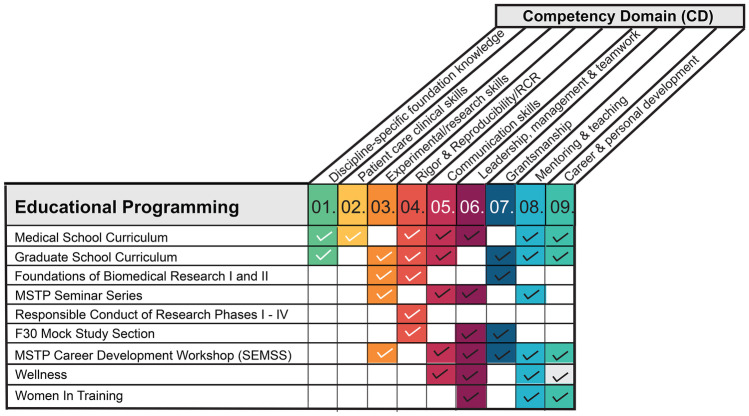
Example matrix of core competencies mapped by educational programming in the Vanderbilt MSTP. Color codes of competency domains (CD) are CD01: discipline-specific foundational knowledge; CD02: patient care clinical skills; CD03: experimental/research skills; CD04: rigor and reproducibility and responsible conduct; CD05: communication skills; CD06: leadership and management; CD07: grantsmanship; CD08: mentoring/teaching; and CD09: career and personal development

References

    1. Salata RA, Geraci MW, Rockey DC, et al. U.S. physician-scientist workforce in the 21st century: recommendations to attract and sustain the pipeline. Acad Med. Apr 2018;93(4):565–573. 10.1097/ACM.0000000000001950 - PMC - PubMed
    1. Williams CS, Iness AN, Baron RM, et al. Training the physician-scientist: views from program directors and aspiring young investigators. JCI Insight. Dec 6 2018;3(23). 10.1172/jci.insight.125651 - PMC - PubMed
    1. Feldman AM. The National Institutes of Health Physician-Scientist Workforce Working Group report: a roadmap for preserving the physician-scientist. Clin Transl Sci. 2014;7(4):289–290. doi: 10.1111/cts.12209. - DOI - PMC - PubMed
    1. Frank JR, Mungroo R, Ahmad Y, Wang M, De Rossi S, Horsley T. Toward a definition of competency-based education in medicine: a systematic review of published definitions. Med Teach. 2010;32(8):631–637. doi: 10.3109/0142159X.2010.500898. - DOI - PubMed
    1. Patrick S, Sturgis C. Necessary for success: building mastery of world-class skills a state policymakers guide to competency education. Accessed August 5, 2020. http://www.aurora-institute.org/wp-content/uploads/necessary-for-success...

Publication types

LinkOut - more resources