


Ethnic differences in ApoC-III concentration and the risk of cardiovascular disease: No evidence for the cardioprotective role of rare/loss of function APOC3 variants in non-Europeans
- PMID: 35528316
- PMCID: PMC9075110
- DOI: 10.1016/j.ahjo.2022.100128
Ethnic differences in ApoC-III concentration and the risk of cardiovascular disease: No evidence for the cardioprotective role of rare/loss of function APOC3 variants in non-Europeans
Abstract
Background: Hypertriglyceridemia is as an independent risk factor for cardiovascular disease (CVD). Apolipoprotein C-III (ApoC-III) is known to regulate triglyceride (TG) metabolism. However, the causal association between ApoC-III and CVD development is unclear. The objectives were to examine the impact of ApoC-III concentration on TG and lipoproteins and investigate the role of known rare loss-of-function APOC3 variants for modulating ApoC-III, TG concentrations and CVD risk in different ethnic groups.
Methods: Plasma ApoC-III levels were measured in a multiethnic sample of 518 individuals comprising 271 Asian Indians (Sikhs), 87 Caucasians, 80 African Americans, and 80 Hispanics.
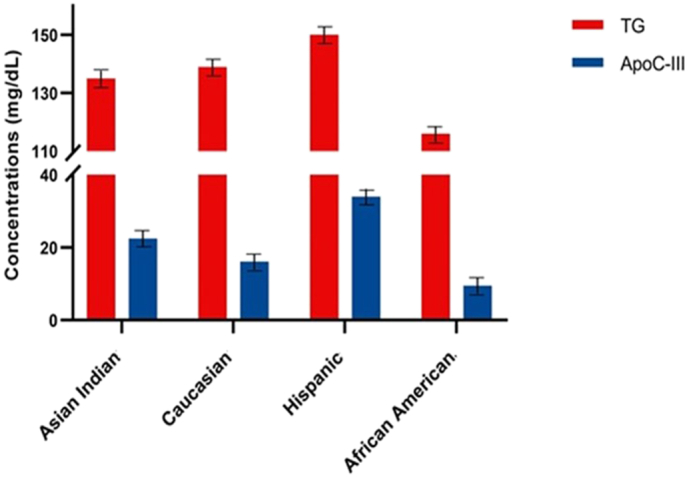
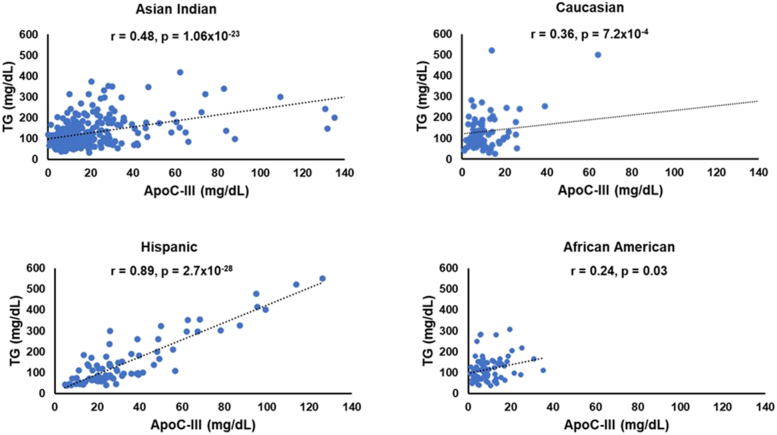
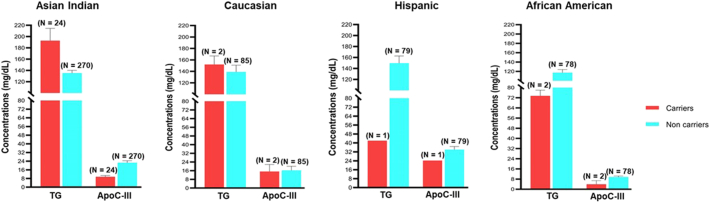
Results: ApoC-III levels showed a robust association with TG in Asian Indians (r = 0.5, p = 1.1 × 10⁻²³), Caucasians (r = 0.4, p = 7.2 × 10⁻⁴), and Hispanics (r = 0.9, p = 2.7x × 10-28). African Americans had lowest ApoC-III and TG concentrations and highest (44%) prevalence of coronary artery disease (CAD). ApoC-III levels correlated with fasting blood glucose (r = 0.25, p = 6.1 × 10⁻⁵) in Asian Indians and central adiposity in Hispanics (waist: r = 0.22, p = 0.05; waist-hip ratio: r = 0.24, p = 0.04). The carriers of rare variants IVS1-2G-A (rs373975305); A43T (rs147210663) and IVS3 + 1G-T (rs140621530) showed high TG but not low ApoC-III levels in Asian Indians and Caucasians.
Conclusion: These results highlight the challenges of generalizing antisense ApoC-III inhibition for treating atherosclerotic disease in dyslipidemia that may benefit only specific sub-populations. The observed ethnic differences in ApoC-III concentrations and CAD risk factors, emphasize in-depth genetic and metabolomics evaluations on diverse ancestries.
Keywords: Apolipoprotein C-III concentration; Cardiovascular disease; Circulating triglycerides; Ethnicity; Lipid metabolites; Rare variants.
Conflict of interest statement
The authors declare that they have no known competing financial interests or personal relationships that could have appeared to influence the work reported in this paper.
Figures
References
-
- Martinez-Amezcua P., Haque W., Khera R., Kanaya A.M., Sattar N., Lam C.S.P. The upcoming epidemic of heart failure in South Asia. Circ. Heart Fail. 2020;13(10) - PubMed
-
- Hokanson J.E., Austin M.A. Plasma triglyceride level is a risk factor for cardiovascular disease independent of high-density lipoprotein cholesterol level: a meta-analysis of population-based prospective studies. J. Cardiovasc. Risk. 1996;3(2):213–219. - PubMed
Grants and funding
LinkOut - more resources
Full Text Sources
Miscellaneous
