


Beyond massive univariate tests: Covariance regression reveals complex patterns of functional connectivity related to attention-deficit/hyperactivity disorder, age, sex, and response control
- PMID: 35528865
- PMCID: PMC9074810
- DOI: 10.1016/j.bpsgos.2021.06.003
Beyond massive univariate tests: Covariance regression reveals complex patterns of functional connectivity related to attention-deficit/hyperactivity disorder, age, sex, and response control
Abstract
Background: Studies of brain functional connectivity (FC) typically involve massive univariate tests, performing statistical analysis on each individual connection. In this study we apply a novel whole-matrix regression approach referred to as Covariate Assisted Principal (CAP) regression to identify resting-state FC brain networks associated with attention-deficit/hyperactivity disorder (ADHD) and response control.
Methods: Participants included 8-12 year-old children with ADHD (n=115, 29 girls) and typically developing controls (n=102, 35 girls) who completed a resting-state fMRI scan and a go/no-go task (GNG). We modeled three sets of covariates to identify resting-state networks associated with an ADHD diagnosis, sex, and response inhibition (commission errors) and variability (ex-Gaussian parameter tau).
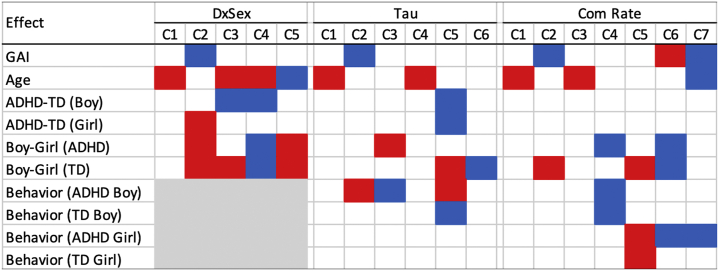
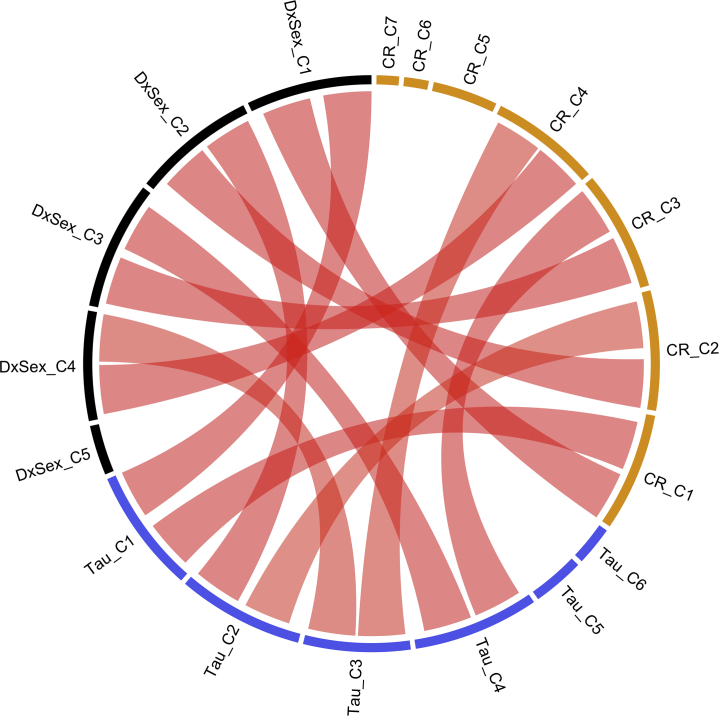
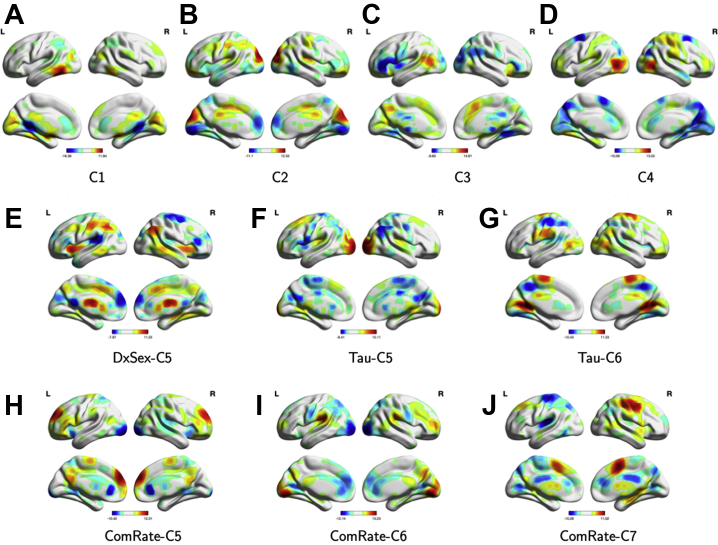
Results: The first network includes FC between striatal-cognitive control (CC) network subregions and thalamic-default mode network (DMN) subregions and is positively related to age. The second consists of FC between CC-visual-somatomotor regions and between CC-DMN subregions and is positively associated with response variability in boys with ADHD. The third consists of FC within the DMN and between DMN-CC-visual regions and differs between boys with and without ADHD. The fourth consists of FC between visual-somatomotor regions and between visual-DMN regions and differs between girls and boys with ADHD and is associated with response inhibition and variability in boys with ADHD. Unique networks were also identified in each of the three models suggesting some specificity to the covariates of interest.
Conclusions: These findings demonstrate the utility of our novel covariance regression approach to studying functional brain networks relevant for development, behavior, and psychopathology.
Keywords: ADHD; children; covariance regression; functional connectivity; response control; sex differences.
Conflict of interest statement
Financial Disclosures Drs. Zhao, Nebel, Mostofsky, Caffo and Rosch reported no biomedical financial interests or potential conflicts of interests. 1These participants were drawn from a larger sample of 690 8–12 year-old children who participated in one of several neuroimaging studies of ADHD conducted at our center between 2008 and 2019, including 318 children with ADHD (228 boys) and 372 TD children (258 boys). Analyses focused on a subset of this sample after excluding participants who did not complete the rs-fMRI scan due to non-compliance (n=23; 16 ADHD), moved excessively during the rs-fMRI scan (n=154; 90 ADHD), or did not have relevant behavioral data (n=296; 97 ADHD).
Figures
References
-
- American Psychiatric Association . 5th ed. American Psychiatric Association; Arlington: 2013. Diagnostic and Statistical Manual of Mental Disorders.
-
- Barkley R.A. Behavioral inhibition, sustained attention, and executive functions: Constructing a unifying theory of ADHD. Psychol Bull. 1997;121:65–94. - PubMed
-
- Nigg J.T. Response inhibition and disruptive behaviors: Toward a multiprocess conception of etiological heterogeneity for ADHD combined type and conduct disorder early-onset type. Ann N Y Acad Sci. 2003;1008:170–182. - PubMed
Grants and funding
LinkOut - more resources
Full Text Sources
Miscellaneous