


Biochar Implications Under Limited Irrigation for Sweet Corn Production in a Semi-Arid Environment
- PMID: 35528935
- PMCID: PMC9072871
- DOI: 10.3389/fpls.2022.853746
Biochar Implications Under Limited Irrigation for Sweet Corn Production in a Semi-Arid Environment
Abstract
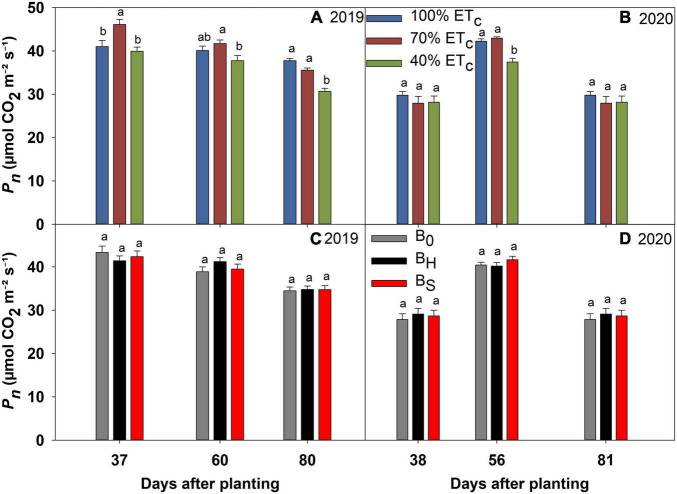
The integration of biochar and deficit irrigation is increasingly being evaluated as a water-saving strategy to minimize crop yield losses under reduced irrigation in arid and semi-arid regions such as West Texas. A 2-year (2019 and 2020) open-field study evaluated the effect of two types of biochar amendments (hardwood and softwood) and three irrigation rates [100, 70, and 40% crop evapotranspiration (ET c ) replacement] on the physiology, plant growth, and yield of sweet corn in semi-arid West Texas. All experimental units were replicated four times in a split-plot design. The chlorophyll content (Chl SPAD ) in 40% ET c dropped significantly compared to 100% ET c and 70% ET c during the reproductive phase. Although water stress under 40% ET c decreased photosynthesis (P n ) to limit transpiration (E) by stomatal closure, it improved intrinsic water use efficiency (iWUE). The above-mentioned gas exchange parameters were comparable between 100% ET c and 70% ET c . Both biochar treatments increased Chl SPAD content over non-amended plots, however, their effect on gas exchange parameters was non-significant. All growth and yield-related parameters were comparable between 100% ET c and 70% ET c , but significantly greater than 40% ET c , except water productivity (WP). Both deficit irrigation treatments improved WP over full irrigation in 2019, but in 2020, the WP gains were observed only under 70% ET c . Hardwood biochar decreased soil bulk density and increased soil porosity, but it had a marginal effect on the water retention characteristics. These results suggest that 70% ET c can be used as an alternative to full irrigation to save water with a minimal yield penalty for sweet corn production in the West Texas region. The hardwood biochar application improved the vegetative biomass significantly but yield marginally during the first 2 years of application. A long-term study is required to test the effect of biochar under deficit irrigation beyond 2 years.
Keywords: drought stress; photosynthesis; physiology; plant available water; semi-arid; water holding capacity; water productivity.
Copyright © 2022 Singh, Singh, Parkash, Ritchie, Wallace and Deb.
Conflict of interest statement
The authors declare that the research was conducted in the absence of any commercial or financial relationships that could be construed as a potential conflict of interest.
Figures



References
-
- Agbna G. H. D., Dongli S., Zhipeng L., Elshaikh N. A., Guangcheng S., Timm L. C. (2017). Effects of deficit irrigation and biochar addition on the growth, yield, and quality of tomato. Sci. Hortic. 222 90–101. 10.1016/j.scienta.2017.05.004 - DOI
-
- Alfadil A. A., Shaghaleh H., Alhaj Hamoud Y., Xia J., Wu T., Hamad A. A. A., et al. (2021). Straw biochar-induced modification of the soil physical properties enhances growth, yield and water productivity of maize under deficit irrigation. Commun. Soil Sci. Plant Anal. 52 1954–1970. 10.1080/00103624.2021.1901913 - DOI
-
- Ali A. B., Haofang Y., Hong L., Yan You W., Elshaikh N. A., Hussein G., et al. (2018). Enhancement of depleted loam soil as well as cucumber productivity utilizing biochar under water stress. Commun. Soil Sci. Plant Anal. 50 49–64. 10.1080/00103624.2018.1547389 - DOI
-
- Álvarez S., Sánchez-Blanco M. J. (2013). Changes in growth rate, root morphology and water use efficiency of potted Callistemon citrinus plants in response to different levels of water deficit. Sci. Hortic. 156 54–62. 10.1016/j.scienta.2013.03.024 - DOI
-
- Atkinson C. J., Aitkenhead M. (2018). How good is the evidence that soil-applied biochar improves water-holding capacity? Soil Use Manag. 34 177–186. 10.1111/sum.12413 - DOI
LinkOut - more resources
Full Text Sources
