


IPV Experiences and Financial Strain Over Time: Insights from the Blinder-Oaxaca Decomposition Analysis
- PMID: 35529309
- PMCID: PMC9067895
- DOI: 10.1007/s10834-022-09847-y
IPV Experiences and Financial Strain Over Time: Insights from the Blinder-Oaxaca Decomposition Analysis
Abstract
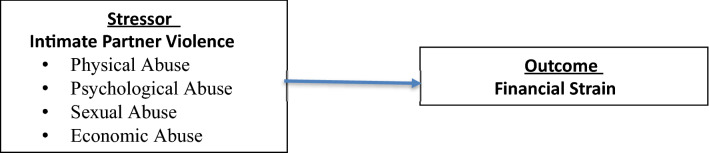
Financial strain is one hardship faced by female survivors of intimate partner violence (IPV) that is often overlooked. This paper examined the relationships between multiple forms of abuse-with a focus on economic abuse-and financial strain. Guided by stress process model, this study tested two hypotheses: (1) economic abuse is associated with financial strain more than other types of IPV; and (2) decreased economic abuse relates to financial strain over time. The study sample consists of 229 female IPV survivors who participated in a longitudinal, randomized controlled study evaluating an economic empowerment curriculum. Results from regression models suggest that physical abuse and economic abuse were significantly and positively associated with the magnitude of financial strain. Oaxaca-Blinder decomposition was used to partition the mean differences of financial strain over time that was mainly attributed to the decrease in economic and physical abuse (78%). Particularly, the decrease of economic abuse contributed to over half (58%) of the decrease in financial strain over time. Advocates should assess survivors' risk of economic abuse, evaluate financial strain, and utilize financial safety planning skills to help survivors build economic security and independence. In addition, policy makers should address issues concerning economic security among female IPV survivors.
Keywords: Decomposition analysis; Economic abuse; Female survivors of intimate partner violence; Financial strain; Stress process model.
© The Author(s), under exclusive licence to Springer Science+Business Media, LLC, part of Springer Nature 2022.
Conflict of interest statement
Conflict of interestThe author(s) declared no potential conflict of interest with respect to the research, authorship, and/or publication of this article.
References
-
- Adams AE. Measuring the effects of domestic violence on women’s financial well-being. Center for Financial Security, University of Wisconsin-Madison. Issue Brief. 2011;5:1–6.
-
- Adams AE, Beeble ML. Intimate partner violence and psychological well-being: Examining the effect of economic abuse on women’s quality of life. Psychology of Violence. 2019;9(5):517–525. doi: 10.1037/vio0000174. - DOI
-
- Ahnquist J, Fredlund P, Wamala SP. Is cumulative exposure to economic hardships more hazardous to women’s health than men’s? A 16-year follow-up study of the Swedish Survey of Living Conditions. Journal of Epidemiology and Community Health. 2007;61(4):331. doi: 10.1136/jech.2006.049395. - DOI - PMC - PubMed
-
- Aldana SG, Liljenquist W. Validity and reliability of a financial strain survey. Financial Counseling and Planning. 1998;9(2):11–18.
LinkOut - more resources
Full Text Sources