


Accumulation risk and sources of heavy metals in supratidal wetlands along the west coast of the Bohai Sea
- PMID: 35529360
- PMCID: PMC9072157
- DOI: 10.1039/c9ra05332h
Accumulation risk and sources of heavy metals in supratidal wetlands along the west coast of the Bohai Sea
Abstract
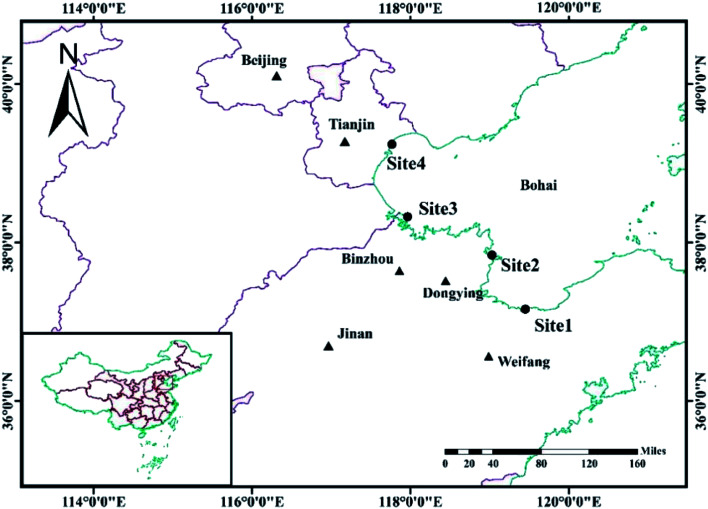
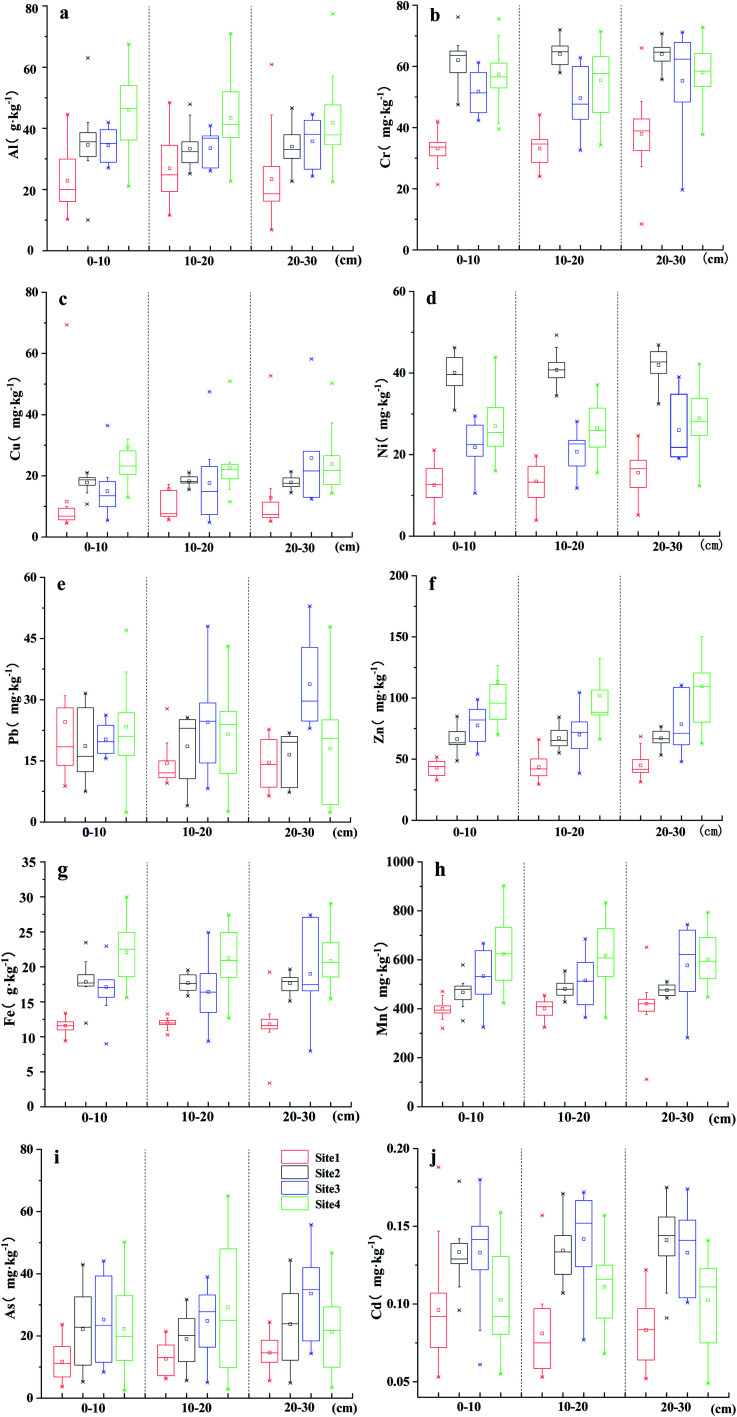
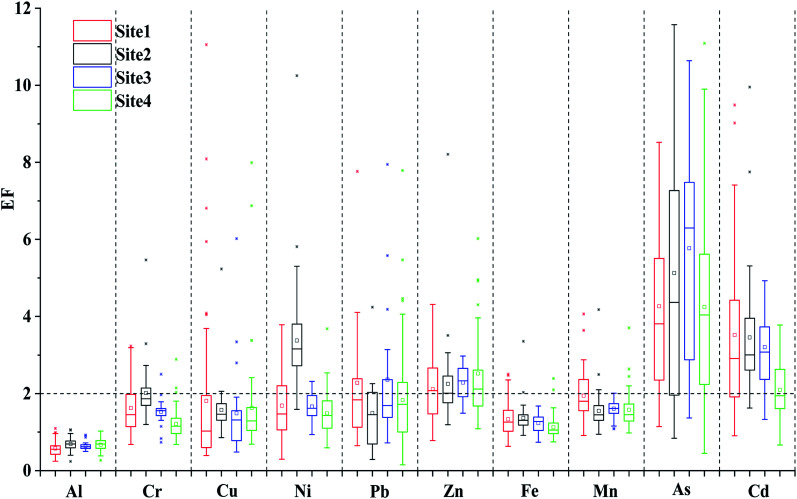
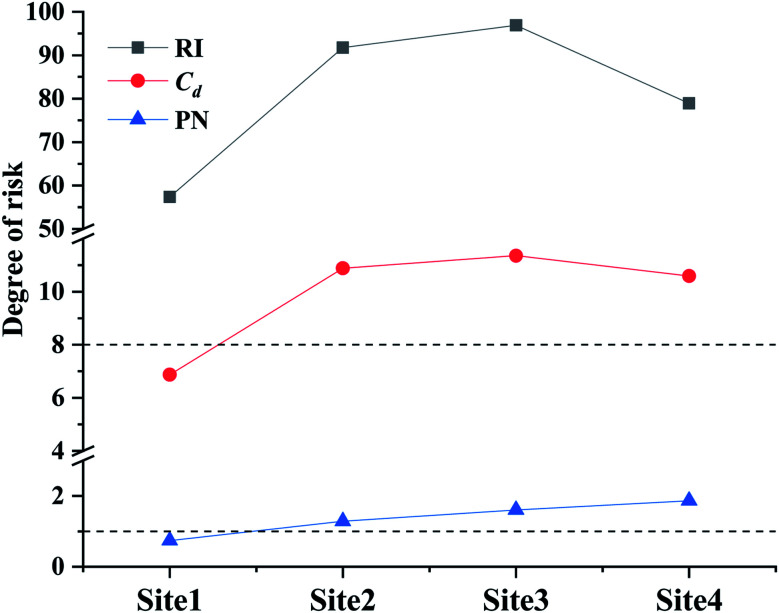
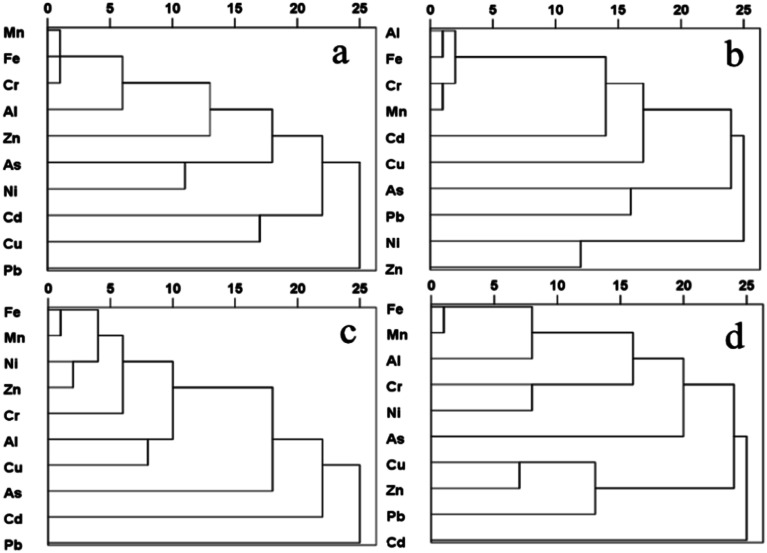
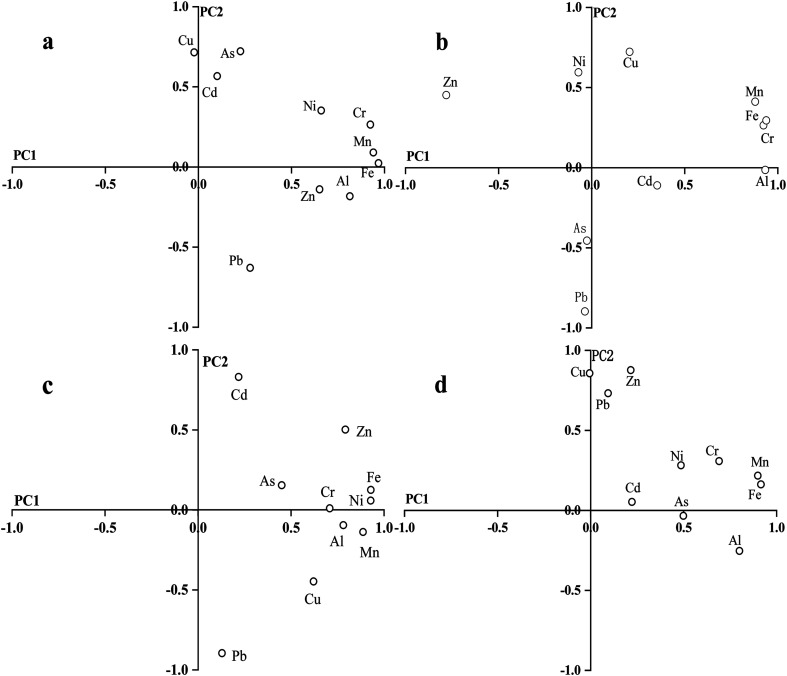
The heavy metals Al, Cr, Cu, Ni, Pb, Zn, Fe, Mn, As, and Cd in the rainfall-driven supratidal wetlands along the west coast of the Bohai Sea (the areas are named site 1, site 2, site 3, and site 4 from south to north in the gradient in this study) are tested for their accumulation risks and sources. Results show that the distribution and enrichment of the heavy metals in the supratidal wetlands are lower in site 1 than in sites 2-4. The risk indices (RIs) of all sites are less than 150, indicating low-moderate risk. However, the RI values are primarily dominated by the risk indices (E r i ) of As and Cd. The accumulative contribution values of E r i -As and E r i -Cd in sites 1, 2, 3, and 4 are 79.05%, 77.80%, 80.54%, and 76.43%, respectively. Additionally, the contamination degree (C d) and the Nemero comprehensive pollution index (PN) of the supratidal wetland in site 1 are 6.86 and 0.74 respectively, indicating a low-risk state. By contrast, the C d and PN values of the other three supratidal wetlands are higher than those of site 1, suggesting an increasing accumulation risk for heavy metals in sites 2, 3 and 4. Our analysis indicates that the heavy metals Al, Cr, Mn, and Fe in all the supratidal wetlands mainly originate from the weathering of rocks and their parent materials. Pb is significantly correlated with anthropogenic activities, while Cu, As, and Cd are likely induced by anthropogenic activities and atmospheric deposition. The sources of Ni and Zn should be determined on the basis of the situation of the wetland and its surrounding areas. For example, Ni is mainly affected by anthropogenic activities in site 2, whereas the origins of Ni are soil parent materials or atmospheric depositions in sites 1, 3, and 4. Our results can provide data to support the utilization strategy and sustainable development plans for marine space resources on the coast of the Bohai Sea.
This journal is © The Royal Society of Chemistry.
Conflict of interest statement
There are no conflicts to declare.
Figures
Similar articles
-
Contamination assessment of arsenic and heavy metals in a typical abandoned estuary wetland--a case study of the Yellow River Delta Natural Reserve.Environ Monit Assess. 2014 Nov;186(11):7211-32. doi: 10.1007/s10661-014-3922-3. Epub 2014 Jul 18. Environ Monit Assess. 2014. PMID: 25034234
-
Ecological risk assessment of metals in sediments and selective plants of Uchalli Wetland Complex (UWC)-a Ramsar site.Environ Sci Pollut Res Int. 2019 Jul;26(19):19136-19152. doi: 10.1007/s11356-019-04711-3. Epub 2019 Apr 10. Environ Sci Pollut Res Int. 2019. PMID: 30972684
-
Heavy metal toxicity, ecological risk assessment, and pollution sources in a hydropower reservoir.Environ Sci Pollut Res Int. 2022 May;29(22):32929-32946. doi: 10.1007/s11356-022-18525-3. Epub 2022 Jan 12. Environ Sci Pollut Res Int. 2022. PMID: 35020150
-
Distribution, ecological risk assessment and source identification of heavy metals in surface sediments of Huixian karst wetland, China.Ecotoxicol Environ Saf. 2019 Dec 15;185:109700. doi: 10.1016/j.ecoenv.2019.109700. Epub 2019 Sep 23. Ecotoxicol Environ Saf. 2019. PMID: 31557569
-
Assessment of heavy metal pollution in the agricultural soils, plants, and in the atmospheric particulate matter of a suburban industrial region in Dhaka, Bangladesh.Environ Monit Assess. 2021 Feb 1;193(2):104. doi: 10.1007/s10661-021-08848-y. Environ Monit Assess. 2021. PMID: 33521861 Review.
Cited by
-
Comparison of metals in eelgrass (Zostera marina L.) and the environment across the North Pacific Ocean: Environmental processes drive source delivery.Environ Pollut. 2024 Feb 15;343:123096. doi: 10.1016/j.envpol.2023.123096. Epub 2023 Dec 7. Environ Pollut. 2024. PMID: 38070647 Free PMC article.
-
Assessing heavy metal accumulation in the invasive blue crab (Callinectes sapidus): environmental and human health implications.Environ Sci Pollut Res Int. 2025 May;32(21):12579-12593. doi: 10.1007/s11356-025-36462-9. Epub 2025 May 2. Environ Sci Pollut Res Int. 2025. PMID: 40316822 Free PMC article.
-
Association between ambient temperature and economic burden of unintentional injury in Tianjin: a case-crossover study.BMJ Open. 2024 Sep 13;14(9):e083891. doi: 10.1136/bmjopen-2024-083891. BMJ Open. 2024. PMID: 39277198 Free PMC article.
-
Using Sediment Bacterial Communities to Predict Trace Metal Pollution Risk in Coastal Environment Management: Feasibility, Reliability, and Practicability.Toxics. 2024 Nov 22;12(12):839. doi: 10.3390/toxics12120839. Toxics. 2024. PMID: 39771054 Free PMC article.
References
-
- Thangavelu M. Bagyaraj D. J. Use of Arbuscular Mycorrhizal Fungi in Phytoremediation of Heavy Metal Contaminated Soils. Proc. Natl. Acad. Sci. U. S. A. 2012;80:103–121.
-
- Zhang G. Bai J. Zhao Q. Lu Q. Jia J. Wen X. Heavy Metals in Wetland Soils along a Wetland-forming Chronosequence in the Yellow River Delta of China: Levels, Sources and Toxic Risk. Ecol. Indic. 2016;69:331–339. doi: 10.1016/j.ecolind.2016.04.042. - DOI
LinkOut - more resources
Full Text Sources
Research Materials
