Predicting surface abundance of federally threatened Jollyville Plateau Salamanders (Eurycea tonkawae) to inform management activities at a highly modified urban spring
- PMID: 35529492
- PMCID: PMC9070359
- DOI: 10.7717/peerj.13359
Predicting surface abundance of federally threatened Jollyville Plateau Salamanders (Eurycea tonkawae) to inform management activities at a highly modified urban spring
Abstract
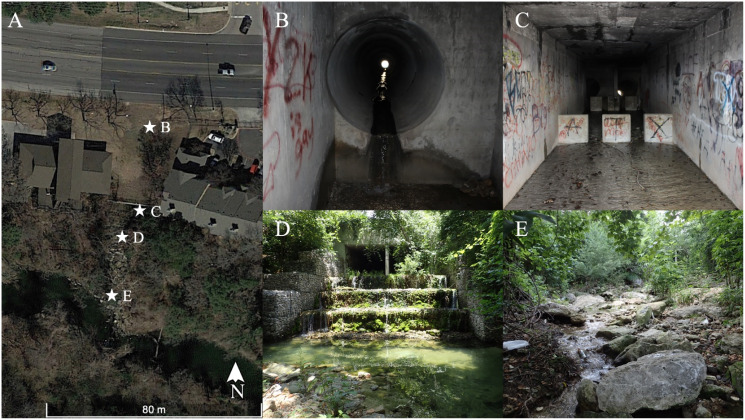
Urban expansion has contributed to the loss of habitat for range restricted species across the globe. Managing wildlife populations within these urban settings presents the challenge of balancing human and wildlife needs. Jollyville Plateau Salamanders (Eurycea tonkawae) are a range restricted, federally threatened, species of neotenic brook salamander endemic to central Texas. Almost the entire geographic range of E. tonkawae is embedded in the Austin, Cedar Park, and Round Rock metropolitan areas of Travis and Williamson counties, Texas. Among E. tonkawae occupied sites, Brushy Creek Spring has experienced some of the most extensive anthropogenic disturbance. Today the site consists of small groundwater outlets that emerge in the seams within a concrete culvert underlying a highway. Salamanders persist within this system though they are rarely detected. Here, we model the occurrence of salamanders within the surface habitat of Brushy Creek Spring using generalized linear models. In the absence of available data regarding the amount of water that is discharged from the spring, we use accumulated rainfall as a proxy for discharge to estimate salamander abundance. Additionally, we present evidence of reproduction, recruitment, and subterranean movement by E. tonkawae throughout this site. Infrastructure maintenance is inevitable at Brushy Creek Spring. We intend for our results to inform when maintenance should occur, i.e., during environmental conditions when salamanders are less likely to be observed in the surface habitat, to avoid unnecessary impacts to this federally threatened species.
Keywords: Abundance; Conservation; Edwards aquifer; Habitat; Management; Salamander; Spring; Threatened species; Urbanization.
© 2022 Adcock et al.
Conflict of interest statement
The authors declare that they have no competing interests.
Figures



References
-
- Adcock ZC, MacLaren AR, Bendik NF, Jones RM, Llewellyn A, Sparks K, White K., IV New occurrence records for Eurycea tonkawae Chippindale, Price, Wiens & Hillis, 2000 (Caudata, Plethodontidae) from an urbanized watershed in Travis County, Texas USA. Check List. 2020;16:1017–1023. doi: 10.15560/16.4.1017. - DOI
-
- Anderson JT, Ward RL, Petty JT, Kite JS, Strager MP. Culvert effects on stream and stream-side salamander habitats. International Journal of Environmental Science and Development. 2014;5(3):274–281. doi: 10.7763/IJESD.2014.V5.491. - DOI
-
- Aronson MFJ, Lepczyk CA, Evans KL, Goddard MA, Lerman SB, MacIvor JS, Nilon CH, Vargo T. Biodiversity in the city: key challenges for urban green space management. Frontiers in Ecology and the Environment. 2017;15(4):189–196. doi: 10.1002/fee.1480. - DOI
-
- Baker JK. Distribution of and key to the neotenic Eurycea of Texas. The Southwestern Naturalist. 1961;6(1):27–32. doi: 10.2307/3669365. - DOI
Publication types
MeSH terms
LinkOut - more resources
Full Text Sources