


The Impact of Language Diversity on Knowledge Sharing Within International University Research Teams: Evidence From TED Project
- PMID: 35529548
- PMCID: PMC9069179
- DOI: 10.3389/fpsyg.2022.879154
The Impact of Language Diversity on Knowledge Sharing Within International University Research Teams: Evidence From TED Project
Abstract
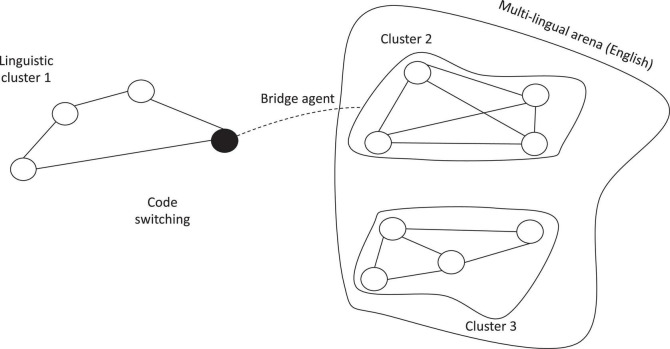
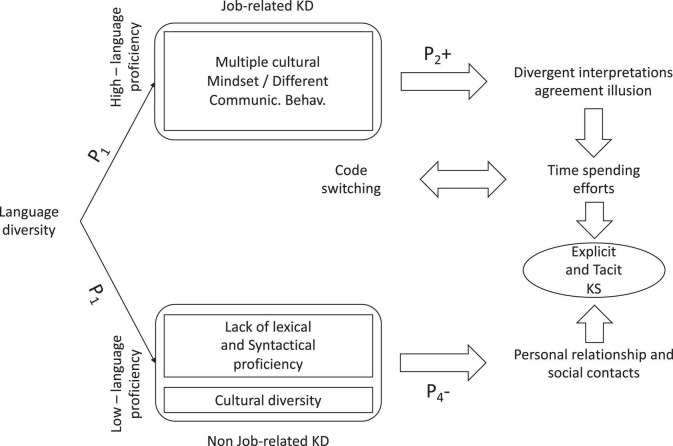
In today's knowledge economy, knowledge and knowledge sharing are fundamental for organizations to achieve competitiveness and for individuals to strengthen their innovation capabilities. Knowledge sharing is a complex language-based activity; language affects how individuals communicate and relate. The growth in international collaborations and the increasing number of diverse teams affect knowledge sharing because individuals engage in daily knowledge activities in a language they are not native speakers. Understanding the challenges they face, and how they manage the emerging difficulties is the main aim of this manuscript. For this purpose, an explorative case study was conducted in an international university research project, namely the TED project. Both interviews and direct observations were employed to understand the phenomenon better and deliberately triangulate data and improve validity. Results show that non-native language use determines the emergence of different language proficiency, depending on the nature of the knowledge domain-job-related vs. non-job-related. Within non-job-related knowledge domains, the lack of linguistic abilities, summed to the perceived cultural diversities, mainly affects people's propensity to engage in personal and more intense social relationships. Under such circumstances, tacit knowledge sharing is reduced with negative consequences on the project's long-term innovative performance. Since the project is still running, detecting language challenges will allow the partners to design and apply effective measures to support cooperation with language and cultural barriers. Among them, code switching, adopted by "bridge" actors, already emerges as tool supporting communication and knowledge exchange.
Keywords: TED project; cultural diversity; knowledge sharing; language diversity; university research team.
Copyright © 2022 Canestrino, Magliocca and Li.
Conflict of interest statement
The authors declare that the research was conducted in the absence of any commercial or financial relationships that could be construed as a potential conflict of interest.
Figures
References
-
- Abili K., Thani F. N., Mokhtarian F., Rashidi M. M. (2011). The role of effective factors on organizational knowledge sharing. Procedia Soc. Behav. Sci. 29 1701–1706. 10.1016/j.sbspro.2011.11.415 - DOI
-
- Abrams L. C., Cross R., Lesser E., Levin D. Z. (2003). Nurturing interpersonal trust in knowledge-sharing networks. Acad. Manage. Perspect. 17 64–77. 10.5465/ame.2003.11851845 - DOI
-
- Ahmad F. (2017). Knowledge-sharing networks: language diversity, its causes, and consequences. Knowl. Process Manage. 24 139–151. 10.1002/kpm.1539 - DOI
-
- Ahmad F. (2018). Knowledge sharing in a non-native language context: challenges and strategies. J. Inf. Sci. 44 248–264. 10.1177/0165551516683607 - DOI
-
- Ahmad F., Widén G. (2015). Language clustering and knowledge sharing in multilingual organizations: a social perspective on language. J. Inf. Sci. 41 430–443. 10.1177/0165551515581280 - DOI
LinkOut - more resources
Full Text Sources
