


Benefits of Equine-Assisted Therapies in People with Multiple Sclerosis: A Systematic Review
- PMID: 35529929
- PMCID: PMC9068279
- DOI: 10.1155/2022/9656503
Benefits of Equine-Assisted Therapies in People with Multiple Sclerosis: A Systematic Review
Abstract
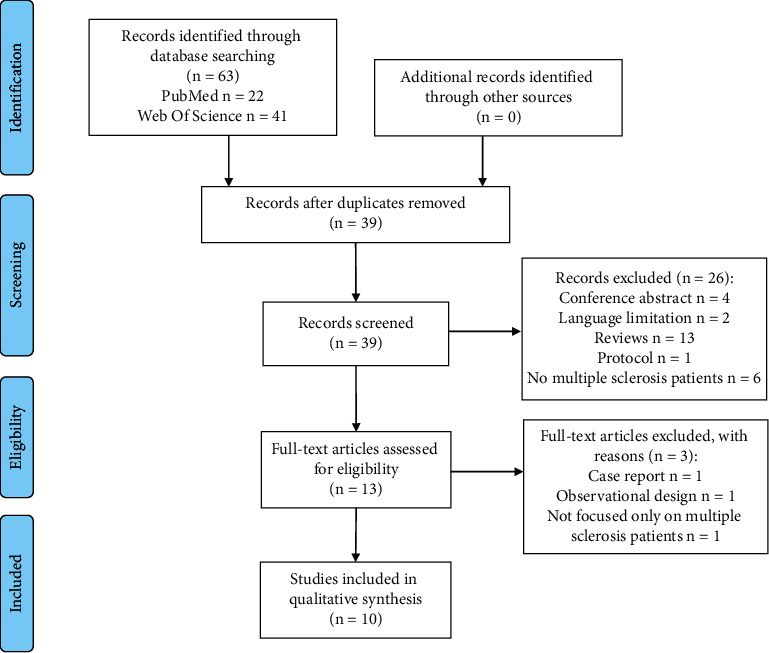
This systematic review aimed to provide an up-to-date analysis of the effects of equine-assisted therapies (EAT) in people with multiple sclerosis (PwMS). The Preferred Reporting Items for Systematic Reviews and Meta-Analyses (PRISMA) guidelines were followed to conduct this systematic review. PubMed and Web of Science databases were employed in the search, which ended in February 2022. The risk of bias analysis was performed using the Evidence Project tool. After removing duplicates, thirty-nine studies were identified. However, only ten fulfilled the inclusion criteria and were included in this systematic review. Therefore, a total of 195 PwMS, aged between 40.3 and 51.3, were included in this systematic review. EAT-based interventions had a mean length of 13.6 weeks with a session´s frequency ranging from ten to once a week. All sessions involved real horses and lasted a mean of 34.4 min. Among the included articles, four were randomized controlled trials (RCT), four did not perform randomization, and two employed a prepost design without a control group. RCTs showed positive effects on quality of life, fatigue, balance, spasticity, and gait speed. Furthermore, non-RCT showed improvements in balance, spasticity, and postural control (postural control was not assessed in RCT studies). Importantly, significant effects were only observed when the comparison group was inactive or followed usual care. Therefore, EAT is a promising and effective therapy to improve quality of life, fatigue, balance, spasticity, and gait speed in PwMS. However, since comparison groups are heterogeneous, results could vary depending on the research design. Moreover, the inclusion of noncontrolled studies (in order to have a wide perspective of the state of art) could increase the risk of bias and make the results be taken with caution.
Copyright © 2022 Ana Myriam Lavín-Pérez et al.
Conflict of interest statement
The authors declare no conflicts of interest.
Figures
References
-
- Faguy K. Multiple sclerosis: an update. Radiologic Technology . 2016;87(5):529–550. - PubMed
Publication types
LinkOut - more resources
Full Text Sources
